
China: Tremendous progress, but ‘more repression than before’


Play
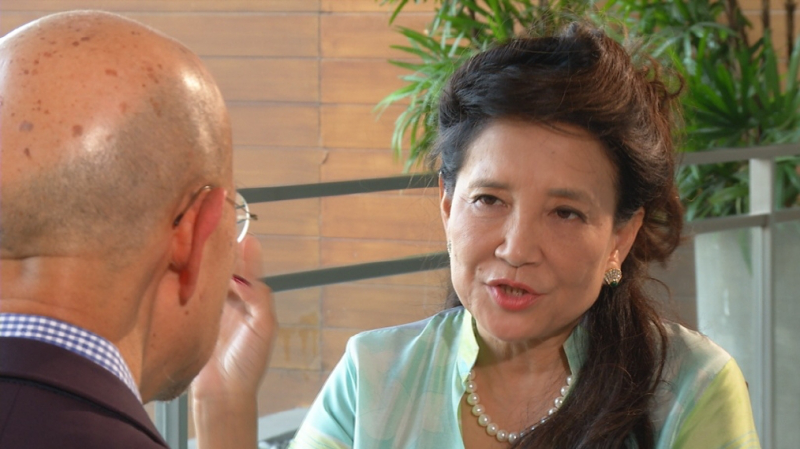
Famous for her best-selling autobiography ‘Wild Swans’, Chinese-born British author Jung Chang talks to Suthichai Yoon, Nation editorial board adviser, about her experience of the Cultural Revolution and her thoughts on the good and bad of China today
Is your new book out soon?
No, it is still being written. This fourth book of mine will be about [Republic of China’s founding father] Sun Yat-sen and the Soong sisters.
Your books have been critical of the Chinese regime. Are you allowed to enter China?
Yes, I can go there, with a condition that I can’t promote my books and talk publicly, although I want to.
Are you researching there for your new book?
I will. They [Chinese authorities] allow me, even though my books have been banned. For instance, I researched Mao Zedong [in China] for my first book [“Mao: The Unknown Story”] in the 1990s.
While you were researching on Mao, did the authorities know you were going to write about him?
Yes, but they didn’t know what I was going to write about him. So when “Mao: The Unknown Story” was published, it was promptly banned by Beijing [and still is].
Why were they against that book?
Because it goes against their political decision, which is to promote Mao. I would totally disagree with that, but they won’t listen to me.
Current Chinese President Xi Jinping is promoting Mao again. Any idea why?
I have no idea. I have done thorough research for all my books and I know exactly what happened.
The recent view is, if you reject Mao, you reject the roots, undermining the Chinese communist party. I can see that point, but one could also argue that if you reject Mao, the party still has legitimacy because of its achievements since Mao died.
But you’re not trying to convince the current Chinese leadership that Mao was a bad guy?
Of course, he was a bad guy, but I’m not trying to convince anyone. I found the facts about him and put them in the book for anyone to see.
But you remain convinced that the conclusions in “Mao: The Unknown Story” are accurate?
The thing is my husband and I have made very few conclusions. We piled up facts that we researched thoroughly. Nobody has refuted our facts, even Chinese officials. They ban my books, but they don’t offer any official refutations, which I’m very pleased about because it means they know that my facts are true.
His successor Deng Xiaoping said Mao was 70 per cent right and 30 per cent wrong. Do you agree?
No, I don’t. Mao was responsible for the deaths of over 70 million Chinese, and I can’t see anything good in that.
However, he had many qualities which explain how he came to power, how he was able to beat Chiang Kai-shek, and get very capable people like Deng, Zhou Enlai and Liu Shaoqi to follow him, and how he could inspire adoration in people. His qualities are, however, not moral ones.
But Without him, would there be a China as we know it today?
There would certainly be China today, and it would have prospered much earlier. If Mao had died when the Communist Party came to power, the difference would be on par with a Russia without Joseph Stalin, with only Nikita Khrushchev and Leonid Brezhnev.
Do you still have nightmares about your childhood as a Red Guard during the Cultural Revolution?
My Red Guard period was brief, just over a month. Everybody joined the Red Guards. At the beginning of the Cultural Revolution, they were ordered to generate terror. Mao used teachers as victims, who were beaten by people as Mao directed. What is more unforgivable to me, and which made me quite angry when I was writing about it, was he also used children as victims. Children in those days were divided into the Reds, the Blacks [“enemies” of the Cultural Revolution] and the Greys. Before I joined the Red Guards, I witnessed a schoolgirl jump from a third-floor window, trying to kill herself. Her father ... was accused of not being “red enough”.
Do you have regrets about your role as a Red Guard? Did you attack your parents?
I don’t have any regrets. In fact, I was never involved in any violence and never abused people. I never criticised my parents. When I came to choose between Mao and my parents, I chose the latter.
That was despite feeling that you had to be a “real Red”?
Exactly. My parents then became “Blacks” and I chose to be with my parents. I went to their camps to work for them so they could rest. I went to “denunciation meetings” when they were victims so they would know that somebody in that historical crowd loved and stayed with them.
My father said if it hadn’t been for his family, he would have committed suicide a long time ago.
Did you suffer feelings of divided loyalty between the Red side and your parents?
The thing is there was no real love from Mao. It was just brainwashing.
It took me many years to realise that he has responsibility. Before that, when I saw people being abused, we used to immediately blame the people who committed the violence. Like many people, I also blamed Madame Mao [Jiang Qing] and her Gang of Four. I started to have doubts on my birthday in 1968, when I turned 16. I wrote my first poem, and the Red Guards ordered me to tear it up and flush it down the toilet. Afterwards I thought this was totally awful.
What was the poem about?
It had nothing to do with Mao or politics. It was about being swept by the wind and not knowing how to think and feel. We were always told that China was paradise and I thought, “if this is paradise, why are people still in need?”
Like other people, I blamed Madame Mao – until 1974, when I knew a little English. A friend working in Beijing gave me a copy of Newsweek. There was an article about China with two small pictures of the Mao couple. The caption said, “Madame Mao is Mao’s eyes, ears and mouth”. Suddenly, somehow it felt like a window opening, and I realised that Mao was responsible for all of this. That is what I pointed to in “Wild Swans”.
The writer JG Ballard said that it is an unforgettable portrait of the brain-death of a nation. I’m reasonably intelligent, and it took me eight years to realise Mao was responsible. Today, many intelligent people still blame the Gang of Four. How ridiculous. Without Mao, they were nothing.
But by 1974 Mao was perhaps too ill to know anything, and the Gang of Four were doing things for him.
It’s not true. If you look at memoirs they wrote, you can see that Mao’s mind was clear right to the end. He used these four people, who actually were nobodies. Two of them were writers, and why would writers be leaders? Their particular contribution to Mao was to package his self-serving goals in ideological garb to make them look attractive and to deceive. Madame Mao did Mao’s dirty work that other people wouldn’t do, and that’s why everybody hated her.
Do you think China today is going in the right direction?
There are many things that I feel extremely happy with and excited about. Just by coming to Bangkok, you see how there are so many Chinese tourists here. Middle-class Chinese families being able to go abroad is tremendous for them and for me also. I think, in this way, the country is going in absolutely the right direction. Living standards are giving people good lives and I feel very happy about that.
The country is also making attempts [to improve], from environmental issues to narrowing social gaps. It is now doing its best.
Is China’s shift away from communism a good thing?
I don’t know that there is such a shift. While using every capitalistic method [to boost economy], the country is also using communist ways of control. It’s currently a mixture between the two regimes. Just like I told you, there are both very good things and very bad things.
Do you think President Xi and his premier Li Keqiang are doing a good job?
I have no comments on those individuals because I haven’t studied them. However, I feel intensively unhappy with the ideological side – books being banned and even more repression than before.
So they are afraid of views that differ from the party line?
I guess so, because they need tighter controls on these key areas as the society becomes more liberal. The social media are also on very tight controls. For example … when “Mao: The Unknown Story” was published, they just deleted anything online about it.
How’s your life in London? Do you miss China?
My life there is wonderful. I also talk to my mother in China every day. She is 85, doing fine although with some health problems. She doesn’t want me to stay with her and neither do I want her to live with me. She doesn’t speak English and her roots are in China. My mother survived the Cultural Revolution but my father didn’t.
After spending so much time in England, do you still consider yourself Chinese?
I don’t go for these identity things. They’re not big to me. I feel at home most in London, but my house there is furnished in Chinese style. I also feel concern about what is happening in China and read the news about it.
As a British citizen, I can vote in England. For China, very few people there have a say – as few as can be counted on the fingers of two hands.
For the full interview, catch Nation TV’s “Timeline” programme on April 2 and 3.
