
Sustainable development: the push to transform our world


Play
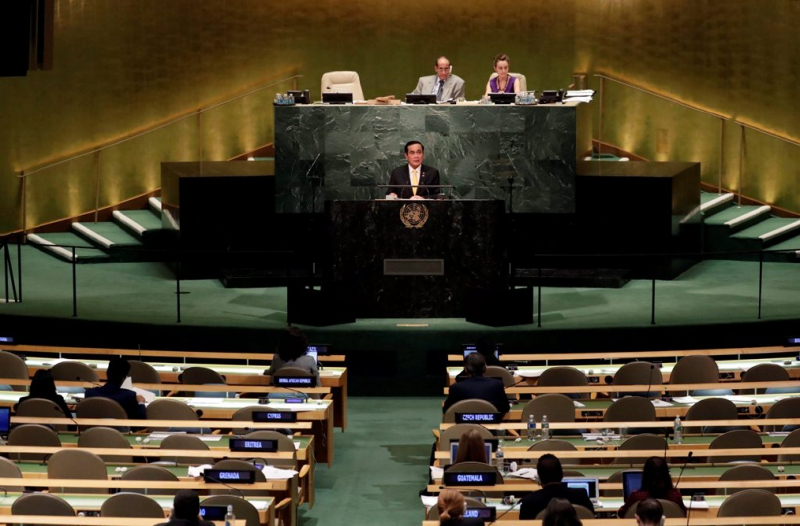
Excerpts of Prime Minister Prayut Chan-o-cha’s speech to the UN general assembly in New York on Wednesday
Last year, the UN General Assembly adopted the 2030 Agenda for Sustainable Development with 17 Sustainable Development Goals that we all have to “push” together in order to achieve balanced and sustainable global development. We have to push for a world where peoples are placed at the heart of the development policy, and no one is left behind.
Thailand firmly believes that sustainable development cannot be realised where there is no peace and security or when human rights are violated, abused or disregarded – and vice-versa.
The recent migration crisis is a clear example of how security, development and social implications are intrinsically intertwined. No country is exempted from effects of crises that happen in the world, even if far away.
To achieve the SDGs, a shared responsibility and collective efforts, as well as active engagement with and contribution of regional, political, or economic groups are vital.
No single country, be it the most powerful or prosperous one, can push for such achievement alone.
We all have to work together for it.
Vision as head of G-77
This year, Thailand has the honour to chair the Group of 77, representing the views of 134 developing countries in various negotiation processes of the United Nations with the objective to transform visions to concrete actions. We have been coordinating and bridging the Group’s position with other groups and partners to enhance mutual trust and promote common interest, in particular, by strengthening cooperation with the group of major economies – the G20.
We have shared our experiences and lessons learnt in overcoming socio-economic challenges through His Majesty the King’s Sufficiency Economy Philosophy (SEP) as an alternative development model, in which people-centred approach, moderation, reasonableness, inclusiveness and resilience are key principles. The SEP model has so far been used and adapted to fit the national context in over 20 countries.
In assuming its chairmanship of the G77, Thailand has initiated the SEP for the SDGs Partnership programme as a platform for exchanging views, experiences and good practices among members. The discussions include key global challenges, for instance investment and ICT for development, climate change, disaster risk management, and development models which match specific needs and context of the members. Expanding and strengthening cooperation with partners have also been highlighted. Thailand stands ready to promote further cooperation with all groups, such as BRICS and Asean, who are ready to engage with us in the implementation of the Sustainable Development Agenda, in order to ensure a stronger push to transform our world in an inclusive manner. Next month, Thailand will host the 2nd Asia Cooperation Dialogue Summit which could also serve as a forum for further discussions on the implementation of SDGs in the region.
Asean and progress at home
At the Asean-UN Summit meeting in Vientiane earlier this month, the UN Secretary-General mentioned the importance of regional mechanisms and how the latter could contribute and give a “push” to international peace and sustainable development. All Asean leaders, including myself, believe that the implementation towards the achievement of the SDGs will be a key factor for the transformation of our world, of our children’s future, in a better way.
The beginning of the Asean Community this year does not only bring the people of Asean closer through economic and cultural links, but also develops cooperation and partnerships, which will lead to conflict prevention and further peace-building within the region.
The Royal Thai government attaches high importance to translating and incorporating such global agenda and goals into concrete action, policy and laws, both at local and national levels. In this connection, we have established the National Committee on Sustainable Development and incorporate the SDGs into our 12th National Economic and Social Development Plan (2017-2021), and to our 20-year National Strategy. We also have a continued policy of providing quality healthcare services for all, including migrants and foreign workers, regardless of their status, through the government’s Universal Health Coverage Scheme, as well as other initiatives such as the anti-microbial resistance campaign. On education, the government has a compulsory education programme to ensure basic education for all, with a view to increase economic opportunity for children and youth in the Kingdom.
Moreover, the government places high importance to the freedom, equality and well-being of people, as well as inclusive and equitable access to basic services. We have reviewed related national laws and regulations with a view to achieve tangible and sustainable results. A new legislation on gender equality to promote women’s rights has been enacted.
Several measures to enhance protection of at-risk and vulnerable groups have been taken, including the establishment of funds to take care of new-born children, persons with disability and elderly persons. Adequate housing and land distribution have also been provided for low-income population, since it is the Government’s view that those peoples, if properly empowered and protected, can be valuable asset and contribute to a strong universal push to transform our world.
On environmental and climate change issue, Thailand is pleased to ratify the Paris Agreement and call on other countries that have not yet done so to become Party to the said Agreement at the earliest opportunity. We have to show our joint commitment, solidarity and shared responsibility in addressing global warming and climate change which affect all humanity, especially Small Islands and Developing States (SIDS).
On our economy, the government initiated the so-called “Thailand 4.0 model”, which employs technology and innovation as driving forces for targeted and sustainable economic development in agricultural and industrial sectors, among others. The model places emphasis on education, infrastructure, research and development, and creating incentives and safe environment for private sector, through the review of business laws and regulations to reach international standards and the fight against corruption. We believe that such approach will help overcoming the “middle-income trap” and allow Thai people to participate in deciding the country’s future in an inclusive manner.
On peace and international security, the government has consistently supported the United Nations’ peacekeeping and peace-building operations. Through their participation in about 20 missions, Thailand’s peacekeepers have contributed to enabling local people to live normal lives, to strengthen their own society as well as to participate in the long term development of their countries. These efforts are also consistent with achieving SDG 16 on peaceful and inclusive societies for sustainable development.
In addition, Thailand highly supports effective implementation of Goal 17 on the means of implementation through strengthened international cooperation and global partnership. We believe that there is not a one-size-fit-all model in achieving sustainable development since each country has its own specific need and limitation. Therefore, we need to adapt relevant development model to the context of each state through experiences sharing, with a view to galvanise such diversity into a harmonised unity.
Preparing for 2017 election
The year 2016 has also been an important year for the Thai people and the direction in which the country is headed. On August 7, the Thai people voted democratically to approve the draft constitution in a referendum. At present, constitutional by-laws are being considered which will lead to a general election in late 2017.
This referendum has reflected the genuine intention of the government to promote democratic processes, while taking into account the views expressed by the international community. The government came in to oversee the situation during a period of transition, to bring about order and security and to pave the way towards sustained political governance. Once the situation returns to normalcy and security restored, the government has put an end to temporary measures such as the recent lifting of military jurisdiction over civilians.
The government remains actively engaged in addressing deeply-rooted problems of security, corruption, human trafficking and crime. We believe that addressing such problems at their root causes can serve as a strong foundation for a sustainable democracy and good governance, with the hope that Thailand and the Thai people will sustainably become quality members of the global community.
