
Why are Abe and Obama so afraid of an apology?
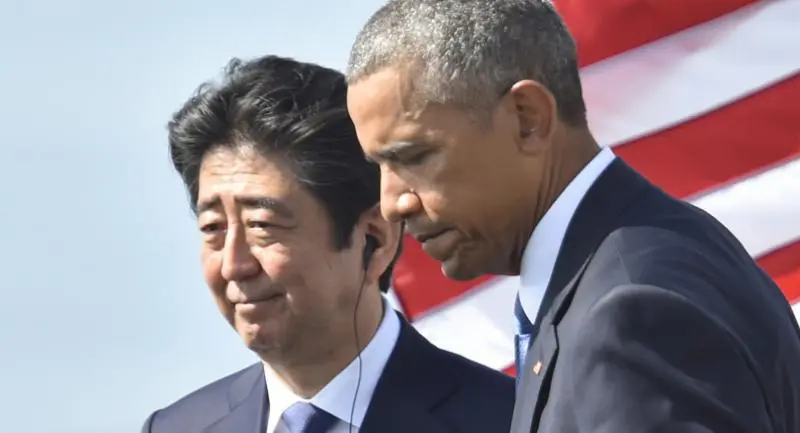


We’ll start at the top of the picture. I will cast several of the verbs in the present, not the past (time) tense. One reason for doing so is that readers should sense these scenes as actually occurring in the present, not in the past.
There are reasons that I hope this may happen.
Thus, in a photograph on page 1 of a newspaper last week, we first note a man called the president of the United States, looking very solemn. (He won’t be the president much longer, which may be relevant. The two of them must get this done now while they can.)
The “while they can.” Well, the president is standing beside a gentleman who appears to be of Asian extraction. Oh, I see. The man next to the president is Prime Minister Shinzo Abe of Japan.
They appear to be equals. They are for example dressed the same. They wear impeccably tailored, dark western business suits. Both are in white shirts. Their ties are both dark blue, knotted at the collar.
The place where the two leaders are standing in the photograph, taken just days ago, is the military installation known as Pearl Harbor. Oh yes, in Hawaii. We all know what happened there. The date at the top of the newsprint tells us the president and prime minister stand there at Pearl Harbor in the month of December. Our present year is 2016. Like the presidency of the man in the photograph, 2016 will soon end. Another reason to do this now.
So, we all know that 75 years ago, on Dec. 7, 1941, the prime minister’s country attacked the U.S. military base at Pearl Harbor. In minutes, 2,403 Americans were killed, and 1,178 wounded. The Japanese lost 64 soldiers. One unfortunate soul was captured.
The U.S. government, in a time of unparalleled fear, went on shortly to incarcerate some 120,000 innocent Japanese-Americans. The government locked these citizens up in camps and kept them there until the war ended. Many of the imprisoned families had loved ones fighting in harm’s way beside their fellow Americans far away. In time, the U.S. of course dropped atomic bombs on Hiroshima and Nagasaki. The numbers continue to be appalling. Reportedly, the killed and wounded at Hiroshima totaled some 150,000 people. The bombing of Nagasaki did that to another 75,000 people. The huge majority of those people were civilians. In the eyes of some, that did not matter. They were “the enemy.”
Overwhelming Figures
It is only a small consolation, but the numbers are disputed. Some call the 150,000 and the 75,000 accurate estimates of scholars. Others say the numbers are too conservative. Any way you look at it, the figures are overwhelming.
A military monument of gigantic proportions looms before the two mere mortals in dark suits in the newspaper photo I am describing. They are dwarfed by this monument. The massive open sides of the monument list each of the names of the victims of Pearl Harbor. Representatives of the American military, handsome, vigorous with young life, and as well dressed (in their own way) as the two world leaders, stand at attention near President Obama and Prime Minister Abe. The soldiers look like they will stand there a very long time.
Political leaders come, and political leaders go. Like our deepest fears and anxieties, our wars seem to stay with us forever.
The day after the picture was taken, media report the prime minister’s words: “ (Japan) must never repeat the horrors of war again.” At a nearby military base, he added, “I offer my sincere and everlasting condolences to the souls of those who lost their lives here, as well as to the spirits of all the brave men and women whose lives were taken by a war in this very place.”
Abe did not apologize for his country. As a matter of fact, the U.S. president, in a recent visit to Japan where, as we mentioned above, his government caused such harm with its atomic bombs, also did not apologize. Now, I ask you, why is that?
We are willing to pay homage to those who have sacrificed their lives. We are willing to travel great distances to shake hands with former enemies. But we are not willing to say we made mistakes. We are not willing to say we take moral responsibility for our wrong. “All this happened, and we were a part of it,” we say, “how sad.” This is not enough.
Why are we so afraid to apologize? Why do we deny ourselves the freedom of saying we know we were wrong, and we are sorry for it?
Father Daniel J Bauer is an associate professor in the English Department at Fu Jen Catholic University in Beijing.
