
Thailand and Japan expand Paditch irrigation to boost farm yields
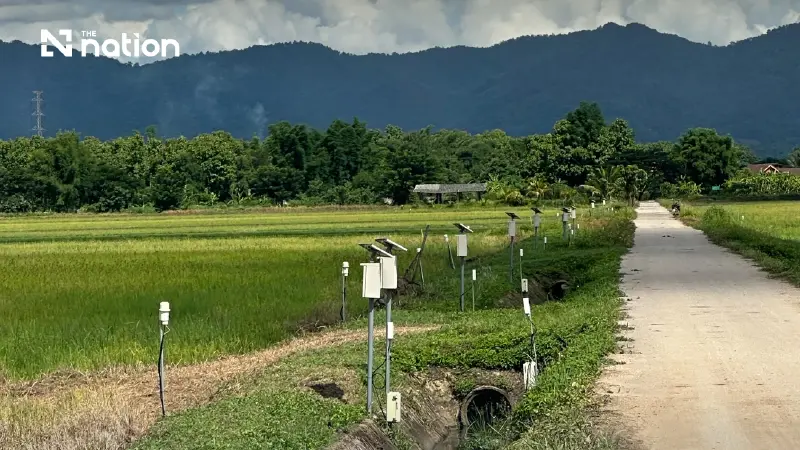


Thailand’s RID and Japan are scaling up Paditch smart irrigation after pilots in Lampang and Kalasin raised rice yields and cut water-delivery delays.
Increasingly volatile weather, droughts, floods, and uncertainty over available water supplies are creating major challenges for Thailand’s agricultural sector. Future water management must therefore go beyond developing new water sources and ensure that every drop is used to its fullest potential.
The Royal Irrigation Department (RID) is consequently moving away from conventional water-delivery methods towards smart water management. Its new approach combines Paditch technology with artificial intelligence, satellite data, and the Internet of Things to control water use more precisely, improve agricultural productivity, and provide farmers in all areas with fairer access to irrigation.

Paditch brings smart water control to individual fields
Sarayut Ngootip, director of the Engineering Division at the RID’s Bureau of Central Land Consolidation, described Paditch as a smart water-supply outlet installed at the paddy-field level to regulate water intake automatically.
Under the conventional system, farmers must manually open and close irrigation gates. This can lead to uneven water use, particularly when farms near the head of a canal take more water than necessary while those farther downstream wait days for supplies to arrive.
Paditch replaces conventional gates and connects them to an online system. Farmers can operate the equipment through a mobile phone or computer, or program it to open and close automatically.
Sensors monitor water levels inside each field, allowing farmers to adjust supplies according to the actual requirements of their crops.
“The central idea is to move away from managing water according to what is available and toward managing it according to the actual needs of each area. Paditch is a tool that makes water distribution more precise,” Sarayut explained.

Thailand and Japan advance smart land consolidation
Paditch was introduced through cooperation between the RID and the Japanese Institute of Irrigation and Drainage under a program to develop smart irrigation systems capable of addressing water-related challenges caused by climate change.
The main objective is to replace a system based largely on available water supplies with one that allocates water according to local demand, supported by digital technology for analysis and decision-making.
Since 2024, the RID has tested 20 Paditch units in pilot areas, divided equally between Lampang and Kalasin provinces.
In Lampang, 10 units were installed in the Kiew Lom Dam irrigation area to tackle delays in supplying water to downstream farmland. Another 10 were deployed in an agricultural land-consolidation area in Kamalasai district, Kalasin, at the downstream end of the RMC irrigation canal serving the Lam Pao Dam area.
Pilot schemes raise yields and reduce competition for water
Results from the pilot areas indicate that Paditch has improved agricultural productivity by enabling farmers to maintain suitable water levels and reduce the risks associated with receiving either too much or too little water.
In Lampang, rice yields increased from approximately 400–500 kilograms per rai to 600–800 kg per rai. In Kalasin, yields rose from 700–800 kg per rai to between 1,000 and 1,200 kg per rai.
Beyond increasing production, the system has helped address long-standing problems involving the distribution of water between farms at the head and tail ends of irrigation networks.
Sarayut noted that the 10 Paditch units in Lampang were installed along the same irrigation ditch. Farmers near the beginning of the ditch had previously tended to take more water than they required, leaving those at the far end waiting several days.
With the automated system, a gate closes as soon as the water reaches a predetermined level, allowing supplies to continue flowing downstream more quickly. The waiting period has consequently fallen from approximately four or five days to just one day.
Paditch has also improved farmers’ quality of life. They no longer need to travel to their fields every day to open or close water gates and can instead manage the system online, leaving them more time to pursue other income-generating activities.

AI, satellites, and IoT sharpen water allocation
Paditch controls water use at the field level, while the RID is also developing a broader smart water-management system incorporating AI, satellite technology, and IoT devices. These technologies are intended to make water allocation more precise and improve the irrigation system’s ability to respond to climate volatility.
The department currently uses Sentinel-2 satellite data to monitor cultivated areas, including crop development and water-use conditions. This information helps officials plan water deliveries according to the requirements of individual areas.
The RID is also working with the National Science and Technology Development Agency to apply the Agro-climatic Timing Intelligence for Modern Agriculture (Ag-TIMA) system for advanced rainfall forecasting and water-management planning.
The approach shifts the emphasis from distributing water according to the amount available to supplying it according to crops’ actual requirements.
“In the future, water management must be driven by data. It will not be enough simply to know how much water is stored in a dam. We must know which areas need water, when they need it, and how much they require so that supplies can be allocated as efficiently as possible,” Sarayut stressed.
Land consolidation improves efficiency and fairness
Sarayut estimated that, for every 100 units of water released from a dam into an irrigation network, only around 30 units may currently reach farmers because of losses along the way and limitations in conventional delivery systems.
Combining agricultural land consolidation with smart water management could raise the proportion reaching farmers to approximately 60–70%, allowing available supplies to be used more effectively.
Land consolidation can also address infrastructure problems affecting agricultural areas, including limited access to fields, inadequate water-delivery systems, and difficulties bringing machinery onto farmland.
These improvements enable farmers to reduce costs, increase production efficiency, and plan their cultivation more accurately. Crucially, the system can reduce disputes between farmers at the head and tail ends of canals because it controls and distributes water more fairly.

Thai Paditch version planned to broaden access
Following the success of the pilot schemes, the RID plans to expand the advanced agricultural land-consolidation development project during its second phase from 2026 to 2030.
The program will extend beyond Lampang and Kalasin to Khon Kaen and Suphan Buri while developing a new version of Paditch better suited to conditions in Thailand.
Japanese-made Paditch equipment currently costs approximately 50,000–60,000 baht per unit. The RID is therefore working with its Japanese partners on a Thai version intended to lower costs and make the technology accessible to more farmers.
One target group is a new generation of “city farmers” who work in urban areas but remain responsible for their families’ agricultural land. Remote controls would allow them to manage irrigation through their mobile phones without remaining at the farm throughout the growing season.
Three-to-five-year goal for nationwide smart irrigation
Thailand’s future water-management strategy will move toward smart irrigation, using technology to improve every stage from data analysis and planning to field-level water control.
Under the RID’s concept, AI will act as the system’s “brain” by analyzing data, while Paditch will serve as its “arms and legs” by carrying out instructions and controlling water use in individual fields.
The aim is to establish a precise water-management system capable of responding rapidly to changing conditions.
In addition to increasing farmers’ yields and reducing their costs, the system will support low-carbon agriculture by promoting alternate wetting and drying (AWD) in rice fields.
This technique can reduce water consumption and methane emissions from agriculture while potentially creating future opportunities for farmers to generate income from carbon credits.
