
Thailands quest for new growth engines
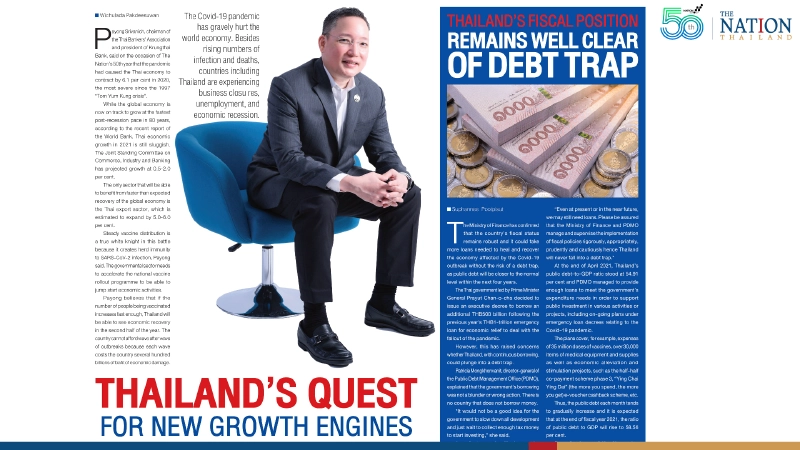


Besides rising numbers of infection and deaths, countries including Thailand are experiencing business closures, unemployment, and economic recession.
The Covid-19 pandemic has gravely hurt the world economy. Besides rising numbers of infection and deaths, countries including Thailand are experiencing business closures, unemployment, and economic recession.
Payong Srivanich, chairman of the Thai Bankers' Association and president of Krungthai Bank, said on the occasion of The Nation's 50th year that the pandemic had caused the Thai economy to contract by 6.1 per cent in 2020, the most severe since the 1997 “Tom Yum Kung crisis”.
While the global economy is now on track to grow at the fastest post-recession pace in 80 years, according to the recent report of the World Bank, Thai economic growth in 2021 is still sluggish. The Joint Standing Committee on Commerce, Industry and Banking has projected growth at 0.5-2.0 per cent.
The only sector that will be able to benefit from faster than expected recovery of the global economy is the Thai export sector, which is estimated to expand by 5.0-6.0 per cent.
Steady vaccine distribution is a true white knight in this battle because it creates herd immunity to SARS-CoV-2 infection, Payong said. The governmental sector needs to accelerate the national vaccine rollout programme to be able to jump start economic activities.
Payong believes that if the number of people being vaccinated increases fast enough, Thailand will be able to see economic recovery in the second half of the year. The country cannot afford wave after wave of outbreaks because each wave costs the country several hundred billions of baht of economic damage.
However, Payong also warned that the pandemic would cause permanent damage in many ways. He said Thailand should find new engines to economic success.
“If we look to the far future of the world and Thailand, the necessity of vaccination will be decreased, therefore, we are in need of a new type of “knight” to drive growth in the future.”
The chairman of Thai Bankers' Association elaborates six key factors to building new economic structure:
K – Knowledge or becoming a knowledge-based economy/society
To drive the country forward at full throttle, all stakeholders need to receive accurate, up-to-date knowledge and information. Thailand has sound infrastructure networks, especially telecommunication. The internet penetration rate in Thailand is above 70 per cent, which is higher than the world average. However, what the country has to accomplish is to link scattered information from different governmental units into one platform and transform this raw information into solid knowledge and services for both businesses and individuals to be able to improve better quality of life and business opportunities.
N – New Normal or adjusting economic policies to adapt to a new world
In addition to keeping pace with the shift in consumer behaviour in the post-Covid-19 era, the international community has started a new consensus, “the Great Reset of Capitalism”, which addresses issues of accessibility, equity, fairness and sustainability in the framework of the ESG.
However, Payong noted that advanced digital technologies might widen the inequality gap between large businesses and small businesses, while the automation technology such as Robotic Process Automation may lead to less demand for labour.
The Thai labour market has been hit hard by the pandemic. High rate of unemployment will have severe repercussions for the country’s economic stability. Tax and investment incentives for every level of businesses are needed to reward businesses paying attention to employment and labour upskill/reskill programmes.
I – Investment or making worthwhile investments to reduce costs
Thailand needs to invest in new growth engines and in enhancing long-term competitiveness. The country’s productivity has been weakened by a much slower rate of investment, only 24-25 per cent of investment per GDP in the past 20 years, when compared to 42.5 per cent before 1997. As a result, the country has been able to generate only 3 per cent of GDP growth in recent years.
Big Data and Blockchain should be employed to efficiently manage limited public and private resources.
G – Government, or efficient management of resources
Thailand’s public debt rose from 41.2 per cent of GDP at the end of 2019 to 54.9 per cent as of April 2021, as it battles the impact of Covid-19. Many experts expect to see a dramatic surge of public debt as the government keeps spending to revive the economy.
Increasing fiscal flexibility, including a review of the fiscal discipline framework and a public debt ceiling of 60 per cent to GDP, is therefore imperative to have enough ammunition to enable recovery of the economy in the next phase, as well as being able to allocate resources for important investments.
H – Household or strengthening the household, which is the foundation of the economy
The structural challenges of the Thai economy clearly surfaced during the Covid-19 crisis. Households and SMEs are the most vulnerable groups, as they have been submerged in piles of debt.
Amount of household debt jumped to 89.3 per cent of GDP in 2020 from 79.8 per cent in 2019. Both consumers and entrepreneurs are struggling because they have less ability to generate incomes. It is difficult for the Thai economy to fully recover because it cannot rely on purchasing power or driving force from large households in an ageing society.
Therefore, the government and private sector should consider a debt reduction plan to allow business activities to flourish.
T – Togetherness, or moving forward together, without leaving anyone behind
Today's world is complex and highly connected. Moving forward in a sustainable way must be a journey that requires cooperation from all parties.
“The next 6-12 months is regarded as a crucial timeframe for Thailand to jump start the engine of growth in our economy, by opening the country,” Payong said.
Payong suggested further that vaccines and a fund should be allocated for the tourism sector, which is one of the key engines to drive economic growth. The goal should be reviving 30-40 per cent of high potential entrepreneurs to be able to restart their operations in a short time.
With the cooperation of all parties, he believes that Thailand will be able to win this war. "The combination of the country's strong economic foundation and the new growth accelerators will enable the country to face various challenges and grow strong in the future,” Payong concluded.

