
Bright future for multifaceted Thailand-US relationship
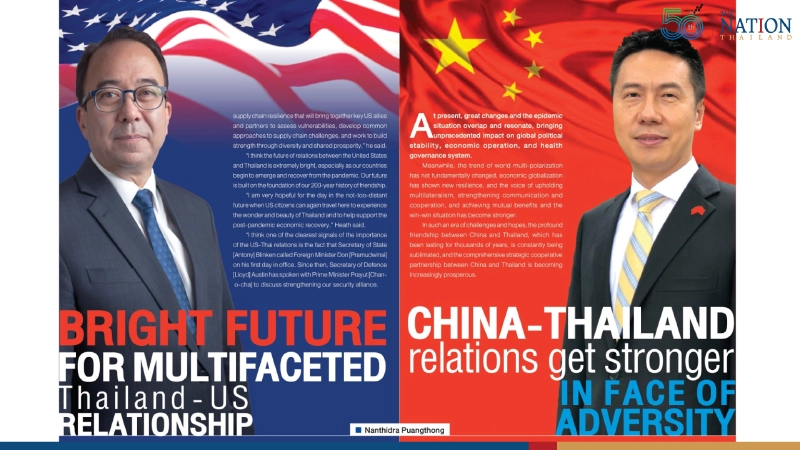


ASEAN is at the geopolitical center of the Indo-Pacific, and Thailand is at the heart of ASEAN. Thailand has helped integrate the economies of Southeast Asia.
The United States and Thailand have enjoyed a close commercial relationship for more than 200 years and that relationship has endured even as our economies have changed from agrarian societies to textiles to manufacturing hubs of automobiles and industrial parts, says Michael Heath, the charge d’affaires at the US embassy, on the occasion of the Nation Group’s 50th anniversary.
Heath sees the opportunity for greater cooperation between the US and Thailand, although the two countries have had a long relationship.
He said over $50 billion worth of goods and services are traded between the two countries, and the US is Thailand’s largest export market.
“Thailand is embarking on a plan to digitalise, decarbonise,and diversify its economy, what is known as Thailand 4.0, and the United States is eager to partner once again with Thailand. With our world-class companies involved in solar, wind, electric vehicles, and battery storage, we believe there is a great opportunity to collaborate on creating a cleaner, more sustainable future together.
“We also see great potential in the digital economy as American companies -- world leaders in cloud, social media, and e-commerce -- can train Thai businesses on how to make the most of the digital frontier.
“We also see the creativity and drive of the Thai people and want to help unlock their potential. One of America’s strengths has been our ability to foster a culture of innovation and entrepreneurship.
“Covid-19 has strengthened our resolve to cooperate with our friends and allies. I am proud that Thailand and the United States are at the leading edge of international health cooperation and have been for over 60 years.”
The US diplomat said the Armed Forces Research Institute of Medical Sciences has been working on cutting edge therapeutic drugs, vaccines, diagnostics, and preventative measures that have saved countless lives in Thailand and across the world.
“In just the most recent example, over the past year, they have been assisting Thai researchers at Chulalongkorn University in developing a new mRNA vaccine that could help tackle future coronaviruses,” the US envoy said.
The CDC and USAID have worked hand-in-hand with their Thai counterparts to help develop the public health system that has kept Thailand’s Covid-19 fatalities far below those of many other countries, he added.
Covid-19 also upended global supply chains and underscored that even in a globalised world, it still matters where your physical factories are located.
“The United States is conducting a global review of its supply chain security, and we see opportunities to work with
Thailand, which has shown itself to be a reliable supply chain partner,” the charge d’affaires of the US embassy said.
“President Biden plans to convene a global forum on supply chain resilience that will bring together key US allies and partners to assess vulnerabilities, develop common approaches to supply chain challenges, and work to build strength through diversity and shared prosperity,” he said.
“I think the future of relations between the United States and Thailand is extremely bright, especially as our countries begin to emerge and recover from the pandemic. Our future is built on the foundation of our 200-year history of friendship.
“I am very hopeful for the day in the not-too-distant future when US citizens can again travel here to experience the wonder and beauty of Thailand and to help support the post-pandemic economic recovery.” Heath said.
“I think one of the clearest signals of the importance of the US-Thai relations is the fact that Secretary of State [Antony] Blinken called Foreign Minister Don [Pramudwinai] on his first day in office. Since then, Secretary of Defence [Lloyd] Austin has spoken with Prime Minister Prayut [Chan-o-cha] to discuss strengthening our security alliance.
Deputy Secretary of State Wendy Sherman chose to come to Thailand on her first trip in office. She had productive discussions with the prime minister and the deputy prime minister/foreign minister about our shared commitment to advancements in healthcare and climate change, two important areas of human security where we are working together with Thailand.”
Heath said the US has long supported Thailand’s leadership within Asean.
“Asean is at the geopolitical centre of the Indo-Pacific, and Thailand is at the heart of Asean. Thailand has helped integrate the economies of Southeast Asia, and we look forward to future collaboration in health, environment, climate change, energy, and transportation,” the US diplomat said.
“We see great potential in Thailand’s work to strengthen ACMECS [Ayeyawady-Chao Phraya-Mekong Economic Cooperation Strategy], increasing regional connectivity and harmonising regulations across the five ACMECS member countries [Thailand, Laos, Vietnam, Cambodia and Myanmar].
On the security front, the United States continues to assist and collaborate with our Thai partners. Joint military exercises, for example, help support Thai sovereignty and preparedness for natural disaster response,” he said.
“We also highly value our law enforcement cooperation on combating transnational crime, including illicit trafficking of people, narcotics and wildlife, cybercrime and money laundering, all of which is in the mutual interest of both of our countries, and the region.
“In 2020, we launched the Mekong-US Partnership to address the challenges faced by the countries of the Mekong. One example of support to Thailand is the creation of the Mekong Dam Monitor, which increases transparency and delivers near real-time information about upstream activity to communities in Thailand and other countries. But the Mekong-US partnership is about far more, including such cooperative efforts as health, counter-trafficking and law enforcement, energy, and women’s economic empowerment,” the US diplomat said.

