
Design must be compatible with local environment


Play
Lessons should be learned from last year's floods, say experts
The architecture of Thai houses must change keeping in mind the country’s environment following last year’s floods, rather than follow global trends, architecture experts said.
Associate Prof Pirast Pacharaswate, a lecturer at the Architecture Faculty of Chulalongkorn University, said that after the flooding in Bangkok and its suburbs last year, architectural design for residential projects must respond to the Thai climatic situation.
“In the past, we have taken factors such as environment and safety in designing our houses. But now, how to co-exist with water is likely to become another factor that should receive attention at least two or three years from now,” he said.
The architecture should be responsive to the weather, which has become increasingly severe over the past years. The right design can reduce environmental destruction. This should be the clear and desirable concept for everyone, including Thais. Local climate has influenced people’s lifestyle. Cold and warm climates have affected the tradition and culture of people.
He added that Thailand is located in a tropical area with high temperature and humidity. Therefore, the humidity tends to stay in our body longer than in a dryer climate. Likewise, architectural design has to take into consideration the humidity factor because it can affect the durability of paint, fungus infection on the walls or deform wooden flooring.
Water is one of the most important elements in tropical weather. Water can come from rainfall, the air and underground. These three sources of water are significant for designing a house.
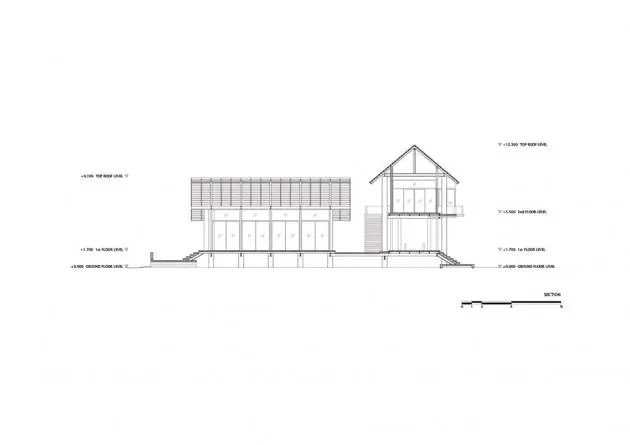
Pirast added that there was merit in the local wisdom of designing the house with an elevated ground floor. His ancestors built houses with an elevated ground floor to serve various purposes. The flooding has made us realise that a house with an open ground floor is suitable for the tropical climate, which is prone to flooding. The open ground floor allows the water to flow. The traditional wisdom is a wise alternative because it can reduce the humidity from the earth. At the same time, it reduces the heat into the house because the open ground floor enhances airflow. The traditional Thai house enables us to live with water.
The next question is how to apply traditional Thai house concepts in modern design. He said the first requirement is to design an elevated ground flood by creating an open floor house to serve various purposes. The floor should be elevated by approximately three metres. However, if you want to use the ground floor only as a storehouse or pet house, the floor can be elevated by only 1-2 metres.
The elevated floor not only prevents the water during the emergency situation but it also serves other purposes such as accommodating electricity and waterworks systems, which are usually installed underground. Installing this system in the ground floor will help reduce the humidity from the earth as well as the possibility of fungus infection.
Modern houses tend to have additional rain shades above the windows. These aluminium or canvas shades don’t always go well with the overall house design. House owners could fix this problem in a sustainable manner by building long overhanging eaves.
With the long overhanging eaves, we will be able to open up the windows to enhance air circulation all the time, come rain or shine. It will quickly run off the rainfall from the roof and let the cool air from outside blow into the house.
The last area of design is a high ceiling with an open terrace, as heat tends to evaporate to higher level.
Therefore, a high ceiling can enhance the circulation of cool air into the house. The ceiling can be 3.50 metres to 4 metres from the ground. Additional height will not cost much. But the result will be worth it.
The above-mentioned concept should be themed for the house of the future, he said.
Savinee Buranasilapin, a director of Thingsmatter Design Studio, shared her ideas on how to factor floods while designing residences this year.
The design should take into account three factors:
First, the flooding has prompted people to pay attention to the difference between the house level and that of the sea and road. The next factor is materials used in construction and interior designing. People have become increasingly aware of natural materials. The last issue is how to allocate the space to serve its function.
Puiphai Kunawat, a director and a co-founder of Somdul Architecture Co, said that house designs in 2012 should incorporate flood-prevention techniques.
An effective technique to deal with the flooding is to use a permanent structure such as a slope in the driveway to block the water from entering the houses.
To design the house to accommodate this barrier, the length of this barrier should not be too long because that would be costly. For houses not accessible from the main road, the house owners may create fencing or grow trees that can serve as permanent barriers. The height of the fence or the trees should be equivalent to the level of the flood water in the past year.
In addition, different layers of pottery plants can create a relaxed feel such as a garden on the first floor.
Besides water barriers, the design should incorporate a drainage system. Heavy rainfall can cause waterlogging in the house. Therefore, the drainage system can help release the water and it will be convenient when the owners have to clean up the houses.
The drainage system can be incorporated by, for instance, using a plastic sieve and covering it with gravels to blend it with the garden.
Home owners can also cover the drainage with the stones that they use in the garden. In addition, an underground drainage system should be installed to accelerate the release of water during the rainy season.
The right design can incorporate flood prevention equipment to the other parts of the house. Water prevention does not only mean blocking water when the flooding occurs, but it should also enable the residents to co-exist with water during the rainy season.
Houses which have been submerged for a long time might be too damaged to be renovated. Traditional Thai houses could provide an answer, she said. Traditional Thai houses are made of lightweight materials such as dried leaves. Therefore, it will not absorb the humidity and not be prone to fungus, unlike modern materials which are made of cement and have many layers of paint coat. House paint is not designed to be used with water. Therefore, many have to repaint the whole house after flooding. The concept of a traditional house can be applied in tropical weather which is vulnerable to flooding, she added.
