
Conglomerates step up property expansion


Play
TCC, CP and Singha groups plan combined spending of Bt100 bn from 2015 to 2019 across several segments
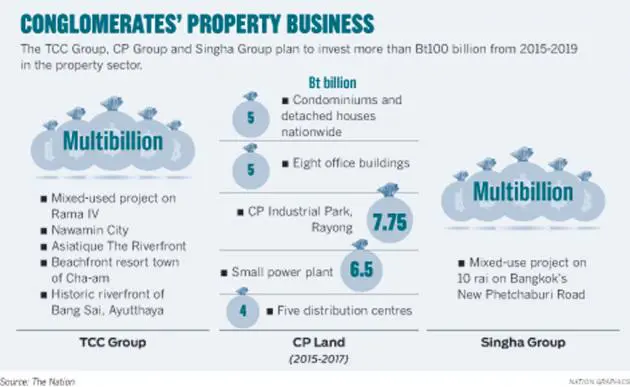
Conglomerates TCC Group, CP Group and Singha Group are all expanding their business in the property sector, with plans to invest more than Bt100 billion between them from next year through 2019.
A survey by The Nation found that in the first eight months of this year, TCC Group – owned by beverage tycoon Charoen Sirivadhanabhakdi – had expanded its investment in the property sector, following its takeover of listed property firms Univentures and Golden Land Property Development in 2007 and 2012, respectively.
Univentures and TCC Asset (Thailand) have together won the contract from the Crown Property Bureau to develop a multibillion-baht mixed-use complex on 90 rai (14.4 hectares) of land on Rama IV.
The land is the site of the former Pre-Cadet School, located at the intersection of Rama IV and Wireless roads in the heart of the capital.
TCC Group also has a master plan to develop its largest land plots in Bangkok, Phetchaburi and Ayutthaya and turn them into “new city” areas, in a 10-year timescale from 2010 and involving multibillion-baht investment.
These projects include a township project called Nawamin City, the Asiatique riverfront project on Charoen Nakorn Road, development in the beachfront-resort town of Cha-am in Phetchaburi province, and in the historic riverfront of Ban Sai in Ayutthaya province.
Via its Berli Jucker conglomerate unit, the group also recently spent US$879 million (about Bt28 billion) to take over Metro Cash & Carry in Vietnam, as part of its plan to enter the regional retail business after its successful takeover of Singapore’s Fraser & Neave last year.
TCC Group also got Fraser & Neave’s property business in Singapore as part of that deal.
As part of its business expansion, TCC Group is now an integrated property developer not only in Thailand but also within the wider Asean market.
CP Group is another Thai conglomerate with a firm focus on property business growth, having started to expand this part of its operations nationwide last year, even though it had established CP Land back in 1988.
CP Land diversifies
During most of the intervening period, CP Land was focused on office buildings and residential development at the rate of one or two projects a year.
Last year, however, the company started to expand its investment in all property market segments, including the development of residential units for sale, office buildings, industrial estates, and hotels by launching its first property fund – worth Bt10 billion.
CP Land then announced a plan to invest more than Bt30 billion from 2015-2017 in five property categories.
The first entails an investment of more than Bt5 billion to develop both condominium and detached-housing projects. The projects will comprise a combined 3,000 units in 10 provinces.
The next is to develop eight office buildings with a combined 55,000 square metres of space in Nakhon Si Thammarat, Phitsanulok and Surat Thani provinces.
Then there is an investment budget of Bt7.75 billion to develop CP Industrial Park in Rayong province on a 3,140-rai plot.
In a further diversification, CP Land will invest Bt6.5 billion in developing a small power plant for the generation of 130-140 megawatts of electricity.
Finally, the company will spend Bt4 billion on the development of five distribution centres in Khon Kaen, Phitsanulok, Chiang Rai and Surat Thani provinces.
The company is also studying whether to expand its investment into Myanmar, with a focus on office building and a hotel.
Including all of these investments, CP Land targets its total revenue hitting Bt6 billion in 2017, said CEO Soonthorn Arunanondchai.
Singha Group investment
Meanwhile, the Bhirombhakdi family’s Singha Group kicked off its business expansion in the property sector by spending Bt7.78 billion to take over listed residential developer Rasa Property Development in April this year.
This follows the beverage group’s establishment in December of two property firms, S Bright Future with registered capital of Bt4.13 billion and Singha Property Management with registered capital of Bt2.07 billion.
Santi Bhirombhakdi and his nephew, Chayanin Tepakam, are major shareholders of both companies.
Chayanin, who is a fourth-generation Bhirombhakdi family member and now vice president at Singha Corp, will be in charge of the new property business.
Singha Corp in 2011 won an auction to acquire a 9-rai plot of land on Bangkok’s New Phetchaburi Road, previously occupied by the Japanese Embassy. It also purchased a 1-rai plot from the Japan International Cooperation Agency.
The resulting 10 rai of land has been developed into a mixed-use complex comprising a condominium, an office building and a shopping mall. Santi now wants to further develop the complex into a new Bangkok landmark and tourist destination.
Singha Corp director Phurit Bhirombhakdi said previously that mergers and acquisitions would be considered as a short-cut process in the group’s diversification into businesses such as property.
“Currently, we cannot start such businesses from the ground up, but can synergise or take up partnerships with existing professionals and experts in the businesses, so that they can help us speed up our business expansion,” he said.
These and other moves by Thailand’s big conglomerates to expand their property-sector business will transform the sector into a more of a corporate market than one of mainly small and medium-sized developers, as competition will be driven by capital rather than technology, said Property Perfect CEO Chainid Adhyanasakul.
