
Residential developers buoyed by prospects of continued recovery


Play
Launches worth more than Bt200 billionn planned for 2015, with much of the development set for the provinces
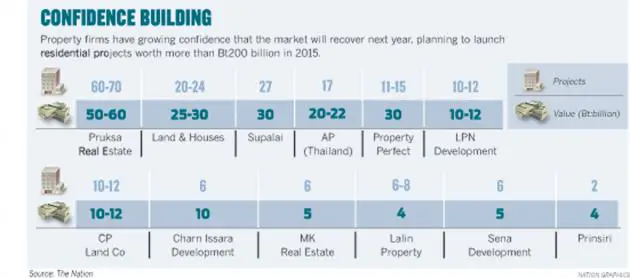
Leading property developers, confident that the residential market will continue to recover next year, plan to launch projects worth more than Bt200 billion during the course of 2015.
A survey by The Nation early this week found that both listed and non-listed property companies plan to launch more residential projects by focusing on Bangkok and the provinces. (See graphic.)
Pruksa Real Estate president and CEO Thongma Vijitpongpun said the property market had begun to show signs of recovering from July to September, and he expected to see stable growth during next year.
As a result, the company plans to launch between 60 and 70 projects worth Bt50 billion-Bt60 billion during the course of 2015, close to this year’s level.
Supalai deputy managing director Tritecha Tangmatitham said the company had earmarked an investment budget of just under Bt5 billion to buy land next year, which is on a par with this year.
This forms part of the developer’s plan to launch at least 27 projects worth up to Bt30 billion next year.
“We saw residential demand start to recover in June when the country’s political stability returned, while we also have confidence that next year’s property market should show strong growth under the government s policy to expand investment in infrastructure, which will boost demand for homes located close to mass-transit systems,” he said.
Property Perfect CEO Chainid Adhyanasakul said the company would expand its investment east of Bangkok, especially in the Eastern Seaboard provinces of Chon Buri and Rayong, as well as in Phetchaburi and the Hua Hin district of Prachuap Khiri Khan, in 2015, as there is strong residential demand in these locations.
“We see strong demand to buy from both locals and foreigners moving to work in these locations,” he said.
Meanwhile, eastern locations also have more facilities to support new residential projects, such as motorways, expressway and the rail system, said the CEO.
“In 2015, we will launch nearly as many new projects in the provinces as in Bangkok,” Chainid said.
“Although the new investment in infrastructure will take time [to kick in], the government policy to develop 10 new mass-transit routes and a nationwide double-track rail system – and invest in integrating the country’s logistics system – is together worth Bt3 trillion from 2015 through 2022. That will drive the property market’s expansion from Bangkok into the provinces, as a result of which we are expanding our provincial investment,” he added.
AP (Thailand) chief marketing officer Vitakarn Jantavimol said his company would launch roughly the same number of residential projects in 2015 as this year – 17 projects worth about Bt22 billion – thanks to residential demand having begun to recover in the second half.
Four or five new projects planned for launch next year will be jointly developed with AP’s Japanese partner, Mitsubishi Estate Group, he said.
Chutima Tangmatitham, assistant managing director of MK Real Estate, said the company planned to launch six residential projects during the course of next year, four of them detached-housing and townhouse projects, and the other two condominium developments.
Three of the six will be projects delayed from this year.
“We delayed launching three projects this year when the country’s political problems in the first half caused us to revise our 2014 new project launches. However, we have confidence that the market recovery in the current half will continue into next year, during which we now plan to launch more new projects,” she said.
All of the above companies are listed on the stock exchange.
Meanwhile, CP Land has set aside an investment budget of Bt30 billion to develop residential projects, office buildings, distribution centres and small power plants from 2015 to 2017.
For residential projects, the company plans to launch at least 3,000 condominium units worth nearly Bt10 billion in the provinces next year.
Sunthorn Arunanondchai, president and CEO of the unlisted developer, said the company was planning such a level of residential development next year due to strong provincial demand.
