
Space debris passes 1.1m pieces, raising risks on Earth
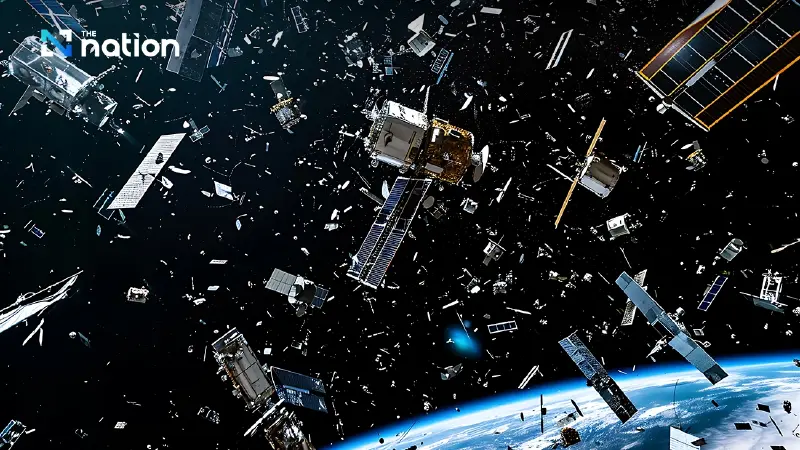


Over 1.1m pieces of space debris orbit Earth, raising risks to aircraft, homes and critical systems such as telecoms, GPS and weather satellites
More than 1.1 million pieces of space debris larger than 1 centimetre are currently orbiting Earth at speeds of up to 18,000 miles per hour. The number is expected to rise as more satellites are launched. The debris includes defunct satellites, loose bolts, and even flakes of paint created by collisions. Despite there being millions of pieces, scientists can track only about 30,000 objects, and the impact on Earth is likely to grow.
The growth rate of debris is directly linked to the number of satellites being sent into orbit. There are currently around 12,900 active satellites, and this could climb to 100,000 within the next decade. Richard Okyay, a physics professor at the University of the Free State, said the amount of debris falling back to Earth is increasing and could accelerate sharply over the next few years.
In addition, around three objects per day—such as rocket bodies or inactive satellites—re-enter Earth’s atmosphere daily, further increasing risks to people and property below.

Recent incidents highlight the danger. A 0.7kg metal fragment from the International Space Station punched through the roof of a home in Florida. A 1.5-metre piece of a Falcon 9 rocket landed near a warehouse in Poland. A 2.5kg fragment from a Starlink satellite landed on a farm in Canada. No injuries have been reported so far, but estimates suggest the risk to human life on the ground could rise to 10% per year by 2035 if satellite launches are not effectively controlled.
At the same time, space debris poses a serious threat to critical infrastructure that underpins daily life—telecommunications networks, GPS navigation, and weather-monitoring satellites. Such damage could have wide-ranging consequences, potentially cutting global GDP by as much as 1.95% if the problem is not addressed. Losing accurate weather forecasting or reliable navigation could cause severe economic and social disruption in the digital era.
The greatest fear is what scientists call the “Kessler Syndrome”—a scenario where the density of objects in low Earth orbit becomes so high that a single collision triggers a cascade of further collisions. Each impact creates large amounts of new debris, potentially making parts of orbit unusable.
For example, just two satellite collisions in 2007 and 2009 produced debris that now accounts for more than one-third of all recorded space junk—showing how severe a single collision can be.
Risks to aviation are also rising. While the probability of debris striking an aircraft is still low today, it is growing fast. One report suggests that by 2030, the chance of a commercial flight hitting space debris could be as high as 1 in 1,000.
Benjamin Vergili Bastida, an engineer at the European Space Agency (ESA), warned that even small falling debris can be as dangerous as an aircraft flying through volcanic ash, which can severely damage engines. A strike at cruising altitude could destroy the aircraft instantly or cause rapid cabin depressurisation, putting passengers’ lives at risk.
Another major consequence is the cost and disruption of closing airspace for safety. In 2022, when a 20-tonne Chinese Long March rocket body re-entered Earth uncontrollably, parts of southern Europe had to close airspace for 30 minutes, forcing more than 300 flights to be delayed or rerouted.
In heavily trafficked air regions—such as northern Europe or the north-eastern United States—there can be up to a 26% annual chance of disruption from the re-entry of large debris.
Predicting debris trajectories remains extremely challenging. Even with AI support, fluctuations in the upper atmosphere make it very difficult to pinpoint an exact impact location. Data analyst Njord Eggen said that an error of just 10 minutes in calculations can translate into a deviation of thousands of miles due to the object’s immense orbital speed. This forces air traffic controllers into difficult decisions: accept a small risk to passenger safety, or impose massive airspace closures with huge economic consequences.
There is also a misconception that modern satellites are always “designed for demise” (built to burn up completely during re-entry). However, James Beck, director of a space engineering research company, tested this and found that highly durable materials—such as titanium and certain alloys—do not fully melt away even under extreme heat during re-entry.
“For a large satellite weighing about 800kg, we can expect at least two to three pieces to reach the ground,” Beck said.
International solutions are still stalled by legal and policy constraints—especially the Outer Space Treaty (1967), which states that any object launched into space remains the property of the launching state indefinitely. This means one country cannot retrieve debris created by another without permission. Complicating matters further, debris-removal technology could be viewed as a weapon, because it could also be used to disable functioning satellites.
Because of this, “space recycling” remains difficult in practice unless there is stronger cooperation and clearer agreements on ownership and removal rights between countries.
To respond to the crisis, the ESA has developed a Space Environment Health Index to measure the sustainability of space missions—similar to energy-efficiency labels on appliances. ESA has also set a goal of “Zero Debris” by 2030, aiming to stop creating new debris from its own missions.
A future project, the DRACO mission, planned for launch in 2027, will use more than 200 sensors to collect detailed data on how satellites break up during re-entry. This information is expected to help engineers design safer satellites and rockets in the future.
Experts say tackling space debris requires a systemic change in mindset—not technology alone. Jin Xuan of the University of Surrey has stressed that satellites should be designed from the start to be repairable or refuellable, alongside stronger international laws that enable debris removal and space recycling. The aim is to protect both people on the ground and the safety of the skies above.
Source: CNN, Earth, Space, Technology Review
