
Marine experts press for closer review of Land Bridge impacts
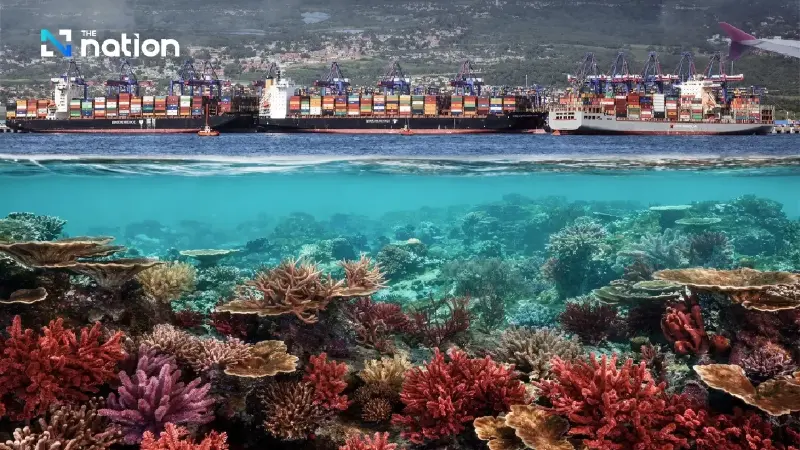


Shadow panel warns Thailand’s Land Bridge project may threaten Ranong’s coral reefs, water quality and seabed ecosystems
A group of marine scientists has formed a “shadow committee” to scrutinise Thailand’s Land Bridge project, warning that the planned deep-sea port in Ranong could pose significant risks to the Andaman Sea ecosystem.
The move comes after the House of Representatives voted against setting up an extraordinary committee to study the project.
However, debate over the scheme’s economic viability and environmental impacts has continued, particularly as the government moves to complete its own review within 90 days.
Dr Thon Thamrongnawasawat, a marine ecology expert and deputy dean of the Faculty of Fisheries at Kasetsart University, said three subcommittees have been established to examine the Land Bridge project.
These cover project-driving mechanisms, project effectiveness and public participation, including a subcommittee tasked with reviewing environmental impacts.
The Marine Science Association of Thailand has gathered senior academics to serve as a shadow committee, aiming to verify technical data and support the review process with recognised scientific standards.
Its work will focus on checking the accuracy of the environmental and health impact assessment, or EHIA, as well as data from the National Economic and Social Development Council.
The committee is preparing to submit its findings and recommendations to the government’s environmental impact subcommittee on June 9, with the goal of making the review process more transparent and cautious.
Seabed data raises concern
The first major concern involves benthic marine animals in the proposed port construction zone.
According to the shadow committee, figures in the EHIA prepared by the Office of Transport and Traffic Policy and Planning differ sharply from parallel studies conducted by specialist marine scientists.
Dr Thon said the figures are highly important because they would be used to calculate the number of marine animals likely to die from land reclamation or dredging.
That calculation could then affect decisions on project value, compensation and environmental damage.
He said an independent agency may need to conduct further study because the available data remains highly conflicting.

Rare coral reefs and sediment spread under scrutiny
The second concern centres on coral reefs.
A study by the National Economic and Social Development Council, conducted through Chulalongkorn University’s academic service centre, found that more than 2,300 rai of coral reef areas on both sides of the project could be affected.
Particular concern has been raised over reefs around Koh Phayam and Koh Khangkhao in Ranong, which are currently in good to very good condition, a rare status for coral reefs in Thailand.
The EHIA by the Office of Transport and Traffic Policy and Planning also found that sediment dispersion during construction could, at certain periods, spread across as much as 200,000 rai.
Dr Thon warned that such a large volume of sediment, without sufficient preventive measures, could seriously affect seagrass beds and coral reefs.
He said the review must also examine whether the cost of preventing or mitigating such impacts has already been included in the overall project cost.
Findings to be submitted on June 9
The shadow committee said its work is not intended to create conflict, but to help clarify technical questions surrounding the project.
Beyond the three main issues, experts are also looking at water-current patterns, water quality and juvenile marine life, all of which could influence the full environmental assessment.
The committee’s findings will be compiled for submission to the Land Bridge environmental impact subcommittee on June 9, 2026, as part of efforts to ensure that any decision on the national-scale project is made with greater caution.
