
35 years on, the spirit of Seub Nakhasathien lives on in Thailand’s forests
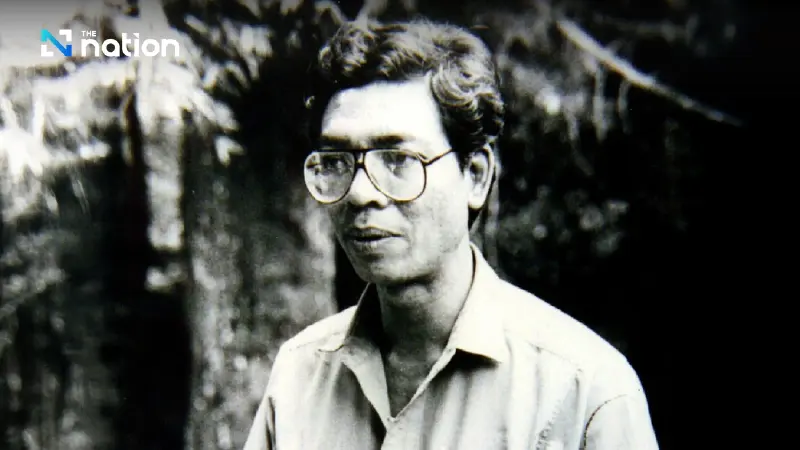


It has been more than 35 years since the sound of a gunshot on September 1 1990 reverberated across the nation, leaving a lasting mark on the hearts of those who love Thailand’s forests.
Seub Nakhasathien, also known as Daeng, devoted his life to protecting forests and wildlife, sacrificing himself to awaken society to the urgency of conservation.
He was among the first to recognise that nature needed defending from human greed, at a time when such concerns were rarely voiced. Seub had many allies, but none matched his courage.
As former chief of the Huai Kha Khaeng Wildlife Sanctuary, he confronted systemic shortcomings: state agencies with inadequate resources, encroachment by vested interests, and the destructive impact of dams. These challenges ignited a fierce determination in him.

“Beyond the floods that endangered wildlife, animals also faced the cruelty of humans who hunted them mercilessly. The gunfire echoing through the valleys of Khlong Saeng dam scarred those of us striving to save them,” the Seub Nakhasathien Foundation recalls.
In one harrowing account, his team discovered the remains of a tapir, its fresh blood staining the earth and its body dismembered.
They searched every boat in Khlong Saeng through the night, refusing to relent. Eventually, they uncovered the tapir’s entrails hidden beneath the hull of a vessel, smeared with oil and filth.
Confronted by such cruelty, and convinced he could never single-handedly solve the crisis of wildlife destruction, Seub made the ultimate sacrifice. His suicide was a desperate plea for society to value nature and act.
Though his life ended tragically, his death gave rise to a movement. His name became a symbol of conscience, sparking guilt, grief, and a sense of responsibility in countless people to stand up for the forests.
His legacy continues to inspire rangers and conservationists. As his foundation notes, if you truly love wildlife, you will dedicate yourself tirelessly to the cause, just as he did.

Selected works of Seub Nakhasathien
- Nesting behaviour of certain bird species at Bang Phra Reservoir, Chon Buri – presented at the Thai Wildlife Seminar, 1981.
- Survey report on birds at Bang Phra Reservoir, Chon Buri – Thai Wildlife Seminar, 1983.
- Detailed planning study for forest rehabilitation and management in the watershed of Khlong Saeng, Cheow Lan Dam project, Surat Thani – 1984.
- Study on wildlife ecology in the Phu Phan Development Study Centre project, under royal initiative – 1985.
- Forest and wildlife ecology in Thung Yai Naresuan and Huai Kha Khaeng Wildlife Sanctuaries – 1986.
- Report on the capture of hog deer at Ko Kradat – 1986.
- The serow in Thailand: distribution and behavioural observations – 1986.
- Habitat survey of Fea’s muntjac – 1986.
- Forest and wildlife ecology in Thung Yai Naresuan Wildlife Sanctuary (Kanchanaburi and Tak) and Huai Kha Khaeng Wildlife Sanctuary (Uthai Thani and Tak) – February 1987, co-authored with Narit Phumipakphan and Saksit Simcharoen.
- Preliminary survey of wildlife in the Phru To Daeng forest, Narathiwat province – 1987.
- Wildlife migration in the Ratchaprapa Dam reservoir – Thai Wildlife Seminar, 1989.
- Analysis of mitigation measures for forest and wildlife resource impacts from the Upper Kwae Yai Hydropower Project.
- Evaluation report on the rescue of stranded wildlife in the Ratchaprapa (Cheow Lan) Dam reservoir, Surat Thani.

Legacy and impact of Seub Nakhasathien
Seub’s death in 1990 sparked profound changes in Thailand’s conservation movement.
- Establishment of the Seub Nakhasathien Foundation, which continues his mission of forest and wildlife protection.
- World Heritage recognition – in 1991, Thung Yai Naresuan and Huai Kha Khaeng Wildlife Sanctuaries were inscribed as UNESCO World Heritage Sites.
- Government forest policies – the state adopted Thung Yai’s management model to protect surrounding western forest complexes, helping to preserve their richness to this day.
- Public inspiration – his sacrifice ignited wider awareness and inspired the public to take an active role in environmental conservation.
“He was a leader. If he could not do it, others would lose confidence. But when the leader worked hard and took on the toughest tasks, everyone else became more determined and motivated. If the chief could make sacrifices, then everyone could too… I am proud to have worked with him.” Seub Nakhasathien Foundation said.

New challenge of climate change
Over the past 35 years, Thailand’s forestry agencies have continued to carry forward Seub Nakhasathien’s vision. Yet the effort has not been enough. Today, conflicts over land use remain, and forest cover in the country continues to fluctuate without stability.
Dams are still being built, while even greater challenges have emerged: the climate crisis and the looming threat it poses to all wildlife, driven by human actions.
If Seub were still with us, he would surely recognise that the forests he once fought so hard to protect now face an even larger existential danger.
Protecting nature cannot rest on the shoulders of one person. It is the duty of all of us, as human beings, to care for the forests around us.
