
Dirty Air Is Costing Thailand Almost 4% of GDP a Year
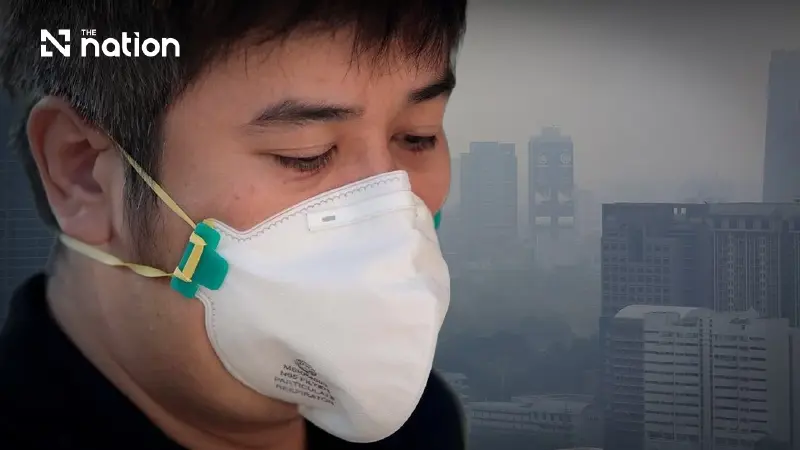


New research puts PM2.5's annual cost near 4% of GDP, as campaigners warn political delay is now a bigger threat to growth than the smog itself
- A World Bank assessment estimates that PM2.5 air pollution costs the Thai economy US$45.3 billion a year, equivalent to 3.89% of its GDP.
- The economic damage extends beyond direct health costs to include lost worker productivity, reduced consumer spending, negative impacts on tourism, and lower property values.
- Long-term consequences of the pollution include hindering the country's ability to attract skilled workers and high-value tourists, and eroding future human capital by affecting children's development.
- A Clean Air Bill designed to address the problem and its economic costs has been stalled in Parliament for years, which campaigners now see as a significant threat to economic growth.
New research puts PM2.5's annual cost near 4% of GDP, as campaigners warn political delay is now a bigger threat to growth than the smog itself.
Ask an economist to put a price on Bangkok's haze, and the number is startling: US$45.3 billion a year, or 3.89 per cent of Thailand's GDP, according to a World Bank assessment that ranks the country 20th worst out of 180 for the health costs of PM2.5 pollution — the second-heaviest burden in Southeast Asia after Indonesia.
That figure, presented by Associate Professor Witsanu Attavanich of Kasetsart University's Faculty of Economics, is not a forecast or a worst case.
It is roughly what dirty air is already taking out of the Thai economy every single year, largely unremarked, while a law designed to bring it down sits stalled in Parliament.
"I'm an economist," said Weenarin Lulitanonda, co-founder of the Thailand Clean Air Network, at the third Nation Visionary Club Roundtable in Bangkok. "What growth are you talking about when you're not dealing with this?"
It is a pointed question, and the data increasingly back it up.
Prof Witsanu's household-level modelling, which draws on pollution readings from the Pollution Control Department, income data from the National Statistical Office and provincial GDP figures from the National Economic and Social Development Council, puts the annual economic damage to Thai households at between roughly 8 and 13 per cent of GDP depending on the year and province — figures that dwarf the headline national estimate once localised health, productivity and lost-activity costs are added up province by province.

Even narrowly defined, the cost of treating asthma linked to PM2.5 alone ran to an estimated 16 billion baht in the most recent five-year study period, against 12.9 billion baht for the coarser, less dangerous PM10 particles.
A tax on productivity, spending and property
The economic damage does not stop at hospital bills. Research cited in the briefing shows office and outdoor workers alike become measurably less productive on high-pollution days, with absenteeism rising in step; conversely, output recovers on clean-air days, suggesting the losses are real rather than merely displaced.
Consumers spend less when the air is bad — Spanish households, cited as an international comparator, cut spending by US$23–35 million on days when particulate readings spiked above normal. Tourism dips in polluted areas. Property values and rents soften where air quality is chronically poor.
None of this shows up neatly in a single line of the national accounts, but together it constitutes what economists increasingly treat as a standing tax on economic activity — one Thailand levies on itself every dry season.
The longer-term bill may be larger still.
Prof Witsanu's presentation warns that persistent pollution leaves Thailand unable to attract high-spending tourists or skilled workers, degrades natural resources including forests, and — because children exposed to poor air develop lower cognitive and physical potential — erodes the human capital base the country will need for future growth.

"The cost of air pollution is tremendous," Prof Witsanu has said of related national-level findings, adding that the 2.17 trillion baht (nearly 11 per cent of GDP) in social costs identified in a 2019 national study accumulates further every year the problem goes unaddressed. "Is economic development worth having the health of the Thai population deteriorate?"
"Environmental security is national security"
That framing — pollution not as an environmental footnote but as a structural threat to growth — dominated the Bangkok roundtable, held under the theme "Sustainable Thailand: No Choice Left, Ready to Stay in the Game".
Jerome Le Borgne of Veolia Environmental Services argued the issue belongs in an entirely different policy category.
"This isn't just climate adaptation; it's a matter of environmental security," he said. "And environmental security is national security — arguably it should be treated the same way as defence."
His arithmetic, he said, is simple: "It will always be cheaper to act now than to act ten or twenty years from now."
For investors, the concern is less about the pollution itself than about the uncertainty surrounding it.
Martin Venzky-Stalling of the Joint Foreign Chambers of Commerce in Thailand (JFCCT), which represents 31 chambers and roughly 8,000 companies, said unpredictable rules unsettle capital more than strict ones.
Consistently enforced standards are preferable to vague ones, he argued, and firms that try to do the right thing are penalised commercially when competitors face no obligation at all.
Weenarin noted that the JFCCT had gone further still, issuing a public letter throughout the bill's drafting process backing effective clean air legislation — a signal, she said, that employers recognise staff falling sick or dying early is a direct economic cost, and that "ineffective legislation on clean air and climate is actually against business interests."
Dr Saniwan Buaban of the People's Party framed the law as economic infrastructure in its own right, establishing a right to a healthy environment for communities, business and government alike.
It also bears on Thailand's international positioning: the country is pursuing OECD membership, she noted, and foreign investors are actively screening destinations for whether they are safe for staff and operations.
"This can help Thailand be seen internationally as a country that pays attention to quality of life and governance," she said.
Asked what would stop Thailand competing effectively on the world stage, she did not hesitate: law and information.
The private sector, she argued, is largely ready to act — the gap is regulatory, from the absence of a legal framework for data centres to the lack of a mandatory, centralised system for monitoring, reporting and verifying emissions.

The human toll behind the balance sheet
The economic figures rest on a grim health foundation.
The Lancet Commission on Pollution and Health, in an analysis updated with 2022 data, found pollution to be the leading environmental cause of premature death worldwide, with air pollution responsible for roughly 90 per cent of that toll — around eight million deaths a year globally, including some 700,000 children, or roughly 2,000 children a day.
In Thailand, an estimated 13.6 million children are affected or at risk. Bangkok, depending on the year, manages genuinely clean air for only four to five months out of twelve — as little as six weeks in bad years.
Weenarin tied the health data directly back to the economic argument, warning that failure to act risks "continued youth brain drain", pointing to the numbers of young Thais who have already left the country.
"They don't see a future," she said. "What future will we have when the youth has left?"
It is a version of the same warning campaigners have made for years: that a country cannot simultaneously court high-value investment and talent while its capital city delivers unbreathable air for half the year.
A law four years in the making — now caught in reconciliation
None of this urgency has translated into a finished law. The Citizens' Clean Air Bill was first submitted to Parliament roughly four years ago alongside six competing drafts from political parties and the government; merging them into a single bill took two years on its own.
The House of Representatives eventually passed the consolidated draft almost unanimously, reflecting, campaigners say, overwhelming public demand — survey after survey places clean air at or near the top of public concerns.
The Senate told a different story. Reviewing the bill, senators removed what Weenarin called "many of the critically important clauses that would actually make this legislation effective", including a "deposit-refund" mechanism requiring bonds from producers of high-risk polluting goods, a reworked chain of authority in provincial air-quality committees, and reporting requirements under a pollutant release and transfer registry.
In their place, the Senate's committee stage added seats for the Thai Chamber of Commerce, the Federation of Thai Industries and provincial business bodies across the national oversight committee, the technical committee and every provincial panel — while cutting maximum industrial fines from 50 million baht to five million.
That rewrite did not survive contact with the House. On 2 September, MPs voted 414 to two to reject the Senate's amendments outright, sending the bill to a 20-member joint committee — split evenly between the two chambers — to negotiate a compromise text.
Democrat Party list MP Karndee Leopairote said seating chamber-of-commerce and industry and banking representatives on the very committees meant to regulate them raises governance risks and potential conflicts of interest in budget allocation and policymaking; People's Party MP Phattarapong Leelaphat, representing Chiang Mai, argued the changes tilted the law toward vested interests that already had representation under the House's original draft.
Whatever text the joint committee produces must now return to both chambers for approval — and if no agreement is reached, the constitution allows the House to fall back on its own version, a draft roughly 80 per cent aligned with the citizen-led bill that started this process four years ago.
What the committee stage cannot afford to lose sight of is what is actually at stake while the clauses are redrafted.
Every dry season Thailand delays is not a neutral pause — it is lost wages from workers too sick to work, fields yielding less because crops and soil absorb the same pollutants as human lungs, and a capital city that talented Thais and prospective investors alike are increasingly free to simply avoid.
A country that wants to be judged on its competitiveness rankings, its OECD ambitions and its ability to draw high-value industry cannot keep pricing that ambition against six clean months a year in its own capital.
Thailand has already spent four years merging drafts, two chambers' worth of amendments, and a 414–2 vote proving where public and parliamentary will actually sit. The economics no longer leave room for the law to keep waiting on the politics.
