
On the wings of a dream


Play
The long-awaited 787 Dreamliner takes a short hop from Suvarnabhumi to Chiang Mai as part of its sneak preview
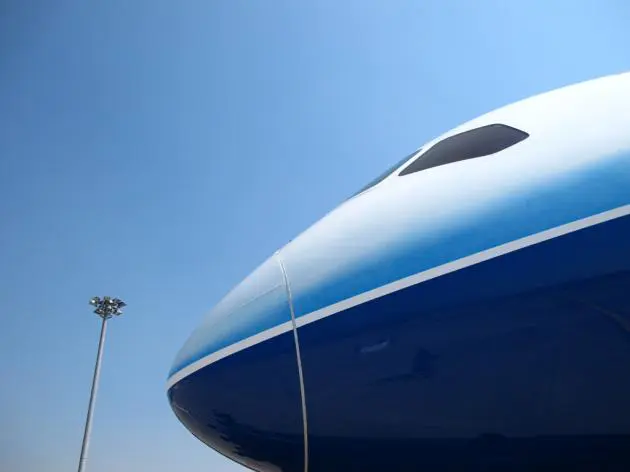
Friday morning in Thai Airways International’s aircraft parking lot at Suvarnabhumi Airport and Boeing’s new “baby”, the 787 Dreamliner is sleeping peacefully in the morning sunshine while aviation industry insiders and media representatives, watched carefully by Boeing and Thai Airways executives, coo over the new arrival. Painted in Boeing’s two-toned trademark of white and blue, the plane is certainly an attractive machine with sleek lines, a dropped nose and bold engines beneath its wings.
This is the third 787 Dreamliner to roll off the production line; the first passenger craft was delivered to All Nippon Airways last September and has been in service since October. Part of Boeing’s “Dream Tour” series, the 787 Dreamliner has stopped over at Suvarnabhumi Airport for a short layover before undertaking a demonstration flight from Bangkok to Chiang Mai.
While waiting for the boarding call, everyone is busy capturing the 787 Dreamliner on their smartphones. I step closer to the 787 Dreamliner and knock on its body, feeling rather like a used-car dealer testing for any funny sounds in the body panels.
The 787 Dreamliner is the world’s first commercial airline made mostly from carbon fibre-reinforced plastic composites rather than aluminium. Thank to cutting-edge technology, the 787 Dreamliner doesn’t sound like a plastic bucket when you knock on its panels.
The 787 Dreamliner is a long-range, mid-size wide-body, twin-engine jet – the kind of aircraft you fly from Bangkok to Sydney or on any transoceanic flight.
When Boeing was developing the Dreamliner, it wanted a game changer kind of aircraft. The 787 Dreamliner is designed to be lighter and faster. What Boeing has done with 787 Dreamliner is more or less what Ford did with the Mustang back in 1964 – give a light body a powerful engine. The machine then runs faster and further.
But the technologies of the mid-20th century and 21st century are very different. While Mustang’s V8 is a gas-guzzler, the Dreamliner’s engine – the Rolls-RoyceTrent 1000 – offers the lowest fuel burn and emissions. Apparently, it takes the Dreamliner just 40 seconds to lift off the runway, climbing smoothly into Bangkok’s skyline.
“The 787 is ideal for a long haul flight,” says Miles Kotay, Boeing’s senior manager for International Communications, who is also onboard the Bangkok to Chiang Mai demonstration flight. “This is a mid-sized aircraft, which makes it easy to fill up the seats. It’s also in the long-range class so it can fly Bangkok to Los Angeles, making it more manageable for marketing.”
But what makes the 787 Dreamliner such a good sell both to airlines and an increasingly environmentally conscious travelling public is its cutting-edge technology. The newly developed engines and lighter airframe allow it to burn 20 per cent less fuel than jetliners of a similar size.
“The Dreamliner is a technological marvel,” says Captain Montree Jumrieng, director of Thai Airway’s technical department who has joined us on the demonstration flight. “The aircraft is equipped with an engine fault detecting system that stays on-line with the ground technical service. If the aircraft needs a technical check-up, the aircraft itself can address the technicians from the air for parts replacement.”
Inside the wide body, this twin-aisle plane has a spacious cabin, meaning wider seats and more legroom, though how much will depend on the airlines and how they want to manage the space. The 787 Dreamliner can seat between 210 and 290 passengers.
On the demonstration flight from Suvarnabhumi Airport, however, the 787 Dreamliner is not fully equipped with all seats. Only in the tail part of cabin has Boeing installed rows of seats in an Economy Class mock-up with unusually generous legroom in a 3-3-3 configuration. On the one-hour flight to Chiang Mai, I feel very comfortable in my back row space.
Travellers in every class will experience more natural light from wider windows, a bigger variety of in-flight entertainment, and higher humidity so no more dry eyes and headaches. Flying on the 787 Dreamliner should reduce the chances of jetlag on a long-haul flight, which has to be good news.
The overhead luggage bins are bigger and passengers can adjust with the touch of the button the amount of light coming into the cabin.
If like me, you hate landing, the 787 Dreamliner really is a dream. I barely notice the smooth descent into Chiang Mai Airport or the easy touchdown.
And the new engines, which keeps the noise down to 85 decibels, making sure the sounds don’t leave airport boundaries, are so much quieter than other plane engines, than even in the last row as we gain height to circled over Chiang Mai Airport, my friend and I can communicate with no interruption.
After three years of setbacks and delays, Boeing is now back on track. The American plane-maker has firm orders for more than 850 of the 878 Dreamliner, each costing between US$185 million and $218 million. Thai Airways International, in its quest to catch up with Singapore Airlines, will lease eight 787 Dreamliners for its fleet, but the first TG Dreamliner won’t be taking off until 2014.
SEE IT FOR YOURSELF
The 787 Dreamliner is now on the Singapore Airshow until Sunday. Asia’s largest aerospace and defence event is open to the public this weekend. Visit www.SingaporeAirShow.com.
