
Gamelan glory


Play
The British composer Benjamin Britten tuned in to the traditional Indonesia music during his visit in Bali
On a Sunday afternoon, Indonesian bamboo flutes can be heard playing against the gentle beat of drums among brick-and-stone houses and temples in the village of Peliatan in the Ubud district of Bali, Indonesia.
Gamelan – the 500-year-old traditional music of Indonesia – is played on a variety of metallophones, drums, sulings (bamboo flutes) and gongs.
In 1956, British composer Benjamin Britten spent two weeks in the Ubud district while on tour, wandering through Peliatan and other villages and listening to gamelan.
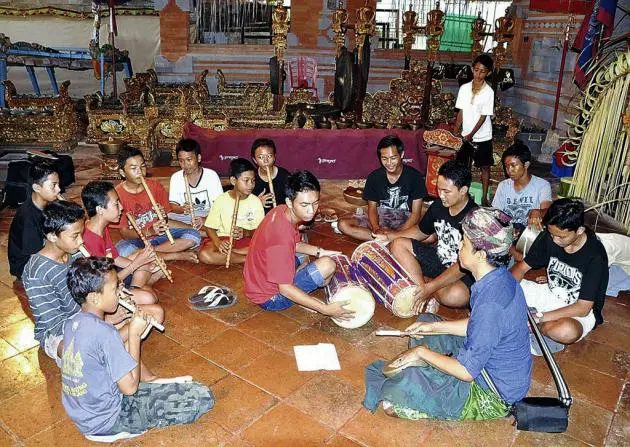
Entranced by the music on my own visit to the area, I peeked into the Balerung Stage theatre to see a group of about 20 boys aged from four to 12. Their teacher, 54-year-old Oka Dalem, led the rehearsal for an upcoming festival at a Hindu temple.
Two of the older boys set the tempo with their drums, while younger boys harmonised as they sang and played the flute. Smaller children followed along on metallophones and gongs placed on the floor.
I was surprised at how well they played together. My taxi driver, a man named Dewa, said: “They’ve been listening to gamelan music since birth. It’s deep in their bones.”
The theatre, the former villa of the Peliatan king, was open and breezy without windows or doors, offering a view of rice paddies and a forest of bodhi trees as the sounds of birds, cicadas and frogs mingled with the music.
“Rehearsals are free to encourage kids to bring their friends,” Oka said. “Anyone can play gamelan once you feel nature around you."
In the evening, about 20 villagers put on a concert. Children dressed in bright reds, golds and other colours danced as their families, dressed casually in T-shirts, watched with smiles.
Listening to the metallophones, flutes, drums and gongs, I felt as if I could see the twisted, tangled trunk of a bodhi tree.
Unlike the seven-note scale used in traditional Western music, gamelan uses a pentatonic, or five-note, scale to create several overlapping harmonies.
This unique sound enthralled musicians in the United States and Europe who tried to break free from the classic forms of Western music.
In a letter to an acquaintance, Britten described the culture of the area as wonderful, rich and noteworthy. A year after his visit, he released the ballet suite “The Prince of the Pagodas”, which incorporated many elements of gamelan in its score and was praised for its exotic sounds.
Britten featured many elements of gamelan in his works, and even adopted a pentatonic scale in the main melody of the opera “Death in Venice” during his later years. Critics praised Britten as having “digested” Eastern music into his own.
However, more than the music itself, I cannot help but think Britten was moved by how close the Balinese are to gamelan.
Britten was already a much sought-after composer, but because of his hectic schedule he was worried that he would lose his creativity.
Perhaps seeing how closely gamelan was woven into people’s lives and the carefree environment in which it was played helped to ease his troubled mind.
When I asked Oka about Britten, he promptly said, “Oh sure, lots of Western musicians loved gamelan”.
It was perhaps the essence of gamelan, as unshakeable as a bodhi tree, that the British composer was drawn to.
