
Days at the museum


Play
Treasures come to life at the Shaanxi History Museum in Xi'An
Hundreds of thousands of tourists make their way to Xi’An every year to marvel at the mausoleum of Qin Shi Huang and his Terracotta army. But with 3,100 years of history to its credit and having served several of the most important dynasties in Chinese history including Han, Xin, Tang and Ming, this ancient capital of China has much more to share with visitors than clay soldiers. If you really can’t afford the time to see them all while in Xi’an, a visit to the Shaanxi History Museum in the old town is a must.
Billed as one of China’s best museums and built in the Tang architectural style, it is home to artefacts unearthed in the province of Shaanxi. From the skulls of Dali people to Tang tri-coloured pottery, the museum can keep the small-time anthropologist busy for days. The more impatient, however, can get through three millennia in less than six hours.
The museum makes for a comprehensive and illuminating stroll through ancient Chang’an, as Xi’an was once known, and most exhibits include labels and explanations in English. The exhibitions are displayed in chronological and historical order varying from the ancient to imperial dynasties. To walk through the exhibitions is to walk into the history of China. Zhou, Qin, Han, Sui, Tang and the other dynasties simply glide past.
I start from the ground floor, which is dedicated to the bronze-ware made during the Shang and Zhou dynasties back in 1600-256 BC. Here, in the midst of an exhibit of bronze arrows and crossbows, one stern-looking tripod turns my head. “Wine Vessel”, says the label. With a dragon design and in a shape of boat, this wine vessel was made in the late Shang period, more than 3,000 years ago. I remember |seeing the warlord Cao Cao drinking from this kind of vessel in the movie “Romance of the Three Kingdoms”. It’s a serious wine vessel for a serious drinker. Full of Maotai liquor, it would render event the strongest soul leg-less in seconds.
Upstairs, one hall is devoted primarily to relics from the Han dynasty and includes a collection of about 40 terracotta figurines from the tomb of the first Han emperor Liu Bang.
Of course China’s history is very long and its students are likely to prefer one particular period to another. Some like Han, especially the dynasty’s glory days, a rich and inventive time where trade flourished with the Roman Empire through the Silk Road network. Others prefer the noble and sophisticated Tang, which marked the arrival of Buddhism to Xi’an and the rest of China.
I’m hooked on the Three Kingdoms dynasty. It was one of the hardest times to live in China after the great Han was torn apart. China was ruled and ransacked by different warlords for more than 100 years. It also fascinated the Chinese novelist Luo Guanzhong, who penned “Sanguo Yanyi” or “The Romance of the Three Kingdoms” and won millions of fans in and outside China for his epic tale of love, betrayal, hate and corruption.
So here, in China’s best museum, I fully expect to see Guan Yu’s long medieval pole arm or a sketch of Diaochan – one of China’s Four Great Beauties who lived during the days of Three Kingdoms. Unfortunately, all that’s left from the period doesn’t run to a pole arm or a portrait, nor even Cao Cao’s wine bowl. Apart from a half-broken pottery piece of a mysterious unicorn, there is little to depict this period of China’s history. People barely survived the hit-and-burn culture of the Three Kingdoms – let alone documents and artefacts.
The highlight of Shaanxi History Museum, however, is the exhibition of Tang dynasty, one of China’s golden ages that saw art, poetry and religion flourished for almost 300 years. Xuanzang, the Chinese monk, made a pilgrimage to India before returning Chang’an with the sacred books of Buddhism. It was also the first time three colours appeared on Chinese pottery. The museum devotes a large hall to these glory days with exhibits varying from pottery, gold, silver and jade works and mural paintings.
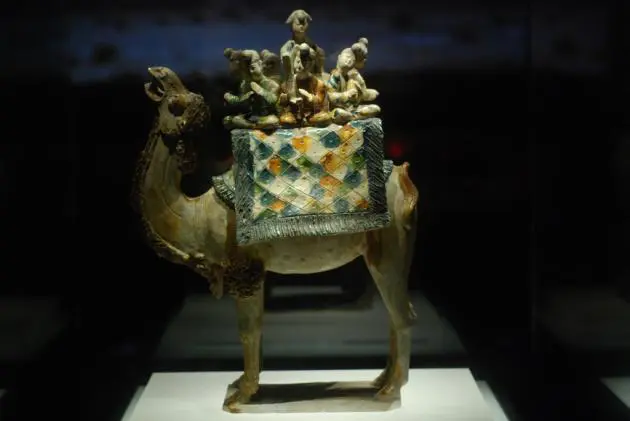
The collection of tri-coloured pottery is very impressive. A vast collection of horses, camels, female figurines, dragon-head mugs, mysterious tomb guardians and funny Chinese zodiac creatures has been unearthed from the villages around Shaanxi and is now on show here. Of these, the three-coloured camels win the greatest admiration.
“Tri-coloured camel carrying musicians on its back”, says the label. This is my favourite piece, depicting a camel standing firm, its head raised as if braying, and its back is loaded with seven carefree musicians. Clad in tunics with tight sleeves and have the typical top-knot hairstyle of ancient Chinese fashion, they faithfully emulate the images of men from China and Central Asia of that time as they trudged along the Silk Road to the tinkle of camel bells.
Other smaller sections are dedicated to the relics of Chinese treasures and artefacts. The Buddha from Zhongshan Grotto is a must-see for visitors interested in Buddhism in China.
Located at the foot of Zhongshan Mountain, these historic grottoes were built around the 4th century, and they house more than 10,000 Buddha images, both big and small. Chinese archaeologists chiselled off a small part of Zhongshan Grotto to showcase in the History Museum. And, since nothing is really “small” in China, the Buddha of Zhongshan occupies one side of the side of exhibition hall.
With more than 375,000 artefacts to observe, budding anthropologists might need at least a week at Shaanxi History Museum. I’ve never been a major fan of museums of any kind, but I would have been more than happy to skip lunch for a full day at the museum.
IF YOU GO
<< Shaanxi History Museum is open Tuesday to Sunday from 8.30am to 6pm. Admission is |free but the number of visitors is limited to 4,000 a day. Get there early and expect to queue for at least 30 minutes. Make sure you bring your passport to claim your free ticket.
<< AirAsia (www.AirAsia.com) flies daily between Xi’an and Bangkok.
