
The proof's in the purin


Play
Hot spring resorts treat visitors to an interesting variety of custard puddings
An old folk tale says that visitors to a hot spring resort come leaning on canes and walk home forgetting they ever had them.
That is exactly how the Tsuetate Onsen hot spring got its name – “Tsue” means cane, while “tate” means standing.
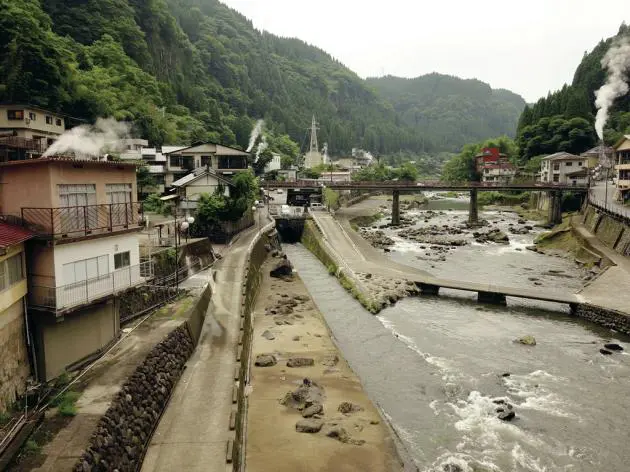
Tsuetate Onsen is located in a mountain town with a population of about 300. It is a common sight to see steam rising from the hot spring, and there are even public areas where you can steam vegetables and other foods using hot spring vapours.
“There’s no particular charm to this hot spring, but recently, tourists have been enjoying various kinds of purin (custard pudding),” says Sawako Takasaki, the proprietor of the inn where I’m staying.
I can’t quite make the association between hot spring and purin and my confusion shows on my face.
“You can see places where you can use hot spring steam. Locals steam vegetables and eggs there every day. For that reason, when we were discussing what we should make to attract tourists, we naturally came up with purin,” explains Takasaki patiently.
Naturally.
Using the steam and thick, locally produced Jersey cattle milk, a group of okami, women who run local inns, are quickly able to create 20 kinds of purin.
Curious about this phenomenon, I visit another inn after seeing a signboard advertising its “Tsuetate purin”.
“I want to try the purin on the signboard,” I tell the innkeeper.
“Coming right up,” he say, adding “We also offer a single-day course in which you can bathe in a hot spring and eat an original purin.”
Each inn takes pride in its original purin, saying theirs is the best in the resort town.
Visiting a number of inns in the area, I gobble up a variety of purin in rapid succession – bittersweet purin, hojicha (roasted green tea) purin and even a fried purin.
While out on my “purin tour”, I come across a group on a Michikusa Annai tour of back alleys that locals call “Sedoya”.
The tour guide, Takahisa Kawatsu, 47, is part of an eight-member volunteer group called Team Sedoya.
“It’s not interesting to only walk through the main streets in a hot spring resort town. The past and present are mixed together in the back alleys,” Kawatsu says.
Just by stepping off the main street and into the back alleys, the scenery totally changes. Small streets spread out like a maze in every direction, with some so narrow that only one person can pass through at a time.
In the back alleys, there is a rarely used recreation hall, as well as various izakaya pubs that show they took down the curtains at the front gates and closed down.
Some back alleys are sometimes used as an outdoor gallery for old photos, and landscape paintings of the hot spring hang on bare cement walls. A cafe capturing the atmosphere of the time, which seems to act as a hideaway, is also open for business.
The increasing number of tourists to the back alleys has led to the revitalisation of the Sedoya area.
After grabbing dinner – minus purin – at the inn, I ride a free shuttle bus to a firefly viewing site. The bus driver tells me that the destination is kept secret to preserve the environment of the area.
At the viewing area, countless fireflies surround us under the starry night. Were it not for the blinking lights of the fireflies, I’m not sure I’d be able to distinguish them from the stars overhead.
“So how did you feel about Tsuetate?” asks another of the people on the tour.
“Compared with Tokyo, time flows slowly,” I answer, smiling as I continue “and after taking a bath at the inn, I'll be able to walk tomorrow ‘without a cane’.”
If you go
_ For more information, call the Tsuetate Onsen tourist association at (0967) 48-0206 or the Tsuetate tourist inns cooperative at (0967) 48-0506.
