
Keeping up with the nomads


Play
Warm hospitality awaits the visitor to the Mongolian hinterland
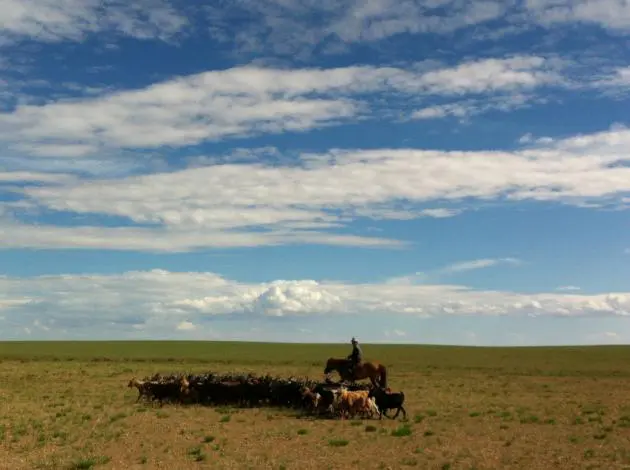
A vast expanse of blue sky spread like a blanket over immense grasslands dotted with white tent-like structures and a smattering of goats, sheep, cows and horses is the image that flashes into my mind when I think of Mongolia in the summer. With the sun shining so brightly and temperatures touching on 30 degrees Celsius, it’s sometimes hard to fathom the freezing conditions so typical of a Mongolian winter.
I’m part of a group travelling in this massive landlocked country that shares its borders with Russia to the north and China to the south at the invitation of the World Society for the Protection of Animals (WSPA). Our destination is Dundgovi province, where we will observe how the local population is managing to cope following the abnormally bitter cold in the winter of 2009-10 that cost their livestock some 16 million animals. Here, the differences between day and night are more pronounced that in the capital Ulaanbator 250 kilometres to the north, dropping to a chilly 12C after dark. The locals, however, probably find it warm: in winter, the temperature can easily fall to minus 50C.
It takes us almost seven hours to travel to Dundgovi and it’s only as our four-wheel drive vehicle crosses the line from town to countryside that we realise that the snake-like earth brown line we’d seen from the air is in fact the road.
Unlike the highways that link the provinces to the capital in most other countries, the road to Dundgovi is unpaved and unlit. No markers point the way so drivers must either be very familiar with the route or have GPS in their vehicles. Pot-holed tracks criss-cross the land, most of them used by rural Mongolians as they search for new locations to set up camp.
In a country where the government owns most of the land and the grasslands provide the vital food for their livestock, these nomadic families are often forced to relocate five to six times a year.
Staring out of the windows, we spot goats, sheep, horses, cows and even some camels munching on the ankle-level grass that carpets the tree-less landscape. Gas stations are non-existent and when nature calls, we scurry off into higher terrain for a little privacy.
Soon we arrive at our destination, a tented camp in the middle of nowehere. Drinking water is scarce so the locals slake their thirst with goat milk, vodka or “airag”, the local spirit made of fermented horse milk that’s traditionally served to visitors.
Families in rural Mongolia remain as large and extended as they were when Genghis Khan founded the Mongol empire back in 1206 so we are not surprised to be greeted at the first ger by a family whose members range in age from three to 80 plus.
After serving us a welcome snack of wafers and vodka, our host Ts Erdene-Ochir proudly shows us his snuff box. These beautifully carved containers, usually made of jade or ivory, are passed on from fathers to sons, he explains. “I wouldn’t sell this even if you offered me US$300,000,” says the 61-year-old with a smile.
Lunch is served in another ger, the home of D Hayanhyrvaa, and features typical Mongolian fare – boiled mutton and big bowl of goat’s cheese. In the countryside a sheep is killed only for special occasions, like the New Year, and one pot is enough to feed a family for the whole month. The parts, offal included, are put in a big pot then cooked with little salt on a stove fired by animal dung inside the ger. It’s surprisingly tasty and smells great. The trick, we’re told, lies with black river stones. Pre-heated stones, put into the bowl during the cooking process, help absorb any bad odours.
Our visit apparently also counts as a special occasion and the family is delighted with the opportunity to eat mutton. We look on with pleasure as one small girl happily devours goat cheese and mutton along with guests for a full hour then, her appetite sated, curls up and falls asleep in front of the food table.
The next ger is shared by two young families with a total of eight members. “How on earth do they manage to find a romantic moment?” murmurs one of our team.
Despite the tough conditions, many Mongolian people enjoy the freedom of the fields. Saiutuya, who works most of the year teaching biology and chemistry, spends the summer on the steppes. As she busies herself milking the goats, she tells us she hopes to retire from academic life in two years and become a full-time animal breeder.
“But for the disaster (which killed most of his animals), I could have owned a helicopter now,” laments her husband, L Sujirjin, 52.
Trucks, four-wheel jeeps and motorcycles surround most of the gers and all are equipped with a satellite dish, solar panels and a satellite phone. A humidity gauge inside the ger tells the nomads when it is time to move.
The toilets are outside and just like the ones in the city are dark and dank, fabricated of two pieces of wood placed on top of deep holes. The strong smell makes us long for the road where nature’s call can be answered in the fresh air.
But for all the inconveniences, we are charmed by the country and its people and as we wave farewell to our kind hosts, our thoughts are with them for a fast recovery and more clement winters.
If you go
_ Most travellers arrive in Mongolia through Chinggis Khaan International Airport, 18 kilometres from Ulaanbaatar. Mongolia Airlines and Air China operate direct flights from/to Ulanbaatar and Beijing.
_ Korean Air also flies daily from Seoul to Ulaanbaatar. Trans-Mongolian train runs once a week from China’s capital to Mongolia.
_ The summer is the best time to visit, with the day time temperature averaging 21 degrees Celsius.
