
Sculpted by Mother Nature


Play
From caves to underground cities to fairy chimneys, Cappadocia in central Turkey has been carved by erosion
With its extraordinary ranges of volanic peaks and conical rock structures, the Cappadocia region in the centre of Turkey combines a lunar landscape with scenery that’s straight from the pages of children’s fairy tales. The local historians don’t mention anything about Smurf villages, though. According to them, this area has been home to several civilisations since the Hittites established an empire here in the late Bronze Age.
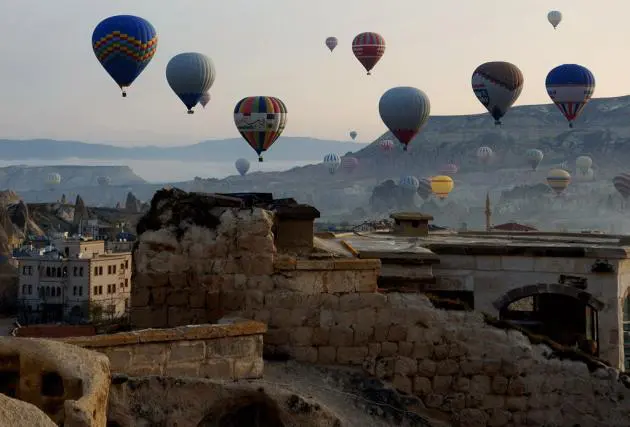
I’m staying in Goreme, a small town of fairy chimneys and cave dwellers. Many beautiful cave hotels are concentrated in the town centre and despite its tiny size, it offers everything from restaurants, ATMs and shops to departure points for buses, cars and hot-air balloons.
Standing on the balcony of Kelebek Hotel, I can see the fairy chimneys all around. I can even walk inside one, put my luggage on the ground, and sleep there like a local hermit. Many hotels, the Kelebek among them, offer similar rooms carved into odd fairy chimneys. It’s such a weird wonderland that I wouldn’t be surprised to see an alien learning out of an UFO while a young Smurf waved at him from a chimney window.
The name Cappadocia literally means “the land of beautiful horses” in Persian but I spot only one during my stay. Spanning Cappadocia are plateaux, valleys, gorges and, of course, fairy chimneys. The topography has created this landscape over hundreds of thousands of years as the soft lava covering known as tuff has been eroded by weather, wind and water.
Rock churches, as many as 200 of them, are scattered around Goreme, which was once the main religious community of Cappadocia, but only 11 of them are located within the present-day Goreme Open Air Museum. Located just 1.5 kilometres from Goreme town, the museum is the best place to see earliest examples of Byzantine churches from the 10th, 11th and 12th centuries.
The museum is in fact a vast monastic complex with individual dining halls, kitchens, living and sleeping rooms, storage sections, churches as well as graves. The walls are adorned with fascinating frescoes drawn in red ochre lines on the rock and feature a variety of religious figures painted by the monks.
Not many things can get me up before sunrise, but the image of hundreds of hot-air balloons above the fairy chimneys is too good to pass up. The sight is stunning enough to tempt me into booking a balloon trip for the next morning.
Besides the cave-pocked Rock Castle of Uchisar, five kilometres outside Goreme, and fantastic landscape of towns and scenic valleys visible above the ground, Cappadocia is home to more than 100 hidden refuges concealed underneath.
Some of the large multi-level underground cities in Cappadocia like Derinkuyu, the deepest, and Kaymakli, the widest, could accommodate more than 4,000 inhabitants. Hittite artefacts have been found around the caves, which has led archaeologists to surmise that they were excavated in Hittite times. These underground cities expanded over the centuries as early Christians tried to escape foreign armies, especially the marauding Roman and Arab soldiers. Heavy keystone doors were built to protect them as well as deep wells, food storage, ventilation shafts, livestock pens, oil and wine presses and churches. Each chamber is linked by narrow gentle slopes and stairs, descending to almost 100 metres beneath the earth's surface. The passageway is about 170cm tall, making it easy to walk straight.
I decide to take a day trip from Goreme to Ihlara Valley and as we approach Ihlara, I catch a glimpse of the snow-capped Mount Hasan. A canyon with a long lush gorge cut into volcanic rock, the geography here is stunning. The green valley is surrounded by steep cliffs more than 100 metres high, filled with fairy chimneys in different shapes and colours, and crossed by the Melendiz stream.
As the valley contains a plentiful supply of water and hidden places, it was the settlement chosen by the first Christians in their escape from Roman soldiers. There are hundreds of old churches in the volcanic rock caves here including Agacalti Kilise (Church under the Tree) with its fresco painted harmoniously in red, green and yellow.
The journey back to Goreme includes a stop at the rock monastery of Selime. Built in the 13th century, it’s a big monastic complex consisting of a cathedral, kitchen, living quarters, storage areas, and a stable. The view from the top of the monastery is superb. A tour guide tells me that a scene of “Star Wars” was filmed in this area though others argue this is merely a rumour. In fact, the film credits Tunisia, not Turkey.
As I gaze again around the magical scenery, I remember how a Turkish friend always boasted about her country – its sun, sea, snow-capped mountains and civilisations. Now I realise what she meant though I have my doubts that Luke Skywalker ever lived here.
Top 10 things to do in Cappadocia
1. Visit Goreme Open Air Museum
2.Explore the underground cities
3. Hike the valleys at sunset
4. Go up in a hot-air balloon
5. Walk the Ihlara Gorge
6. Enjoy Cappadocia wine
7. Stay in a cave hotel
8. Climb Uchisar Castle
9. Bike riding
10.Pottery making in Avanos
If you go
_ Cappadocia is an area in Turkey’s Central Anatolia area and best known for its unique moon-like landscape, underground cities, cave churches and houses carved in the rocks. Turkish Airlines operates several direct (nonstop) flights from Istanbul Ataturk Airport (IST) to Kayseri Erkilet Airport. The airline also operates direct flights between Bangkok and Istanbul.
