
The spirits of Spreepark


Play
Tourists take a trip back in time to a Communist-era amusement park in Berlin
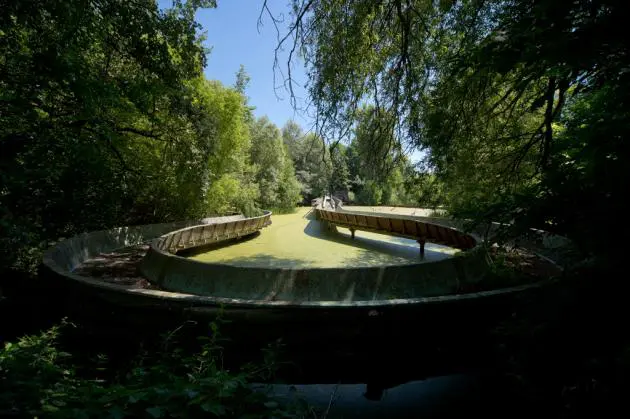
The yellow boats of the log-flume ride are docked inside their amusement-park station, looking as if the last guests have just disembarked. But in fact, the last paying visitors left almost 12 years ago.
Correspondingly thick is the layer of dust on the floors. The windowpane of the ticket booth has been smashed in. The pond under the channels used for the water ride is topped by a layer of green algal scum.
The water ride is one of nine rides left in Berlin’s Spreepark leisure complex. Like all the other rides, it has been standing dormant since November 2001 – and has established itself as an oddball tourist attraction.
For four years now Christopher Flade, with the owners’ permission, has been offering guided tours of the park on weekends.
On a recent Sunday afternoon around 50 people – both Berliners and international tourists – showed up, not wanting to miss this offbeat attraction in the Plaenterwald area of the eastern part of Berlin.
For many, this is a trip back into the past: Half the visitors knew the park back in the days of the former East Germany.
The Spreepark was inaugurated on October 4, 1969 to mark the 20th anniversary of the German Democratic Republic. The “people’s enterprise Kulturpark” was the country’s only permanent amusement park.
“You could go on rides here that didn’t exist anywhere else, because they came from the West,” Flade tells the group. He’s wearing a red vest that is a bit tight for him, but it is an authentic one that Spreepark personnel once wore – and the last such vest remaining.
After German reunification in the wake of the fall of the Berlin Wall in November 1989, the Spreepark fell under the jurisdiction of Berlin city administration, which aimed at the time to set up a “recreation park along Western lines”.
It began looking for a private investor. The concession was awarded to Spreepark GmbH, a company belonging to businesswoman Pia Witte.
After the reopening, not many of the attractions from the old East German days were left. Besides its trademark ferris wheel, all that’s left are the entrance booths – and the toilets.
Witte invested around 40 million Deutschmarks (US$26 million dollars today) in the first few years, installing a swinging boat, a small rollercoaster, and a bigger looping-rail ride.
The former concrete grounds where the amusement booths were gave way to lakes and grass-covered spaces.
But after all the renovation work, the adjoining Plaenterwald was declared a nature protection zone, with the result that all of a sudden, the parking lots could no longer be used. Visitor numbers began dropping steadily, and in 2001 Witte shut the place down.
Spreepark GmbH declared insolvency, and since then, no new investors have been found.
The park has now more or less been left to itself. Nature is reconquering the space, covering it with vegetation, so that now a favourite view of visitors is of the ferris wheel and a bridge surrounded by woods.
“I have no idea why this is,” comments Flade. All the time, TV and film producers are calling, wanting to use the bridge as a setting for some film scene.
And it has gained a reputation as a favourite spot for filming other types of scenery – such as scantily-clad young ladies romping amid the park’s giant model dinosaurs, including T-Rex, part of whose tail is missing.
“Playboy magazine has become a regular guest here,” Flade explains.
Visitors aren’t permitted to visit the area without a guide, but not everyone heeds this.
“Some days, the security guards apprehend up to 500 trespassers,” Flade says. Those who haven’t been caught have carried out some heavy-duty vandalism, he said, telling about the night about the raid on the dodgem-car ride.
“No, it wasn’t just one bumper car that vanished – it was the entire ride,” Flade said.
Sometimes the security guards show leniency towards the culprits.
For example, they apprehended a 90-year-old woman who got stuck sitting in the ferris wheel.
“It used to be so nice here,” she told the guards. “I just wanted to do it one more time.”
