
Wind, rain and sand in your face


Play
The Dutch island of Vlieland still welcomes visitors in autumn
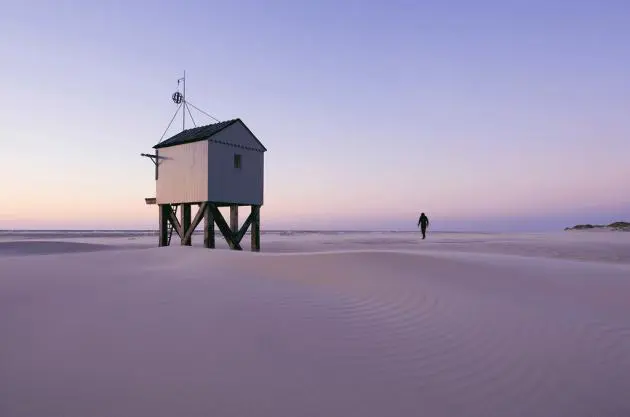
It could be the Sahara: as far as you can see, nothing but blindingly white sand and a deep blue sky. But the temperatures don’t fit the illusion.
Huddled closely together and wrapped in warm clothes some families are riding in the back of the Vliehors Express, a military truck painted a bright yellow. Its giant wheels are churning through the sand.
Welcome to the island of Vlieland in the shallow tidelands off the Dutch coast.
It’s not a place that global tourists visit much. Arriving here in autumn is an even tougher sell. Every ray of sunshine feels like a gift. But it is such an extraordinary spot that you accept the poor weather as the price of a special experience.
Vliehors is claimed to be Europe’s single biggest sand surface, and one can readily believe it.
The view from the Express is one like a giant abstract painting: the upper half blue, the lower half yellow. Otherwise, absolutely nothing.
On second glance, however, there is something. Here and there are the wrecks of military tanks, lending a surreal element to the scene. Vliehors is, for the most part, an off-limits military zone, a place where the Dutch Royal Air Force practises bombing raids.
The first outpost of civilisation is a former postal station. From here you ride a bicycle into town. This means a 10-kilometre ride and it can be a long one if you are suddenly hit by a rain shower.
Most of the route leads through a dark pine forest that provides some protection. Only rarely does a car pass you. Tourists may not bring their cars to the island, and Vlieland itself has only about 1,000 local residents.
There is just a single town on the island, Oost-Vlieland. There was once another, West-Vlieland, but it was swallowed up by the sea.
The tree-lined Dorpsstraat (village street) of Oost-Vlieland feels like the middle point of the island. Here, you can take a seat, stare at the flames in a fireplace, and try to imagine what it would be like to spend your entire life on Vlieland.
Amid the flat scenery there is one “mountain”– the Vuurboets sand dune, 36 metres high. Atop this is an 18-metre-tall lighthouse. From up there you feel you’re on top of the world.
Since time immemorial the Vlielanders have had a broad horizon. For many generations they were forced to go to sea, for want of any other means to make a living. One prominent Vlielander was Willem de Vlamingh, who explored the Australian coastline 70 years before Captain James Cook. Most Vlielanders, however, were whale hunters.
From atop the Vuurboets dune you look out over the shallow Wadden Sea, you might spot an old sailboat, a flat-bottomed vessel, gliding into the harbour. With its large wooden stabilisers jutting out on both sides, it looks like some antediluvial fish with giant gills.
Further out, on a sand bank between Vlieland and Terschelling, lies the wreck of the Lutine, a frigate of the Royal Navy that went down in 1799 with a huge treasure of gold on board.
The value of it today is put at 50 million euros (Bt2 billion). But so far, nobody has managed to salvage it. The sea has only surrendered the ship’s bell, which now hangs at the headquarters of Lloyd’s of London.
In bygone times, the Lloyd’s bell would be rung whenever a ship sank.
Vlieland’s greatest attraction remains the beach. Naturally autumn is no time to lie down on the sand, nor is it a place for a stroll, because this term implies proceeding at a leisurely, relaxed pace.
The wind is whistling through the dune grasses and whipping up the sand in your face, forcing you to squint your eyes or look downward.
You don’t hear anything except the wind and the waves breaking offshore.
In the end, you will wind up taking the ferry back to Harlingen. You don’t want to fall prey to feeling stranded out at sea. But then something peculiar happens. Once the island vanishes on the horizon, one gets a strange feeling, one of homesickness for the place.
