
Prayers for the dead


Play
The Kui people of Si Sa Ket prepare to feed the spirits of their hungry ancestors
Most cultures around the world celebrate the dead. Mexico is one of the most famous with its Dia de Muertos, where family and friends gather to pray for and remember friends and family members who have died. Taiwan has its famed ghost day and Halloween, though now a mainly commercial festival, stems from a belief that the deceased would come back to life.
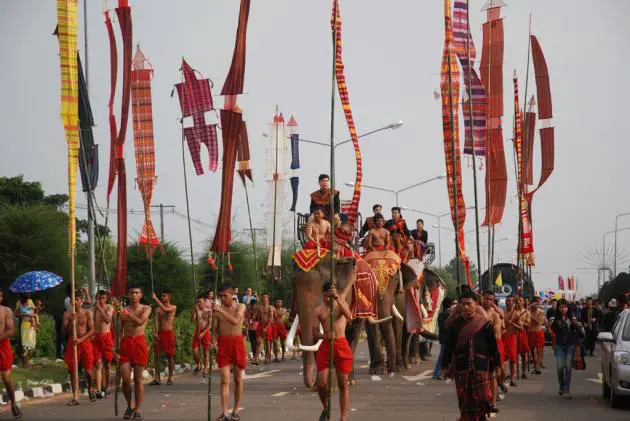
The Khmer-speaking communities of Si Sa Ket’s Khukhan district also celebrate their ancestors with the Saen Donta Festival on October 1 and 2.
This isn’t however George Romero’s “Day of the Dead”, where troops of dead bodies roam around the small town, but instead a happy time with a feast of colourful costumes, lots of food and drink, plus parades and floats.
As in Mexico, the festival focuses on bringing together family and friends to pray for family members who have died and Saen Donta is probably best described as a reunion party for the living and the dead.
“Sons, daughters, in-laws, grandchildren – all family members will return home,” notes an 80-something grandmother, as she starts to explain the notion of this reunion of family member for the Saen Donta Festival. “The members (the one who are alive, of course) help to prepare the food and offer it to the dead ones.”
As part of the festival, the locals prepare a feast to welcome the departed members as well as appease the hungry ghosts.
“We, the Kui people, have a strong commitment to making offerings during the Saen Donta Festival," adds Suwan, an elderly member of the Khmer-speaking people who are scattered around Si Sa Ket, Surin, Buri Ram and the southern part of Thailand’s Northeast. “Otherwise, the hungry spirits will curse us.”
The Saen Donta Festival lasts for two days. On October 1, the relatives will bring a tray of offerings – including roasted chicken, pork, khao tom and dessert – to the family at the top of their lineage. Names of every departed soul will be called out loud imploring them to take the offering. Not a single name is to be missed or the living could find themselves in trouble and cursed by a deceased ancestor.
On the second day, the local people dressed in their unique tribal costumes, carry baskets full of roasted chicken, barbecued fish, fried meats, mainly pork, vegetables, cigarettes and jars of rice wine before gathering at the public park in front of the town hall. Apparently, this impressive feast should keep the hungry ghosts happy for a few days.
The festival is a real treat for hungry travellers too and you’ll catch sight of several Saen Donta “groupies” convening along the main road.
As you’re waiting for the new floats to arrive, the locals offer the onlookers some steamed rice buns, bananas and a sort of rice cake. Gulping down the throat-burning, home-made rice wine, you’ll also pick up a few Khmer words and earn some good-natured laughter.
The rite ends as the last incense burns down to ashes and the villagers head home with baskets full of roasted chicken for dinner.
If you go
_ Si Sa Ket is about 500 kilometres to Bangkok’s East. Trains depart Bangkok's Hua Lamphong station daily as do air-conditioned buses.
_ The nearest airport is in Ubon Ratchathani – to which Thai Airways, Nok Air and AirAsia operate daily flights from Bangkok.
