
Shopping on the rails


Play
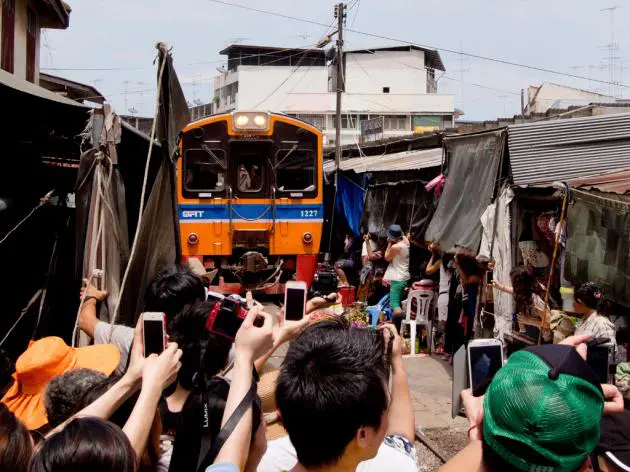
Getting real close to a train in Thailand's "umbrella pulldown market"
Vegetables, fruit, fish, meat, soups, juices and cooked treats, plus a lot of pushing, shoving, shouting and cackling hens: on the marketplace of Mae Klong, 70 kilometres south-west of Bangkok, you can feel life pulsating.
But eight times a day there is one unique spectacle: the booth operators must quickly pack up all their wares, because a railroad track runs right through the market.
When the front car of the rail unit announces its imminent arrival with a deafening blast of its horn, the traders routinely pull their goods out of the way and the train then glides past them, just centimetres away from the fish and vegetables and other goods.
The Talad Rom Hoop market, which translates roughly as the “umbrella-pulldown market”, is the name of this tourist attraction.
On the right, a woman is stacking a pyramid of juicy green and yellow mangoes. Come, try, she says in gestures to the visitor, holding out bits of fruit impaled on toothpicks.
Next to her, two young girls are offering purple-coloured pitaya fruit, which is also known as dragonfruit. The woman next to them has made a spiral of some giant shrimps atop a tin tray. Everywhere you look, people are examining, touching, bargaining and weighing the wares on offer.
The market is long and narrow. The booths are squeezed close together, behind them the walls of buildings, in front of them the railroad tracks. When a siren sounds to warn of a train approaching, the booth operators jump to their feet.
“Get back!” shouts a market guard, before giving a sharp blast on his whistle.
With practiced hands the vendors gather up their goods atop rollers and pull them back out of the way. The woman grabs her tray of shrimp while her father tugs sharply at some ropes to pull the tattered awning back.
The train's whistle blasts a warning, three times, and then hundreds of tons of steel on wheels rumble through the narrow alleyway toward the nearby railway station.
It's not travelling fast, but being up so close to a 4-metre-tall steel monster creeping past you can be terrifying.
The whistle, which out in a broad expanse of the landscape might stir up some deep longing of wanderlust, can penetrate down to your bones when the train is just inches away.
Scarcely has the train passed, when the alley quickly fills up once again. The awnings are extended, the umbrellas are unfolded, the goods are rolled forward, and business resumes.
It all begs the question: why a market here, of all places?
And the simple answer from a woman selling fish, as translated by a Thai local, goes like this: “And why not? My grandparents were already here, selling things”. The rail line has been in existence for more than 100 years now, and the market probably as well.
Someone else suggests there may be another reason. The vendors along the rail tracks don't have to pay any market fees. The rail company and farmers reached an arrangement and nobody gets upset about the Talad Room Hoop market.
Nobody has ever heard of an accident.
And, on the route between Ban Laem and Mae Klong, tourists often ride the train simply to be able to take pictures of the spectacle outside their windows.
If you go
_ Trains leave daily from Wongwian Yai’s railway station to Maha Chai marketplace in Samut Sakhon province. (There is no train to Maha Chai at Hua Lamphong railway station). Once you arrive at Maha Chai, you have to take a ferry across the river to Tha Chalorm marketplace – where Ban Laem – Mae Klong trains leave at 7.30am, 10.10am, 1.30pm and 4.40pm.
_ Wongwian Yai railway station is about a 10-minute walk from Wongwian Yai BTS station.
