
Our boys in the trenches


Play
An interactive WW1 gallery is the highlight of London's newly re-opened Imperial War Museum
The Imperial War Museum began collecting items for an exhibition on World War I even before the conflict had ended.
Britain’s War Cabinet decided in 1917 to set up the museum, and its staff immediately asked the public to send in potential exhibits, with the intention of commemorating the horrors and hardships of the war as experienced by all sections of society, civilian and military.
The response was overwhelming.
“We have more than 32,000 three-dimensional objects, up to 750,000 photographs, and 10,000 sets of diaries and private papers,” enthuses James Taylor, head of content for the museum’s new First World War Galleries.
That made choosing exhibits extremely hard. The museum is displaying just 1,300 of the items in a remarkable new exhibition that makes full use of interactive technology, film and sound.
The highlight is perhaps a reconstructed trench, complete with periscopes and the sound of gas-attack warnings, artillery fire and bombs going off. The roar of a Sopwith Camel fighter plane – suspended above – can also be heard, while an enormous Mark V tank appears about to cross the trench.
A lot of effort has been put into making the exhibits “speak” to visitors. The aim was to “give a voice to the people who created them, used them or cared for them,” says the museum's director general, Diana Lees.
One poignant exhibit is a concerned letter sent from Emily Chitticks to her fiance, Private William Martin, at the front line on March 25, 1917. She did not know that he had already been killed by a sniper the day before.
She never married, “as my heart and lover are buried in his grave in France”. She died in 1974.
“We can give any number of statistics about the breadth of the suffering, but that tells me about the depth of it as well, and this happens to 750,000 British families,” Taylor says.
There’s also a jacket with a sleeve missing where it had to be cut away to save the owner's arm; sardonic street signs from trenches, such as “Hell Fire Corner”; and pieces of the planes in which German ace Manfred von Richthofen and Britain's James McCudden crashed and died.
One of the most extraordinary exhibits is the “camouflage tree” one of only two remaining from the 45 made by the British during the war.
An artist would be sent into No-Man’s Land to sketch a picture of a dead, leafless tree, the only upright objects still remaining there.
The picture would then be used to reconstruct the tree out of steel, and, under cover of darkness, troops would replace the real tree with the fake. Soldiers could then climb inside to observe the German lines.
While the exhibition is primarily concerned with the British experience, there is also lots about the millions of fighting troops from the Empire – from Australia, Canada, India, New Zealand and South Africa.
Photographs show wounded Indian soldiers being treated at the Royal Pavilion in Brighton, where it was hoped they would feel at home because of oriental-inspired architecture.
Set aside the tragedy, there is also humour. One Australian soldier had a nibble of his notoriously hard army biscuit before deciding to put it to better use as a postcard with the message: “A Happy Xmas from Dardanelles 1915”.
Although the museum originally set out to document World War I, it continued to collect exhibits from the conflicts Britain has since been involved in – including World War II, the Korean War and those in Cyprus, the Falklands, Iraq and Afghanistan.
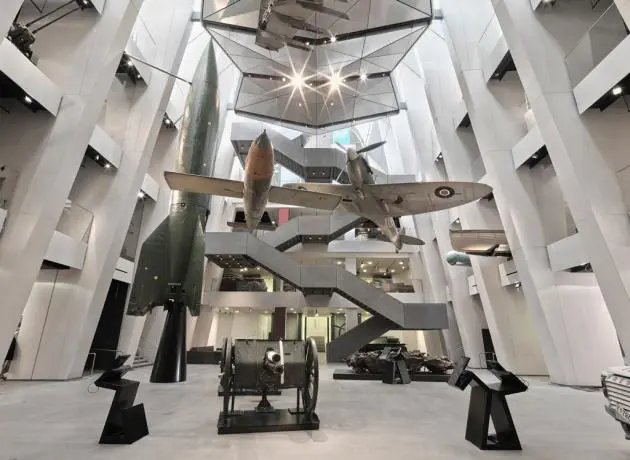
The newly designed atrium, an enormous space at the heart of the museum, contains a World War II era British Spitfire plane and a German V2 rocket, as well as the wreck of car mangled in a 2007 Iraqi street bombing, and a Reuters Land Rover hit by rocket fire in the Gaza Strip.
Over the decades, the museum has faced criticism about the relevance of its name and its implied pretensions.
But Lees defends it, saying: “The ‘Imperial’ bit is now much more about being a historical fact than it is a political agenda.
“We’ve had some quite interesting suggestions like changing it to ‘Battle Space’.
“But we’ve decided that as we’re so well known as the Imperial War Museum, we’ll stick with that.”
