
Magic and surprises in old Sehwan


Play
A visit to the undisputed throne of Lal Shahbaz Qalandar
Sehwan, Pakistan, can be the perfect weekend getaway for a Karachi walla, especially in winters. Or let’s just say one should go there only in winters – I can say that, because I went in the summers and it was too hot.
The road from Hyderabad is well maintained and traffic seems to be well in order. The fields of sunflowers by the highway make the route even more scenic.
It takes around an hour and a half to reach Sehwan from Hyderabad, covering a distance of approximately 150 kilometres.
Sehwan – or Seevistan, as it was called centuries ago – was an important stronghold for regional plenipotentiary and traders flocked to its serai (inns with a central court where caravans could pause) amid their journeys to faraway places. But now most of that fortune has withered away.
Trade routes have shifted and the seat of power has moved to new urban centres and in between much of the older charm has dwindled. Now when you enter the city a sense of sadness hits you.
Amid the blazing heat of the sun, vehicles, carts and people fighting for their space on the dusty roads, you can see villagers from nearby areas getting in and out of a Suzuki pickup, a popular means of transport in the area.
There is very little plantation and high salinity has eaten away the paint on aesthetically unpleasant modern construction. The recent development is erratic and slogans of different political parties and posters of their leaders only add to the confusion.
Various politicians lay their claims to the Sehwan of today. Many have done so over the centuries, but it remains associated with one dervish whose legend seems to grow with every passing day – Lal Shahbaz Qalandar. His stature dwarfs that of everyone else here and his shrine dwarfs every other structure. His claim to the throne of Sehwan remains unchallenged even today.
Syed Mohammad Usman Marwandi, popularly known as Lal Shahbaz Qalandar, was a 12th-century Sufi who was born in Marwand in present-day Afghanistan. He travelled to Medina, Karbala and Mashhad to seek spiritual guidance and, according to popular legend, was instructed to settle in the subcontinent to spread the word of God there.
He was a contemporary of Syed Jalal-ud-din Bukhari of Uch Sharif. He settled in Sehwan after travelling extensively in present-day Punjab, Sindh and Ajmer and finally settled in Sehwan.
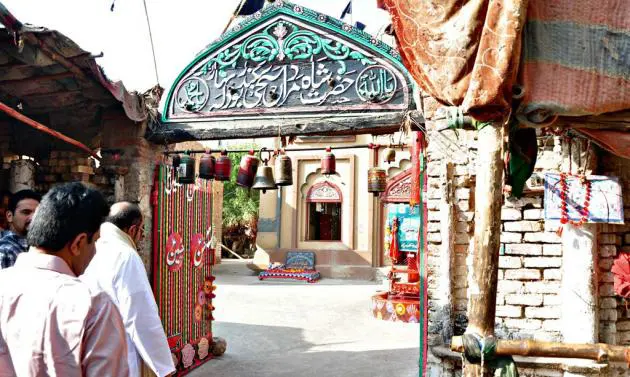
His favourite disciple was Bodla Bahaar, whose shrine is near the old fortress and is definitely worth a visit. You can find a group of singers there celebrating the legend of Lal Shahbaz and Bodla Bahaar. People told us the famous story of Bodla Bahaar rising from death and turning the fortress upside down.
The story goes that the ruler of Sehwan grew fearsome of the popularity of Lal Shahbaz and Bodla Bahaar and ordered Bodla Bahaar cut into pieces. The soldiers obeyed and scattered the pieces.
When Lal Shahbaz heard of the incident, he called the name of his favourite disciple and his chopped-up body magically reassembled to answer his master’s call. When the ruler still did not heed to Lal Shahbaz’s preaching, Bodla Bahaar turned the whole fortress upside down. People claim that the ruins still show an upside-down settlement.
Walk down the narrow alleys from Bodla Bahaar to Lal Shahbaz’s shrine. It is full of shops selling everything from flowers to chaddars to plastic toys and Chinese electronics. There’s never a dull moment there.
People sipping tea, smoking pipes, sharing marijuana joints, shopping and lighting clay diyas (lamps) throughout the night.
The most striking phenomenon is the presence of women. They are everywhere, either just shopping or enjoying music, some even dancing to the shrine’s dhamaal. They are free from social stigmas that follow them elsewhere.
