
Passion for the pink city


Play
Tourists and lovers flock to Jaipur during the cool season
Sleepy-eyed tourists queue up early in the morning to board a deluxe train at the New Delhi Railway Station to Jaipur, an important part of northwest India’s celebrated Golden Triangle tourist circuit, comprising Delhi, Jaipur and Agra.
Jaipur is the capital of the country’s largest and ostensibly the most colourful state, Rajasthan, meaning “the land of kings”. As one of the leading tourist destinations in India, it attracts more than 30 million visitors annually, including 1.5 million foreigners.
Famously known as the Pink City due to its extensive use of pink sandstone, Jaipur is also referred to as the Paris of India for its royal splendour and beauty. It charms with its magnificent palaces, lavish mansions and rich cultural life.
After around five hours by train from New Delhi – a convenient journey that takes in views of vast plains and settlements over some 250 kilometres – the scene goes from interesting to spectacular. Pedestrians, cycle rickshaws, bullocks, camel carts and elephants jostle for space on the busy roads of Jaipur while Rajasthani men and women dressed in eye-catching multi-hued costumes walk alongside.
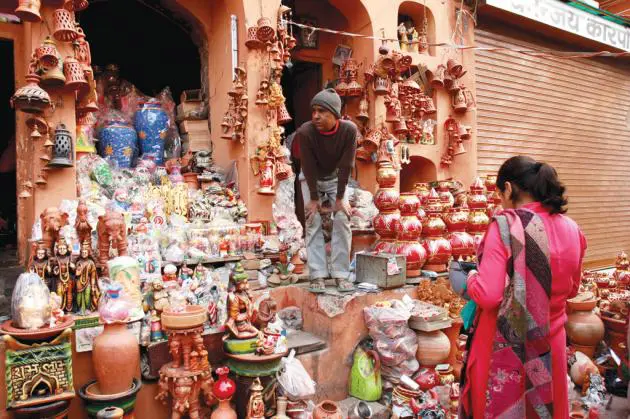
To a visitor that has just witnessed the relative order of Delhi, the noise and hectic activity in Jaipur is fascinating. The bustling crowds, especially in the older part of the town like the Johari Bazaar with its pink-coloured shops lining both sides of the long road, create an old-world charm that enchants.
“Jaipur is the gateway to India’s largest state by area and has a rich royal legacy. The opulent palaces, royal heritage and amazing age-old architecture inspire awe among the tourists,” says Bawar Singh, manager of Jaipur Travel.
“And folk culture, lively dances, local crafts and puppetry all offer a unique experience.
“Besides, Jaipur’s close proximity and convenient connectivity to the national capital makes it a perfect destination for tourists curious about Rajasthan.”
The best way to begin an adventure in this royal city is to start from Hawa Mahal, the Palace of Winds, located in the heart of the city. Hawa Mahal was built for the women of the erstwhile royal family to privately watch the city’s festivals and processions through its hundreds of small intricate semi-octagonal windows made from red and pink sandstone.
An amazing blend of Rajasthani and Mughal architecture, combining elements of Indo-Islamic and Indo-Aryan styles, the five-storey architectural wonder erected on a raised podium was built more than 200 years ago in sandstone and rises 16 metres above the ground. The palace’s more than 900 small windows are adorned with intricate latticework and colourful glasswork.
Close to the Hawa Mahal is Jantar Mantar, a grand stone observatory and another tourist hot spot. Built by an 18th-century scholarly Rajasthani king named Jai Singh, it showcases scientific instruments from medieval Indian astronomy.
“The complex instruments were used to study the movement of constellations and stars in the sky,” Raju, our guide, tell us. “Its massive sundial still works very well and has been providing accurate time for centuries. This is among the best preserved of India’s historic observatories.”
The City Palace next to the Jantar Mantar is one of the most illustrious places around. Also situated in the centre of the city, the City Palace exhibits a classic blend of Mughal and Rajashtani architecture and is home to an art gallery and a museum.
The sprawling complex was built between 1729 and 1732, with subsequent additions made up until the 20th century. It houses some of the best carved buildings, gardens, halls, museums, galleries and courtyards, displaying an exquisite workmanship, crafts and the richness of a bygone royal era.
The huge palace includes Chandra Mahal or Moon Palace, a seven-story building which forms its prominent part. Each floor has a different name. On the top of the Chandra Mahal is a royal flag unfurled, which was used to indicate the king’s presence in the palace in ancient times.
Jal Mahal, meaning “water palace”, is yet another marvellous palace built in the middle of a lake and is worth a stop on the way to Amer Fort, some 10 km from Jaipur and one of the state’s most beautiful and impressive landmarks. Built in the 16th century, its grand architecture features large ramparts and a series of gates and cobbled paths.
Besides its royal grandeur, Jaipur also has some very popular festivals that draw tourists in large numbers from across the globe, the most prominent being the Elephant Festival, Camel Festival and Kite Festival.
But the real magnet is the city’s regal ambience. Of late, marrying in royal Rajasthani style has become a fad with foreigners and brings in plenty of foreign currency to the travel and hotel industry. Elephants, musicians, and even guests are hired to give the foreign tourists a feel of the Maharaja-style wedding.
“Such marriages are becoming so popular that the local government has decided to levy taxes on them,” says Akshat Mathur of travel agency Virasat Experiences.
And so the world’s romance with the royal Pink City of Jaipur lingers on.
If you go
_ Jaipur is well connected to India’s capital New Delhi and other major cities by train and air. From New Delhi it is best to take the early-morning deluxe Jaipur Shatabdi Express train, which reaches the Pink City in about five hours.
_ The best time to visit is between October and March, when the weather varies from pleasant to cold. Avoid the summer months as the temperature can be unbearable.
_ Popular items for sale in Jaipur include handicrafts, gemstones, jewellery, carpets, blue pottery, quilts, trinkets and Rajasthani puppets. Shop at reputable establishments if planning to buy something expensive.
