
Settling in and stretching out


Play
Airbus' new baby promises travellers a few inches of additional comfort on a long-haul flight
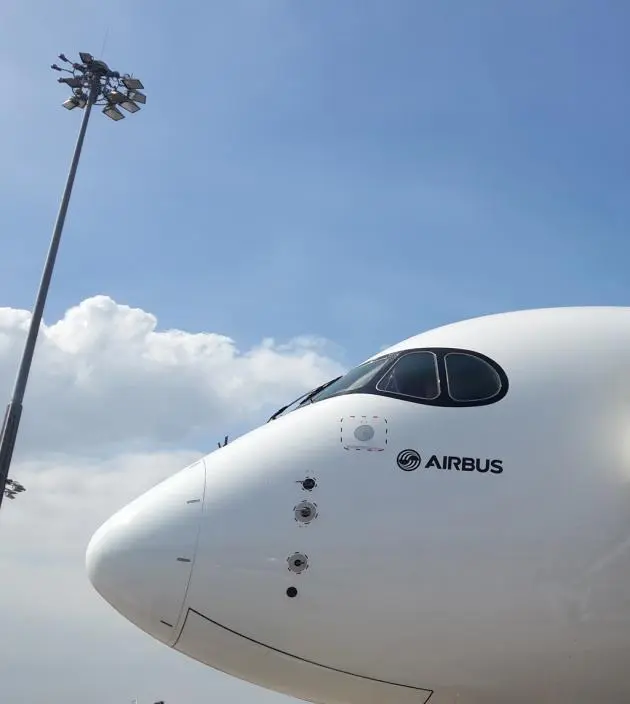
Standing proudly in front of Thai Airways International’s hangar at Suvarnabhumi Airport, the Airbus A350 XWB is demanding every bit as much attention from aviation industry insiders and media representatives as a supermodel. Painted in classic two-toned black and white, you can tell the A350 XWB from its lesser cousins by its unique curved windscreen that brings to mind vintage aviator goggles. The aircraft is attractive with two bold engines and remarkable blended winglets.
This is the fifth Airbus A350 XWB to roll off the factory floor, and travellers will no doubt come across many of its kind on long-haul flights. As part of its Asia Tour, the new aircraft stopped over at Suvarnabhumi Airport for a short layover before undertaking a demonstration flight.
Designed by the European manufacturer, the Airbus A350 XWB is a family of long-range, twin-engine wide-body jet liners. It’s the kind of aircraft you take for a long-haul flight from Bangkok to London or beyond. The aircraft is built to compete with the Boeing 787 Dreamliner – one of the sophisticated commercial aircraft posing a serious threat to Airbus A330 series. When Boeing sent its Dreamliner on the “Dream Tour” in 2012, the A350 XWB was on its way from the drawing board to the sky. Now, just two years later, the Dreamliner has the A350 XWB hot on its tail, with Qatar Airways scheduled to take delivery of the A350 WXB next Monday.
“It took Airbus eight years to build A350 XWB. This is not a resizing of the A330 or the A380. It was designed and built from scratch,” says Mike Bausor, the A350 XWB marketing director at Airbus.
“The A350 XWB is the most sophisticated aircraft in this segment. You don’t need to design a new aircraft in the next five years.”
Bausor insists the A350 XWB is not competing directly with the mid-sized 787 Dreamliner, saying it’s the B777 series that will likely feel the threat.
On Suvarnabhumi Airport’s tarmac, as we wait for the boarding call, everyone is busy capturing the AA350 XWB with their smartphones. I step closer to the huge engine beneath its wing.
Exclusively equipped with Rolls-Royce “Trent XWB” engine and without an option for a GE engine, Airbus A350 XWB is a totally European job.
As 2pm approaches, the tarmac heats up and the clouds from the morning burn off. The Airbus A350 XWB taxies past THAI’s Boeing 777-2D7 before making its way to the runway. Once the air traffic control gives the green light, the captain lifts the Airbus A350 into the sky. It’s a nice and easy take-off, and even sitting in 46L (the worsen seat possible on the last row of Economy Class) I don’t feel the pull of gravity and mutter a brief prayer of thanks to the powerful Trent XWB, the sixth generation of the Trent family of engines.
Airbus has high hopes for the A350 XWB. For one thing, it offers 25-per-cent lower fuel burn. The aircraft seats up to 369 passengers in a two-class layout, and can fly non-stop up to 14,350 kilometres – which is approximately about one and half times the distance between Bangkok and London.
“The A350 XWB family is ideal for operating on routes between Bangkok and European cities,” Bausor says.
From the traveller’s perspective, especially those of us who travel Economy class, the flight is likely to be more comfortable than in other jets thanks to the “xtra” wide body. With a 3-3-3 set of nine abreast lay out, Airbus A350 XWB offers 18-inch-wide seats with 32-34 inch pitch for standard economy class. And that means a little more space.
I’m grateful for those extra inches that even in the last row of Economy Class provide me with a little more leg room and mutter another prayer of thanks, this time to seat maker Recaro, for combining maximum living space and comfort with an exceptionally light weight. You probably won’t even be overly bothered if the passenger in front of you decides to recline his seat.
Jet lag too is likely to be eased thanks to cabin light and air improvement. The air management system, for example, changes the total cabin air every two to three minutes. In addition, the A350 XWB has a lower cabin altitude pressure that contributes to the feeling of well-being on the longest-range trip.
The Airbus A350 XWB, however, is designed for a long-haul journey, and a “sneak preview” on a flight that lasts for just two glasses of sparkling wine doesn’t tell you much. What I can say for certain is that Airbus’s new baby is a very quiet even when it’s climbing and gaining altitude.
As at the end of October, Airbus had received 750 firm orders from 39 customers for the A350 XWB, 24 of them Asian airlines. Thai Airways International has purchased four aircraft and is to lease eight more for its fleet. The first THAI A350 XWB will arrive in mid 2016. If you cannot wait, try Qatar Airways.
The state-owned flag carrier of Qatar will be using its brand new Airbus A350 XWB on its Doha-Frankfurt Route from January.
