
Cruising above the clouds


Play
Don't know what to do for your next holiday? How about flying around the world in 19 days in a private jet
Swiss-born chief pilot Gregor Schweizer is a man of few words. His speech before takeoff in Osaka, Japan is limited to: “Ladies and gentlemen: enjoy the flight!”
What more needs to be said? The 30 passengers know the safety drill, the planned route, the drinks available onboard. They’ve heard it all before. They’ve already flown five legs on this plane and the total figure will be 11 before they finally disembark at the end of the holiday.
These wealthy passengers have signed up to fly around the world in one plane with the same crew in 19 days. It’s a trip that will take in four continents, seven countries and 39,700 kilometres, from the North Sea island of Sylt, Germany to the African island of Zanzibar, with stops in New York, Canada, Alaska, Japan, Palau and Vietnam.
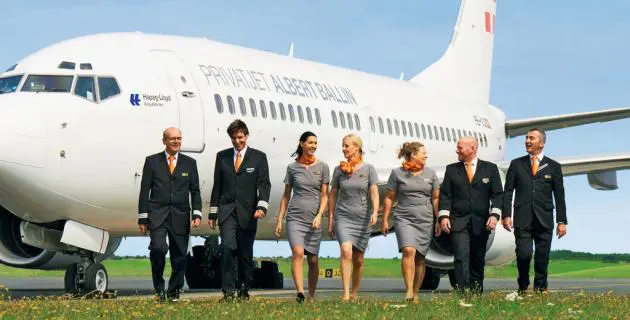
It’s like a luxury liner cruise, only with a chartered Boeing 737 carrying two pilots, four cabin staff and a technician instead of a mighty cruise ship. The Hamburg-based company behind it, Hapag-Lloyd Cruises, calls the trip an “air cruise.”
There are other parallels to a cruise ship: All meals in the air or on the ground are included in the price. There’s a luggage service and a doctor on board, a chief tour guide who has worked on cruise ships and two experienced travel guides who act as walking entertainment.
The German-speaking passengers are like those commonly found on a luxury cruise too. The majority is of retirement age. Typical customers are entrepreneurs who have sold a medium-sized company or handed it over to their children and now have the time to travel.
Air cruises are not cheap – the daily cost is at least 3 times that of a cruise ship. For the total cost of the around-the-world trip – one of the longest tours on the programme – one could buy a nice car brand new.
There are of course the environmental costs too – aren’t there already enough planes in the air? These issues don’t plague the passengers though, or at least they don’t talk about it if they do.
In business, you already get to fly first class to the major cities of the world, comment a couple from Germany’s Black Forest. But when does one get a chance to fly directly from Alaska to the South Pacific?
One of the passengers, a retired teacher and widow from Switzerland, likes to go hiking and sailing. She says she would find a conventional sea cruise “too boring”. She likes the air cruise because one gets to stay in each country for two or three nights, rather than just seeing ports and making short excursions near them.
Another guest was given the trip as a present for his 80th birthday. “I’ve always dreamed of a voyage around the world,” he says, but he never considered doing it on his own. He finds the service on board almost too luxurious: “I don’t need the champagne, I’d rather drink orange juice.”
Being a private jet, the plane doesn’t have to stick to scheduled flight plans or the usual airports. If there’s a big enough runway there, every place is reachable. And sometimes even a conventional runway isn’t essential. “We have also landed on snow runways,” the pilot says.
Because Kodiak, an island off the southern coast of Alaska, is one of the best places in the world to observe brown bears, the plane flies there. Palau, a remote archipelago in the Philippine Sea, gets on the itinerary because it’s a beautiful place to dive.
Often it’s the little things that are most popular among the passengers, such as an evening rickshaw ride through Hanoi or dinner on the beach in Zanzibar under the African night sky.
Keeping a watchful eye on everything is chief tour guide Ingrid Schwarz. She is the heart and soul of the journey, equally blessed with both patience and a talent for organisation. She does what she can to meet special requests – a balcony room at the hotel for a smoker, an alternative programme to snorkelling for two water-shy travellers.
Schwarz is always on the go. She’s the first off the plane, travelling with the bags to the hotel and checking out the rooms. When the group returns to the plane later, she’s already there with the captain, waiting at the steps to welcome them.
Then there’s the doctor, Roland Uhling. The medic from Hamburg cares for sore throats, stomach upsets and sprained ankles, but also helps out with the baggage.
The greatest gripe that a surprised Schwarz faces on this trip is over the in-flight food. It’s cold, doesn’t taste good and takes too long to come to your seat, according to complaints that develop.
In a way, these passengers grumble about the same thing as travellers on scheduled flights. But in another way they are different: they are very wealthy and at home are used to perfect food, perfectly served.
Shortages are hardly the problem here. Catering firms deliver high-class meals on trays. The plane stocks enough beverages and snacks to feed a convention, including wine, juices, coffee, tea, nuts and chocolate.
Ingrid Schwarz talks with the crew and checks out the supplies. Then she makes a decision. For the last part of the journey, a professional cook will be on board to supervise food presentation in the Boeing’s galley.
