
Streets of memories


Play
How a down-and-out Communist showcase charmed Tom Hanks
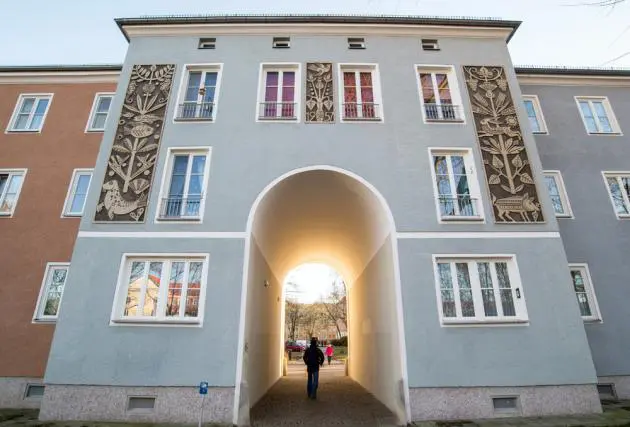
It would be exaggerating to speak of splendour. Communist-era architecture in East Germany however did sometimes offer more than grey and gloomy pre-fab apartment blocks.
On Eisenhuettenstadt’s central Lindenallee boulevard, for example, you’ll find buildings with expensive exterior decoration in Meissen porcelain, the ceramic used to make Dresden shepherdess figurines.
Located 75 kilometres southeast of Berlin, Eisenhuettenstadt is an artefact of communism, a piece of faded propaganda with the potential to amaze tourists. Oddly, few tourists stop by. Perhaps its being a steel town puts them off. Or are they having too much fun in Berlin?
The city was built from scratch as a showcase for the “Socialist” way of life and most of its wonderful bizarreness is still there to see.
“In the class struggle, the aim was to demonstrate that workers in the Socialist countries could live comfortably,” notes Eberhard Harz, a tour guide in the city, which was started in 1950 on the bank of the Oder River.
Harz, 64, was formerly an engineer employed to build a mill producing hot rolled steel in the city. But then the East German state “ran out of gas,” he says. That economic and political collapse culminated in the fall of the Berlin Wall in 1989.
Now he leads people around, pointing out the architectural features and oddities of a city that has been called the largest outdoor monument in all Germany. Completely designed on the drawing board, it was the first Socialist city on German soil.
The slogan when it was built was: “Steel, Bread, Peace”.
Initially it was called Stalinstadt, after Soviet dictator Joseph Stalin. The Communists conceived of it as a counter-example to the gritty Ruhr industrial region of West Germany.
When Stalin was vilified after his death, the city was renamed Eisenhuettenstadt in the early 1960s – literally, Ironworks City.
Lindenallee is lined with shops, restaurants and a theatre. Harz says that in East German days, people liked to come to Eisenhuettenstadt because there were more goods available in the shops to buy.
“By East German standards, the supply situation was always better here than elsewhere,” he says.
Whereas in other German cities the main boulevard usually leads to a castle or palace, Lindenallee ends right at the gates of what was once a gigantic steel factory employing 18,000 at its peak.
Today, under the name EKO-Stahl, it belongs to the ArcelorMittal global group and the workforce numbers just 2,500.
A sign of the changed times is a franchise of US fast-food restaurant chain Burger King right outside the factory gates. There have been many other changes in the 25 years since German reunification.
Eisenhuettenstadt’s population has dropped to 27,500, well down from 50,000 plus back in the days of Communism. People continue to leave.
ArcelorMittal sees signs of a turnaround and speaks of a “rising industrial region”. But it’s a sentiment that not many people seem to share beyond the factory gates. “The city is down and out,” says Manfred Faber.
Except for the steel plant and a paper factory, there are no other significant employers in these parts.
Faber – not his real name – is sitting on a wooden bench in City Centre, the main shopping mall. Here, every shop is advertising special sales, discounts and price reductions. All the same, the hardware store has gone out of business, and a major supermarket is to follow next fall.
Faber, 80, speaks with irony of the changed situation.
“Back then (in Communist days), we all had money to spend, but nothing to spend it on. Now, there are plenty of things to buy, but nobody has any money.”
Over the years, efforts have been made to restore and modernise many of the boxy apartment buildings. But not every building could be saved. Since 1990, some 6,100 apartments have been razed, and urban planning officials say another 475 apartments will be razed by 2017.
To be sure, Eisenhuettenstadt has had one warm glow of pride since unification.
The man who created the happy moment was Hollywood actor Tom Hanks.
The tourism office is still plugging the Hanks connection even though his once-only visit took place a long time back, in November 2011.
At the time, Hanks was in the Babelsberg studios in Potsdam, near Berlin, shooting film scenes for the movie “Cloud Atlas”.
Taking a day off from work, Hanks drove to Eisenhuettenstadt – and was charmed, or at least fascinated – by the guided tour he took.
Every awed resident can tell you how later, on American TV talk shows, Hanks talked enthusiastically about his visit to what he called “Iron Hut City”.
Today, at the tourism office, you can buy an “Iron Hut City” T-shirt, or another one with a German slogan that translates as, “Once you find Hollywood ho-hum, visit Eisenhuettenstadt for some real fun!”
Tourism office director Kathrin Henck says a campaign promoting the Hanks connection has spurred visitor numbers higher. In 2014, more than 100 group tours of the city took place and hotels sold 30,100 overnight stays.
Harz proudly notes that it was he who showed Hanks around.
The actor had been told about “Stalinstadt” and Harz did his best to point out all the aspects and facets of the doomed socialist era.
“He was fascinated,” Harz says proudly.
