
Roping up for victory


Play
The residents of a small district in the Eastern province of Chanthaburi celebrate Songkran with a tough tug-of-war
Every year around the time of the Songkran festival, the population of a small area in Chanthaburi brave the heat for a contest of strength that leaves the winners strutting around proudly and the losers licking their wounds under the bodhi trees. This annual tug-of-war at Tapon Yai temple returns for its 2015 edition on April 17 and offers visitors jaded by water throwing a new and very enjoyable take on Thailand’s new year traditions.
“The Tapon rope war started sometime in the late 19th century during the reign of King Chulalongkorn. The annual battle has been a fixture on Tapon’s calendar ever since,” the abbot of Tapon Yai Temple tells Explore.
“In those days, several villages would send their best men for the battle, and the winners would go home with the Pha Prabart – a length of cloth imprinted with four circles representing the footprints of four Lord Buddhas.”
The annual tug-of-war was introduced to the town of Tapon by a stroke of luck.
It seems villagers in the area were struck by a mysterious epidemic. With no modern medical care and treatment available, a monk instead gave the people the revered cloth bearing the footprints and suggested they organise a procession around the village. The epidemic abated as suddenly as it had come.
“Everyone wanted to have the revered cloth to ward off fatal diseases even though the epidemic had been eradicated,” says the abbot. “So the tug-of-war was introduced to find the holders of Pha Prabart.
“The winning team goes home with the miracle cloth and keeps it until next Songkran Festival when a new battle of strength is organised.”
Undeterred by the searing heat, the two teams brave the elements – and each other – for this annual bout in the temple grounds. Each team is made of 10 players from the respective temples and villages. The rope is thick and long and centred on a sizeable oxcart, leaving the ends for both teams to tug. The oxcart itself carries a replica of the sacred cloth and a drummer. When the stronger team pulls hard, the wheels of the oxcart move a little towards them. But just as the wheels are about to roll across the line, the other team digs in, pulls back and pushes the “brake” by pressing the rope on the ground. The struggle continues for a while before one side rallies with a long and brutal pull.
The battle is divided into two bouts with the contestants changing ends after the first. A third round is needed if they equalise.
“The first match is quite easy. The second one seems to go on for an eternity,” says Niphan Somboonnil, a member of the Tapon Noi village team.
Some of the battles are amusing and entertaining, particularly the one that sees housewives go up against village leaders. The women – who are allowed a larger number of players than the men – ensure a good fight, while the males tend to dig deep to maintain their pride and strength. As the drumbeats intensify, the gleeful crowd cheers and shouts “Pull! Pull harder! Pull longer!”
“As it’s part of the home-coming week during Songkran the rope battle draws many locals and visitors from further afield,” says the village headman.
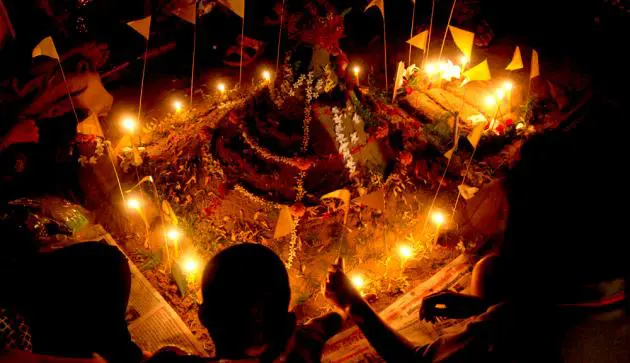
Playground gives way to fairground as the teams go home to shower and change in preparation for the sand pagoda competition, which relies less on strength than on creativity. Clutching buckets full of sand, families race to carve their miniature pagodas before offering them to the temple. The pagodas are decorated with flowers, flags and candles and as darkness falls, they illuminate the night sky.
Families sit quietly behind their flickering creations waiting for the monks to come round so they can make their offering, bringing the day to a calm and perfect end.
It’s a reminder that the traditional New Year can also be humble and that water and powder are not the only ingredients for an enjoyable Songkran Festival.
IF YOU GO
Wat Tapon Yai in Chanthaburi’s Khlung district, is about 20 kilometres from Laem Sing, a beach destination that boasts a wide range of accommodation and restaurants. The tug-of-war takes place at the temple sometime in the afternoon of April 17. It is followed in the evening by the offering of the sand pagodas, which finishes around 8pm.
For VDO clip and many more photos, visit www.NationMultimedia.com/travel.
