
Feeding the spirit, calming the mind


Play
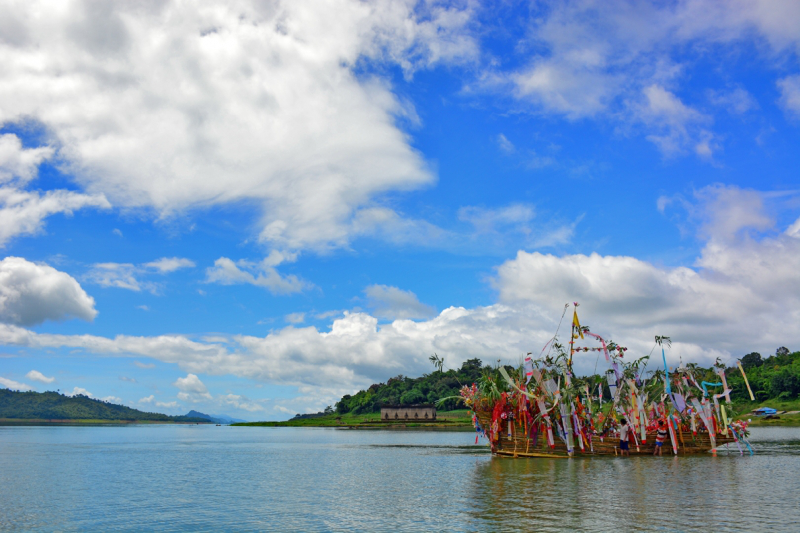
Sangkhla Buri’s Mon community pays respect to its ancestors with a boat laden with food
The Mon communities in Sangkhla Buri, a small town on Thailand’s western border with Myanmar, will once again be remembering their ancestors next week with a spiritual festival that sees the whole town come alive. A fascinating event that for the past few years has drawn thousands to the area, the Mon Floating Boat Festival, as it is known, reunites the departed with the living.
This year’s festival is being held from September 15 to 17 and is expected to again draw both Mon-speaking people from all over Thailand for family reunions as well as curious tourists.
“The ritual is known to the Mon as ‘Pohamord’, which roughly translates as the Boat of Offerings,” says Mon resident Arunya Chareonhongsa.
The festival not only commemorates departed Mon pilgrims but also banishes evil and brings luck to those still living. It’s a ritual that dates back to the Mon Hanthawaddy Kingdom (1369-1539) and marks the journey of a high-ranking monk and several Buddhist pilgrims across the Bay of Bengal to fetch a set of Buddhist scriptures in Sri Lanka. On their return trip, one boat capsized in rough seas and the pilgrims inside it drowned. On hearing the news, the king sent another boat, this time unmanned and made of bamboo, which was laden with food.
“The boat of food means to appease the hungry souls of the priests,” Arunya explains. “Once the departed priests are happy with the offering, they might send us the Buddha’s teachings and scriptures.”
Like many Asian cultures, the Mon believe their ancestors are lurking somewhere beyond this world, and they can roam around and even return to their homes at this time of year. Chinese and Khmer communities hold true to the same belief and kill chickens and set up the altars for the departed. What makes the Mon different is that they send a boatload of food into the open water.
On the first day (September 15) locals and visitors surround the Phutthakhaya Chedi at Wat Wang Wiwekaram to watch as the men shape long bamboo poles into a boat, a process that usually takes a full day.
While the men are building the bamboo boat, the women busy themselves cooking and preparing the offerings, which mostly consist of popcorn, ripe bananas and boiled rice in banana leaves, candles, honey, water and sticks of sugarcane.
When the boat is ready and decorated with colourful paper flags, it is moved to the front of the huge pagoda where it serves as the centrepiece for the celebrations that follow on the next two nights.
The highlight is the series of cultural shows that showcase the distinctive ways of the Mon. Both old and young dress in beautiful traditional attire – red sarongs and white shirts – and move towards the boat holding trays. Young men, with mouthfuls of chewy betel nut and winning smiles, try to lure the girls who are carrying baskets of food on their heads.
“In the olden days, we also made a lantern and would load it with yellow string and the necessities for entering the monkhood before releasing it into the sky,” Arunya explains.
“Whoever found the monk’s set would be ordained. If a woman found it, she would make a great contribution to the Buddhist temple.”
The ceremony culminates in the boat being towed to the riverbank and pushed out to the water where it begins its slow journey to the spiritual world.
IF YOU GO
< Sangkhla Buri is a home to one of Thailand’s largest Mon communities as well as to Karenni and Bangladeshi populations that add to its ethnic diversity.
