
Venice of the East, Reborn: Bangkok's Plan to Reclaim Its 1,100 Canals as Linear Parks
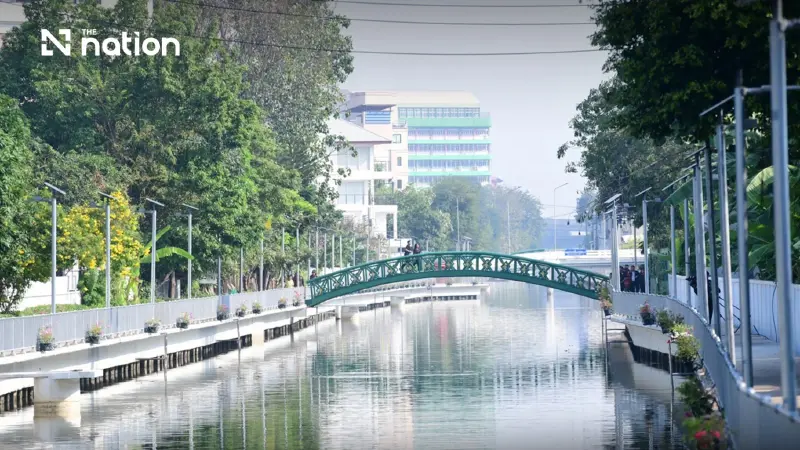


Bangkok's BMA is reclaiming 1,100 neglected canals as walkable public corridors — reversing half a century of car-centric concrete in a city that sinks two centimetres every year
- Bangkok is implementing a "Blue & Green Network" plan to convert its 1,100 neglected canals into walkable, biodiverse linear parks, reversing a past policy of paving them over for roads.
- The initiative is being rolled out through pilot projects, such as the 4.5-kilometre Chong Nonsi Canal Park, which integrates walkways, water treatment systems, and public transit connectivity.
- Beyond creating public amenities, the project serves as critical climate infrastructure designed to mitigate flooding and manage water in a city that is sinking and facing rising sea levels.
Bangkok's BMA is reclaiming 1,100 neglected canals as walkable public corridors — reversing half a century of car-centric concrete in a city that sinks two centimetres every year.
For much of the second half of the twentieth century, Bangkok pursued a single spatial strategy: concrete. Canals that had once served as the city's lifeblood — markets, temples, and communities built along their banks — were filled in and paved over to accommodate the car.
The "Venice of the East" became a case study in urban heat, seasonal flooding, and the absence of accessible green space. Today, a deliberate reversal is under way.
The Bangkok Metropolitan Administration's Blue & Green Network — its guiding concept described as "Revitalising City, Connecting Quarters, Weaving the Future" — is the most ambitious reordering of Bangkok's public realm in decades.
sssThe BMA, in partnership with landscape architects, civic planners, and international researchers, is seeking to transform the city's more than 1,100 canals (khlongs) from neglected drainage channels into walkable, biodiverse Linear Parks. Five pilot projects launched simultaneously, each targeting a different part of the city's waterway fabric.
The highest-profile of these is the 4.5-kilometre Chong Nonsi Canal Park, which cuts through Bangkok's central business district. Designed by landscape architect Kotchakorn Voraakhom of LANDPROCESS and modelled in part on Seoul's Cheonggyecheon Restoration Project, the park connects the CBD to dense residential neighbourhoods across three districts.
It was the first canal park of its kind in Thailand, integrating pedestrian walkways, water plants, nature-based treatment systems, and BRT lane connectivity into a continuous blue-green corridor.
The Stockholm Environment Institute, which conducted early 2025 fieldwork across Bangkok's pocket parks, offered a nuanced assessment of Chong Nonsi.
The park attracts significant foot traffic — particularly in the late afternoon and evenings — but critics noted that construction replaced 30-year-old native trees with smaller non-native species and increased concrete coverage and that water quality improvements had been slower than anticipated.

The SEI concluded that for nature-based solutions to be truly transformational, form must not take precedence over function, and communities must be genuinely engaged in design decisions.
The second major axis of the Blue & Green programme targets Bangkok's historic inner-city waterways, notably the 5.5-kilometre Phadung Krung Kasem canal.
Winding past Hua Lamphong railway station and through the old city gates, this project emphasises heritage preservation alongside walkability and micromobility.
A 1.25-kilometre priority stretch from Charoen Sawat Bridge to Kasatsuek Bridge has been prioritised for early-phase development.
The urgency behind these projects is scientific. Bangkok sits on soft alluvial soils and subsides at roughly two centimetres per year.
The IPCC projects global sea levels to rise 33 centimetres by 2050. In this context, every canal park is also a flood buffer, a water management asset, and a carbon sink.
Kotchakorn's team has noted that their water management strategies are designed to absorb rainfall from 50- to 100-year precipitation events – a benchmark that places Bangkok's canal parks firmly in the category of critical climate infrastructure, not simply a pleasant public amenity.
