
Digital tech, skilled work force key to Thailand’s future, experts tell Nation seminar
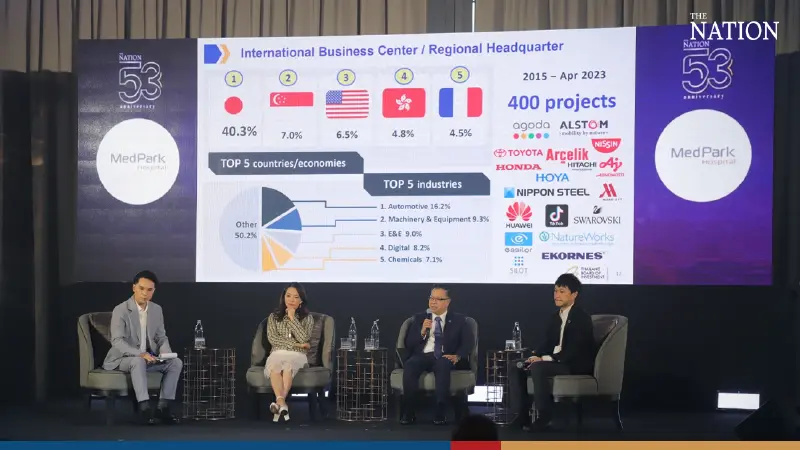


Thailand urgently needed to adopt digital technology and develop the right skill set in its workforce if it wanted to be one of the top destinations for global investors looking to set up manufacturing and supply chain facilities, the country’s top experts from both the public and private sectors said.
They were speaking during a panel discussion on Monday on "Reimagine Investment Trends: Preparing for Multiple Challenges”, as part of the seminar titled "Thailand Economic Resilience and Opportunities" hosted by The Nation to celebrate its 53rd anniversary.
Narit Therdsteerasukdi, secretary-general of the Board of Investment (BOI), Jareeporn Jarukornsakul, chairman of the executive committee and group CEO of WHA Corporation, and Jirayut Srupsrisopa, founder and group CEO of Bitkub Capital Group Holdings, were among the panellists.
They discussed and debated how businesses and industries should move forward in order to be more resilient, adaptable, and better-equipped to harness the forces of change that would bring challenges and opportunities in the coming years.
Golden era for investment
Despite several risk factors threatening the global economy, such as high inflation, geopolitical tensions, extreme natural disasters caused by climate change, and other unexpected uncertainties, Asean, particularly Thailand, has becoming an enticing destination for investors and manufacturers from around the world, the BOI secretary-general said.
He explained that Asean is now in the global spotlight due to its nonpartisan stance and the lack of any fallout on these countries from tensions between superpowers.
Each Asean country has its own strengths, and Thailand is no exception, he said.

According to the BOI, Thailand has greater potential to serve as the gateway to Asean and wider Asia due to the country's strategic location with connectivity to Asean and China, as well as its well-established infrastructure, such as power, water, seaports, airports, road, and rail.
Thailand also is well-equipped with digital advancements, such as a 5G network, a world-class data centre, and cloud services.
The country is already a leading manufacturing hub with a strong supply chain for automotives, electronics, and electrical goods, along with a high-quality workforce.
Thailand also provides non-financial incentives, has a green transition policy, and a safe and resilient business environment, he said.
"Thailand's foundation, such as its comprehensive infrastructure and digital technology, is already among the best in the region,” Narit said. “However, the country still has a lot of issues to work on in order to shine brighter than others," he added.
Narit cited several examples of what Thailand needed to do, including have more free trade agreements with other countries, more advanced technologies and innovations, more economic corridors spread across the country for investor alternatives, and development of required human resources skills.

Digital technology
As the country's leading industrial estate service provider, WHA CEO Jareepon pointed out that the global sustainability trend and Thailand's ageing population had compelled her company to transform its business model and embrace digital technologies.
Back in 2017, WHA announced its new goal of becoming a leading tech company by 2024, in order to meet the demand of global manufacturers for smart-eco industrial estates that are more cost-effective and productive, as well as green manufacturing solutions required by country regulations.
As a result of this strategic business direction, WHA achieved an all-time high revenue last year and expects to set a new record this year, she said.
She added that changes and challenges are unavoidable when running a business. Therefore, the best way to deal with these unpredictable difficulties is to be well-prepared by using technology.
Along with enhancing and implementing technology, she advised businesses to also reskill and upskill their workforce.
She noted that no matter how advanced the technology used, it would be useless if there were no quality talents involved.
"Aside from digital transformation, one of the urgent issues that the country should now take action on is reskilling and upskilling Thailand's workforce," she said, adding the task requires collaboration between the public, private, and people sectors.

Reforming education
Bitkub CEO Jirayut agreed with Jareeporn. He cited a World Economic Forum report, which estimated that in the next 10 years, one-third of the world's population will need to be reskilled, and that all of today's skilled workforce, particularly technical skills, can be replaced by artificial intelligence (AI).
The majority of skills required for the future workforce are soft skills such as leadership, critical thinking, teamwork, cooperation, and communication abilities, he said.
He urged the country's universities to establish an online learning platform to make it easier for people to reskill and upskill, as well as reform the teaching system so that institutions can develop talents with digital literacy, agility, and resiliency.
He noted that in order to sustainably drive the country's growth, Thailand must improve its people inclusively.

Expectations from next govt
All three panellists expressed concern about the country's political impasse. They said the delay in appointing a new prime minister could harm the country's growth.
However, they expected domestic politics to be a short-term worry, which would fade as soon as the country gets a new cabinet.
Jareeporn said manufacturing is a long-term investment, and the domestic political situation is one factor to consider. Fortunately, the history of Thai politics has consistently demonstrated that, regardless of political uncertainties, core economic policies have never been affected.
The private sector is simply waiting for a clear signal before proceeding, she said.
Jareeporn then used this opportunity to deliver a message to the new government.
"The private sector wants the appointment of the right ministers in the right jobs to help drive the country's economy. Rather than a minister appointed based on party quota, we want someone who is wise and knows the job," she said, adding that she would like to see the new government work closely with the private sector to attract foreign investors by implementing concrete supportive policies.
Meanwhile, Bitkub CEO Jirayut pointed out that the new government must address both short- and long-term issues.
In the short term, he believes the new government should focus on resolving the high household debt, improving the skills of the current workforce, grooming new talent, and restructuring social welfare to address the ageing population.
In terms of long-term development, he advised the new government to prioritise the digital green revolution trend.
“The digital green revolution is a key phase in Thailand's long-term development. The word reflects Thailand’s future direction and the skills that the country should develop for Thais,” Jirayus said.
BOI secretary-general Narit expected the new government to fully support the agency's policies and initiatives, which would focus on five priority sectors: bio-circular-green business, electric vehicles, smart electronics, digital and creative.
Furthermore, he said the BOI intends to make the country the regional headquarters for leading corporations.
Apart from driving five priority sectors, Narit noted that the BOI has a roadmap to promote Thailand as an international business and talent hub, strengthening the supply chain while upgrading to smart and sustainable industries, decentralise investment nationwide with area-based programmes, and improve global minimum tax and adjustment of investment promotion tools.
Meanwhile, when asked what he hopes to see the most from the new government, he said human capital development.
“We [Board of Investment] are working to improve Thailand’s position as an Asean hub for talent, and would like to see the government implement robust policies to develop new talent and attract skilled foreigners to the country,” he said.
