
How Thailand's Invasive Fish Crisis Became a Story About One Company Instead of an Entire Supply Chain
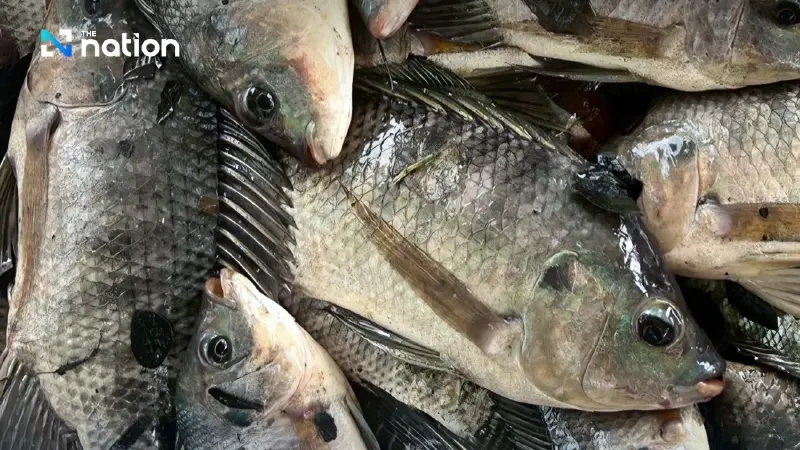


For more than a decade, the blackchin tilapia (Sarotherodon melanotheron) has evolved from an obscure aquatic species into one of Thailand's most controversial environmental issues
Yet as public debate intensified, the story gradually became centered on a single question: Which company brought the fish into Thailand?
That question is important. But it may not be the only question that matters. As the controversy unfolded, a far larger and more complex issue received comparatively little public attention: How did blackchin tilapia become embedded in Thailand's supply chain, aquaculture system, and international trade network?
The dominant public narrative has largely focused on a single legally documented importation for research purposes in 2010. According to official records, approximately 2,000 fish were imported under government authorization. Subsequent accounts stated that the research project failed, the population declined significantly, and the remaining fish were eventually destroyed.
Yet if that account represents the entire story, several critical questions remain unanswered.
Most notably, official export records reportedly indicate that between 2013 and 2016, eleven companies exported approximately 230,000–320,000 blackchin tilapia to seventeen countries. Regardless of how those records are ultimately interpreted, their existence raises a fundamental question: Where did those fish originate?

If hundreds of thousands of fish entered international trade within only a few years, there must have been a breeding population, production capacity, and supply chain capable of supporting such exports. Fish do not appear spontaneously. They require broodstock, hatcheries, grow-out facilities, distribution channels, and commercial demand.
Understanding that supply chain may be just as important as identifying the original point of introduction.
The discussion becomes even more complex when considering that invasive species rarely enter new environments through a single pathway. Around the world, scientists have documented multiple introduction routes, including aquaculture activities, ornamental fish trade, accidental releases, undocumented movements of aquatic species, and maritime transport through ballast water.
Some researchers have suggested that blackchin tilapia may have reached Thailand through channels other than the single documented importation. Such possibilities remain hypotheses rather than established facts, but they illustrate why a comprehensive investigation should consider all plausible pathways rather than focusing exclusively on one.

Recent genetic studies have added another layer of complexity. Emerging research has suggested the possibility of multiple introductions rather than a single origin event. If future scientific evidence supports this hypothesis, the history of blackchin tilapia in Thailand could prove more complicated than previously assumed.
The export records themselves also warrant careful examination. International aquatic animal trade relies heavily on scientific nomenclature. Export documentation, health certificates, customs declarations, and inspections commonly identify species by scientific name. In the reported export records, the species was identified as Sarotherodon melanotheron.
Some officials have argued that these records may have resulted from documentation errors. If so, the circumstances surrounding those discrepancies deserve transparent clarification. If not, then the records raise legitimate questions regarding the origin, breeding, and movement of the exported fish.
What is striking is how differently other countries have approached similar invasive species challenges. In the Philippines, where blackchin tilapia populations were reported in Manila Bay and surrounding waterways years ago, scientific and regulatory efforts focused primarily on tracking distribution, assessing ecological impacts, monitoring fisheries, and controlling population growth. The central question was often how to manage the species rather than how to construct a narrative around a single actor.
Thailand, by contrast, has witnessed a debate increasingly framed around identifying one responsible party.
Yet environmental crises are often products of systems rather than individuals alone.
A complete understanding of Thailand's blackchin tilapia problem requires answers to several interconnected questions. How long has the species been present in the country? Were there introduction pathways beyond those already documented? How should the reported exports by eleven companies be explained? What do genetic studies reveal about population origins? And what weaknesses, if any, existed within monitoring, traceability, and aquatic animal movement controls?
These questions are not mutually exclusive. They are pieces of the same puzzle. The ultimate challenge is not merely determining who may have introduced blackchin tilapia into Thailand. It is understanding how the species became established, reproduced, entered commercial networks, and spread across ecosystems.
Only through a transparent examination of scientific evidence, trade records, regulatory documents, and supply-chain data can that story be fully understood.
Until then, Thailand's invasive fish crisis may continue to be viewed primarily as a story about one company, when it may in fact be a story about an entire supply chain.
