
Time running short as search for Titan sub focuses on undersea sounds
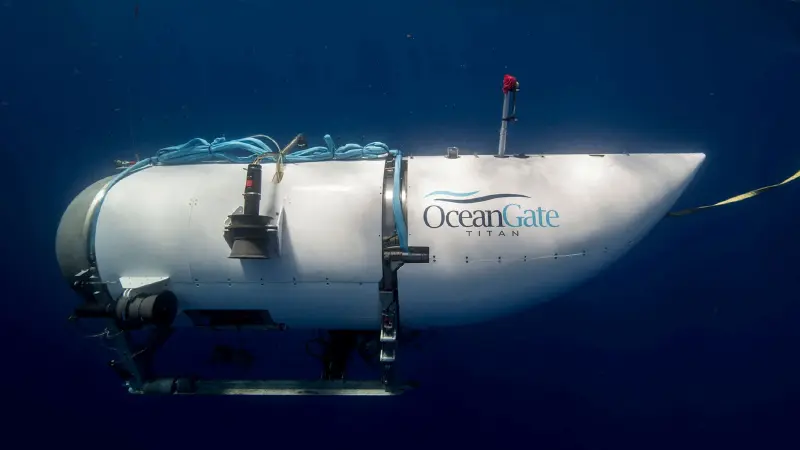


Rescuers searching for a missing submersible near the wreck of the Titanic on Wednesday concentrated their efforts on a remote area of the North Atlantic where undersea noises have been detected, though officials cautioned the sounds may not have originated from the vessel.
With estimates suggesting the air supply on board could run out in a matter of hours, an international coalition of rescue teams was sweeping a vast expanse of the ocean for the Titan, which vanished on Sunday while carrying five people on a deep-sea voyage to the century-old shipwreck as part of a tourist expedition.
The US Coast Guard said remotely operated vehicles (ROV) were deployed underwater near where Canadian aircraft recorded the noises using sonar buoys on Tuesday and Wednesday but have not found any sign of the Titan yet.

Coast Guard Captain Jamie Frederick said at a press conference that analysis of the noises has been inconclusive.
Even if the submersible is located, retrieving it presents huge logistical challenges, given the extreme conditions miles (thousands of meters) below the surface.
Teams from the United States, Canada and France using airplanes and ships have searched more than 10,000 square miles (25,900 square km) of the open sea, roughly twice the land mass of the US state of Connecticut.
The 22-foot (6.7-meter) submersible Titan, operated by US-based OceanGate Expeditions, began its descent at 8 a.m. (1200 GMT) on Sunday. It lost contact with its surface support ship near the end of what should have been a two-hour dive to the Titanic.
The Titan set off with 96 hours of air, according to the company, which would mean the oxygen could run out by Thursday morning. But experts say the air supply depends on a range of factors, including whether the submersible still has power and how calm the people aboard have remained.
The wreck of the Titanic, a British ocean liner that struck an iceberg and sank on its maiden voyage in 1912, killing more than 1,500 people, lies on the seabed at a depth of about 12,500 feet (3,810 meters). It is about 900 miles (1,450 km) east of Cape Cod, Massachusetts, and 400 miles south of St. John's, Newfoundland.
Those aboard the submersible, the highlight of a tourist adventure that costs $250,000 per person, included British billionaire and adventurer Hamish Harding, 58, and Pakistani-born businessman Shahzada Dawood, 48, with his 19-year-old son Suleman, who are both British citizens.
French explorer Paul-Henri Nargeolet, 77, and Stockton Rush, founder and chief executive of OceanGate, were also reported to be on board.
"This is very risky": Experts warned OceanGate about Titan safety concerns in 2018

Experts raised safety concerns back in 2018 about the submersible vessel that has been missing since Sunday.
The Titan submersible is a 22-foot (6.7-meter)-long vessel operated by Everett, Washington-based OceanGate Expeditions. But some industry experts and a whistle-blowing employee had worried about its safety, notably that OceanGate opted against certifying the Titan through third parties such as the American Bureau of Shipping, a leading classifier of submersibles, or the European group DNV, an independent quality assurance and risk management company that sets standards for the design safety of underwater vehicles.
Will Kohnen, chairman of the Marine Technology Society's (MTS) committee on manned submersibles, addressed a letter dated March 27, 2018, to OceanGate founder and CEO Stockton Rush, who is piloting the missing vehicle. In the letter, Kohnen expressed what he said were widespread concerns about the Titan, and Kohnen said he later discussed the letter with Rush.
"As chairman of the submersible committee, I stand by the letter and all the sentiments of our members that were worried," Kohnen told Reuters in an interview on Wednesday
The issue was not any single design flaw, but that OceanGate chose not to pursue the industry's recognized certification process.
"It was not certified, so it had no oversight during design, fabrication and testing. So it's self-certifying, in that what you call experimental, and is there room for experimental? Yes. To take people down? No. If it's experimental, you should not be taking people down," Kohnen said.
The letter came about after many submersible experts voiced concerns over the Titan during a three-day annual symposium, Kohnen said. He said he asked the MTS board to send the letter on behalf of the entire society, but the board declined.
"There's no joy in saying, 'Boy, we were hoping this wasn't going to happen,'" said Kohnen.
World-class scientist calls missing sub 'overall catastrophic failure'
A scientist and journalist who dived to the Titanic wreckage two decades ago said on Wednesday there must've been an "overall catastrophic failure" for the OceanGate Expeditions submersible to go missing on Sunday.
Michael Guillen, former ABC News science editor who got trapped in a Titanic's propeller and survived the expedition in 2000, told Reuters there's evidence that stands out from the case.
Firstly, the fact that the vessel lost communication so early in the descent which, according to Guillen, takes between two and three hours in total.
Guillen also explained that a "mere communications" failure isn't as feasible since the Titan is designed to come back to the surface automatically in the event of a crisis, which didn't happen.
According to Guillen, the undersea noises that have been detected in the North Atlantic search area are a positive sign but are "no guarantees" because if the sub is found, extracting it involves a different degree of complexity.
The submersible had 96 hours of air, according to the company's specifications, which would mean the oxygen could run out by Thursday morning. But Guillen explained that depends on many factors, such as occupants of the sub breathing heavily under stress.
Questions about the safety of the Titan were raised in a 2018 lawsuit filed by OceanGate's former director of marine operations, David Lochridge, who claimed he was fired for voicing concerns that the hull could not withstand extreme depths.
In its own court claim against Lochridge, OceanGate said he refused to accept the lead engineer's assurances and accused him of improperly sharing confidential information. The two sides settled their court case in November 2018.
Neither the company nor Lochridge's attorney have commented on the details of the dispute.
Months prior to the suit, a group of submersible industry leaders wrote to OceanGate warning that the "experimental" approach" to the sub's development could result in "minor to catastrophic" problems, the New York Times reported.
Stay calm, keep breathing: Swiss submarine pilot hopes missing sub passengers can hold on
Swiss submarine pilot Philippe Epelbaum said 'staying calm' was key to conserving valuable oxygen as supplies dwindle on the missing Titan submersible whilst CO2 levels may be rising.
As the international search and rescue operation was underway for the sub in a remote patch of the Atlantic Ocean, Epelbaum said the passengers would have to manage the devastating psychological effects of being lost.
"I do hope that the captain is a person who keeps calm, still thinks about all options will which are still available, to do the right decisions as long as he still can do anything," Epelbaum said on Wednesday.
"As soon as you are stressed, your consumption is going to be like the double or the triple. So it means that the 96 hours, you know, is not guaranteed," Epelbaum said.
Calcium carbonate is also needed to convert carbon dioxide back into oxygen, said Epelbaum, adding that this running out was another problem to worry about.
OceanGate Expeditions' Titan was designed to carry up to five people to a depth of 4,000 meters (13,120 feet). The wreckage of the cruise ship Titanic sits on the ocean floor about 3,800 meters (12,500 feet) below the surface.
"The signals and conversation cut about one and a half hours after departure. And normally a submarine sinks at about 30 metres per minute. So that means that they would be about on a depth of 2000 metres when whatever happened. So to get stuck in the middle of nowhere, I cannot imagine that this happened," Epelbaum said, saying it was likely the submersible had drifted lower down and maybe even crash-landed on the Titanic.
Rescue tactics, said Epelbaum, would be unique as this was a very rare situation. Thankfully, if found, the sub with all its passengers can shoot back up to the surface without waiting for decompression because the capsule stays in one atmosphere, a unit of measurement equal to the average air pressure at sea level.
Even if the submersible is located, retrieving it presents huge logistical challenges, given the extreme conditions miles below the surface.
Reuters
