
Malaysia unveils exoskeleton to boost palm oil harvesting amid labour crunch
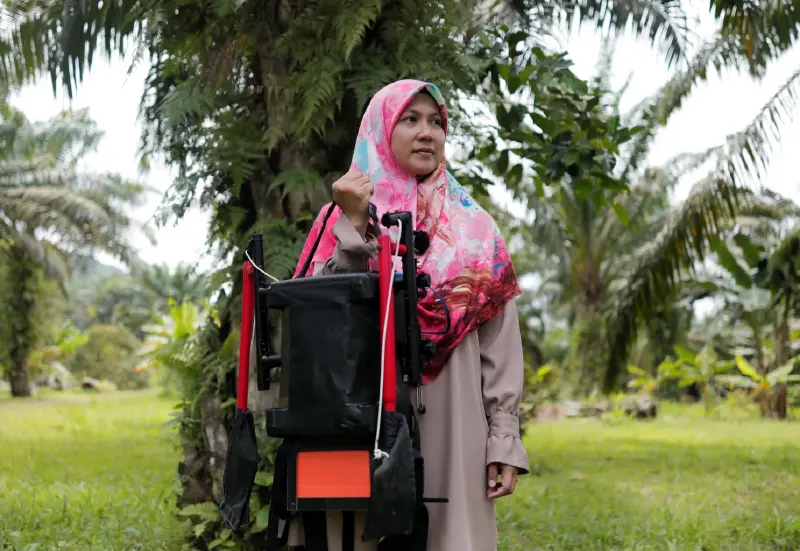


Malaysian research student Haziq Ramli wears an outfit resembling a light jetpack, with poles strapped to his biceps, to wield a long pruning pole that clips heavy bunches of fruit from oil palm trees nearly twice his height.
"The use of the exoskeleton gives support to both sides of my upper arm. So when I'm working, it holds up my arm, so as such, I'm not using energy," says the bespectacled Haziq, clad in jeans and sneakers.
Working on a family plot of roughly two football fields (1.2 hectares), he is part of a team trying to perfect the wearable exoskeleton, which promises to lighten the load for labourers as they manipulate pruning poles weighing as much as 8 kilos.
“Based on our experiments… it reduces about 20 per cent of the workload of harvesters,” says Hazlina Selamat, the lead researcher of the University of Technology (UTM) team who developed the exoskeleton, which is dubbed “Terer”.
Hazlina estimates 200,000 ringgit (1.6 million baht) has been spent on developing prototypes and envisions the exoskeleton could cost around 7,000 ringgit (56,400 baht) if mass-produced.
Efforts to automate harvesting in the world's second-biggest palm oil producer have accelerated in the wake of the Covid pandemic. Almost 80 per cent of Malaysia's plantation workers are migrants, many recruited from neighbouring Indonesia to do the back-breaking work of harvesting, but pandemic curbs caused a shortfall of about 120,000 workers this year.
The labour crunch is expected to cost companies over 20 billion ringgit in losses this year, according to industry estimates, hurting margins and giving an edge to bigger rival Indonesia which has no such labour problems.

With Malaysia set to face increasing competition from emerging producers in Africa, Latin America and India in the coming years, innovations are now crucial not only to address the unsustainable reliance on labour but to ensure the industry did not lose out to competitors.
“Eventually there'll be more and more players in the world that are producing palm oil. So if, come to a stage we are not competitive with them, then I think the whole industry will be affected and it will not be good,” said Ahmad Parveez Ghulam Kadir, the director-general of the Malaysian Palm Oil Board.
Experts say it will take time for automation to phase out manual labour though, as few existing machines are practical for traversing vast and towering plantations. There is also concern that a swing to mechanisation would threaten livelihoods.


Palm oil farmer and engineer Hamidon Salleh, who has been assisting the researchers at UTM, is keen to get any help being offered.
"I would be really happy if there is technology… to ease agricultural work,” he says, holding up a heavy motorised pruning pole to lop off a palm frond at his plantation.
Reuters
