
Year of the Dragon
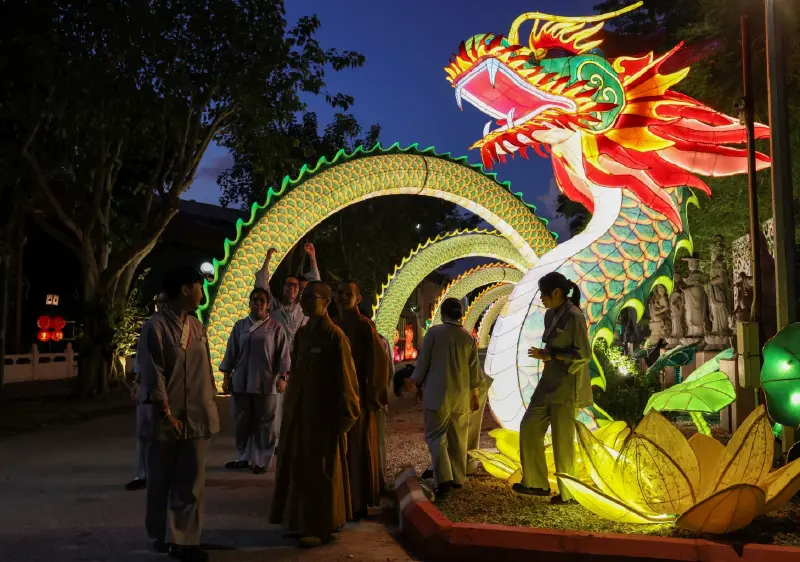


Spring Festival is the most important festival in China. It is also celebrated by Chinese communities around the world.
Based on the Chinese zodiac, 2024 is the Year of the Dragon. The Chinese dragons symbolize strength, energy and vitality. Four experts share their views on the dragons and the Chinese New Year with China Daily.

'Long' live the dragon of change
In a late-night show with Conan O'Brien, Nicolas Cage said he thought he was born in the Year of the Dragon. Therefore, he had a dragon tattooed on himself. Later, he discovered that, according to the lunar calendar, he was born in the Year of the Rabbit. The dragon-turned-rabbit had an identity crisis.
The coming Lunar New Year is the Year of the Dragon. This time, Nicholas Cage is not having an identity crisis. The dragon is.

Many Chinese people worldwide, especially those fluent in English, advocate calling the Chinese dragon "long", which is a transliteration of the Chinese character Long and phonetically more appropriate than the pinyin "long", though.
This distinction is not entirely unreasonable, since the dragon in English and the long in pinyin in Chinese are two different mythical creatures.
According to the website loong.ca, the Chinese "long" has "the head of a camel or horse, the horns of a deer, the eyes of a rabbit, the ears of a cow, the neck and body of a snake, the belly of a kind of huge clam, the scales of a carp, the claws of a hawk, the palm of a tiger, and without wings".
If such an image is too complex, the main thing to remember is that the Chinese dragon is a sea creature while the Western dragon seems to be a land animal, living in castles or dungeons.
Indeed, in medieval Western art and literature, dragons were often associated with evil and chaos. They were sometimes portrayed as adversaries that needed to be vanquished by the virtuous.
The Chinese dragon, on the other hand, was seen as a benevolent character because it, for instance, was a harbinger of rain, bringing water to end drought. There were dragon king temples in many places in China where people would plead for relief from either droughts or floods.
I am not yet ready to join the "long" line to rebrand the dragon. This coinage is mostly a belated correction of an earlier translation error: Whoever translated the "dragon" into "long" should have used another word in Chinese, for instance, jiao or jiao long, if the idea was to distinguish between the Western and Chinese dragons.
It is a little late now to change the Chinese character long to "long" to avoid the negative connotations of the word "dragon". The connotations of the dragon have changed. So has the audience that is trying to make sense of the nuances of these connotations.
The word "dragon" does not always have a negative connotation. There is some duality to the character of the dragon, just as there is some duality to each one of us.
In English literature and mythos, the dragon can symbolize formidable power and strength. It also guards and protects treasures from thieves and bandits. It is alert, attentive, and dutiful.
In recent years, in popular culture, movies such as Mulan have injected some cuteness into the image of the dragon.
In the film, Mushu the Dragon is Mulan's closest companion, a merry and cheeky little fellow voiced by Eddie Murphy. And remember, if Nicholas Cage did not love the image of the dragon, he would not have been so devastated to discover that he was born in the Year of the Rabbit.
In the English language, the dragon is also associated with a hero's journey. Knights or heroes went on epic adventures to slay the dragon to prove their bravery and worthiness.
In Chinese culture, the dragon itself is on a mission and it acts on its own in situations that call for different kinds of action: When there is a flood, the dragon sucks up the water.
When "the drought of March hath pierced to the root," one would plead to the dragon to bathe every vein and every flower, as Chaucer said in his Canterbury Tales.
In certain myths, dragons can change form, which may symbolize rebirth or the cyclical nature of life.
But the dragon that impresses me the most is the dragon in the I Ching, also known as the Book of Changes, an ancient Chinese divination text. The dragon in this book is in a constant state of transformation, growth, or even rebirth.
At the beginning of the book, the author talks about humanity in terms of the dragon. In the first stage, the dragon is "hidden" and advised not to act. In the second, the dragon appears out in the open, symbolizing that a nobleman is coming to the scene.
In the third, it is busy in the day and beset with worries at night. In the fourth, it flies over the abyss. In the fifth, it flies to heaven. In the sixth stage, the dragon becomes arrogant doing things it will eventually regret. In the final stage, a group of dragons is flying without a lead dragon.
To me, it is a great depiction of our lives, as we journey through anonymity, initiation, growth, persistence, accomplishment, and then to arrogance and fall (regrettable consequences) until we learn to play as a member of a team of fellow dragons.
I don't know how many of you readers were born in the Year of the Dragon or the Year of the Rabbit, but aren't we all like the dragon of I Ching? We want to be discovered, recognized and praised. To that end, we work hard and take great risks.
One day, we make our mark like the dragon flying freely in heaven. Hence, we should beware of pride, for it always leads to a fall. We learn, and hopefully, in the end, we fly like a dragon in the League of Dragons without a lead dragon.
Happy New Year of the Dragon!
Ma Xuejing - The author is a translator and columnist based in Texas.
Overcome Lunar New Year jitters to enjoy celebrations
In the rich tapestry of Chinese traditions, Spring Festival is not only the grandest festival but also serves as a cultural metaphor. It symbolizes family reunion, the culmination of a year's efforts, and the hope for a happy and prosperous year ahead.
But in contemporary society, shifting lifestyles and changing values have somewhat transformed the meaning and celebration of the Spring Festival.
In particular, for the younger generation, the once eagerly anticipated festival has evolved into a time fraught with pressure, giving rise to a phenomenon known as "New Year phobia".
It has become a complex intersection of emotions for youths nostalgia for childhood memories warmth of family gatherings, and a reflection of the past year's momentous occasions.
As they transition into adulthood, the festival brings new challenges for youths, from becoming a giver instead of a receiver of red envelopes to facing the pressure of marriage and career building from family members.
Media reports show that mental stress due to societal expectations, economic pressure of gift-giving, and "Spring Festival phobia" have cast a shadow over the once joyful occasion for youths.
German-American psychologist Kurt Lewin's theory of approach-avoidance conflict provides insight into this phenomenon.
While the youth yearn for the warmth of family and the joyousness of festive gatherings, and seek a supportive and inclusive atmosphere, they may feel overwhelmed by the weight of familial expectations, fearing they cannot meet elders' expectations regarding their career and marriage.
Modern media amplify anxieties related to marriage pressure, income comparisons and excessive spending, contributing to sustained anxiety among today's youth, disrupting their comfort zone and triggering a sense of fear.
As Spring Festival nears, the internal conflict the "New Year phobia" gives rise to is gradually manifested in multiple ways. In the era of information overload and technological advancement, contemporary youths struggle to find a balance between tradition and modernity, individualism and family values, societal expectations and personal worth.
With economic growth and increased material wealth, expensive gifts and cash-heavy red envelopes have become a yardstick for measuring the strength of relationships and the depth of interpersonal relations.
This invisible pressure induces anxiety among many youths, especially when conversations during Spring Festival revolve around professional positions, income and achievements, prompting them to feel they are being evaluated or judged.
Discussions on subjects such as marriage and childbirth expose the widening gap between the younger generation and their parents, making youths feel that their freedom is being encroached upon.
Additionally, frequent and often superficial social interactions during the festival, particularly with older relatives, are perceived by the youth as mere formalities, further diminishing their sense of value and contributing to the "New Year phobia".
To address the "New Year phobia" phenomenon, we propose three key initiatives.
First, the youth should take the lead in shaping a new Spring Festival culture by becoming the architects of their celebrations. Instead of rejecting the festival cognitively or avoiding it emotionally, they could try to discover and appreciate their family traditions and participate in their celebrations. Take red envelopes as an example.
They represent the blessings of the elders. Such blessings, or red envelopes, can also be given through innovative means including multimedia greetings, a QR code containing self-created paintings, letters, and videos for a heartfelt blessing. After all, a youth-driven Spring Festival will be more exciting and celebratory.
Second, modern families need to adapt to the times and create a more relaxed family atmosphere. Despite the "New Year phobia", the home remains the anchor for youths; it is a sanctuary for their souls and a buffer against societal stress.
By accepting reality in terms of youths' careers and income and providing support, families can help young people better cope with future challenges.
Parents can proactively explore the city where their children work, not just wait for them to come home for the New Year. When the psychological benefits of returning home for Spring Festival outweigh the potential stress, youths will naturally embrace the celebrations wholeheartedly.
Third, contemporary society should be more open and inclusive, both preserving traditional customs and celebrations and using innovative ways to celebrate the Spring Festival.
While thousands of years of traditions should be preserved, it's not necessary to rigidly adhere to every custom. While upholding cultural confidence, it's crucial to welcome fresh ideas from the younger generation and respect their new approach.
By leveraging technological advancements, we can tell the story of the Chinese Lunar New Year in a universal language.
By embracing Spring Festival rather than succumbing to the fear of societal pressure, youths can effectively dispel the fear of marriage pressure, familial expectations, economic stress and obligatory social expenditure. And by preventing these pressures from taking hold of the mind, the youths can gradually dissipate their anxiety. This will pave the way for the emergence of a revitalized Spring Festival culture, allowing everyone to wholeheartedly partake in the celebrations.
Wang Bin
Wang Bin is an associate professor of psychology at Southwest University of Science and Technology. Fu Haojie is a PhD candidate at Tongji University.
Intercultural Dimensions of Spring Festival
About 9 billion passenger trips are expected to be made during the Spring Festival travel season this year, from Jan 26 to March 5. Not for nothing is the Lunar New Year the biggest festival in China.
Spring Festival sees by far the largest internal migration of people in the world and it takes place every year. Hundreds of millions of workers travel back to their hometowns every year to celebrate the Spring Festival with their families.
People in most other countries have no idea how much sacrifice these workers have to make to secure their livelihoods. And for many, this is the only opportunity to meet their family in one year.
Many cultural practices, rituals and customs contribute to the charm and appeal of the Spring Festival. The Lunar New Year is also celebrated in countries such as Vietnam, Japan, the Democratic People's Republic of Korea, the Republic of Korea, Thailand, Indonesia, Singapore and Malaysia, as well as by overseas Chinese across the world.
There are many legends behind Spring Festival and many versions of those legends, with the most popular being about the monster "Nian". Nian, as the legend goes, used to emerge from his den in the dark sea on the eve of every Lunar New Year to invade the village and gorge on human and livestock flesh.
So before every Lunar New Year's Eve, all the villagers would flee to the remote mountains to escape Nian's attack.
But before one Lunar New Year, an elderly man appeared in the village. He was offered some food by the villagers but asked to flee the village to escape Nian's jaws. But he refused to do so. Instead, he asked an elderly woman to let him stay in her home and requested the villagers to not flee to the mountains.
The elderly man, who knew what Nian feared, pasted red paper on all the doors and windows of the old woman's home and kept them open, instead of closing them out of fear. He also lit bright lamps in and around the house.
When the monster, curious to see why so many lamps were lit in one house, approached the house, the bright red colour and the dazzling lights made him tremble.
Irritated, the monster stomped to the front door. But as soon he reached there, the elderly man and some of the villagers began beating drums, tolling bells and bursting firecrackers.
The radiant red colour, the blinding lights and the deafening noise of the firecrackers and drums were too much for Nian to take, and he fled the place never to return.
The elderly man's knowledge and courage made the villagers realize that red colour, bright lights and bursting firecrackers are the magic keys to scare away the monster.
Till today, the Chinese people decorate their homes with red paper cuttings and lamps, light bright lights, and burst firecrackers as a symbolic ritual to dispel misfortune, and welcome prosperity and happiness. This is a classic case of acculturation and integration of identity elements from a source culture.
The intercultural mediation process is crucial and can be seen in the physical presence of the Chinese people in other countries, either in an individual capacity or through institutions such as the Confucius Institutes, Chinese cultural centres or Chinese enterprises.
Spring Festival brings out the traditional Chinese cultural elements in all the Chinese people, whether they be in China or other countries. This collective behaviour is observed wherever the Spring Festival is celebrated.
However, the Spring Festival is subject to certain rituals, conventions and customs that are manifested during a particular time of the year. It is a time for family reunion, meeting with friends and relatives, and welcoming a new year in the hope it will bring prosperity, happiness and social harmony.
Why do we love and celebrate festivals? Celebrating festivals provides a certain kind of relief, an escape from the humdrum of everyday life, a respite from worries. It is a deviation from norms. In many respects, festivals and everyday life are interdependent. A festival is unthinkable without this difference.
Spring Festival is first and foremost a celebration of the family, and even if one celebrates it alone, the family is always present. Festivals, including Spring Festival, always strengthen an individual's involvement in the family as a social group, and by extension the wider community.
Festivals are occasions for celebration, and even if the myths, legends sagas and fairy tales of ancient times are used to heighten their appeal and value, they are always geared toward a certain meaning. The greetings on New Year, a birthday or a wedding are an assurance of a fulfilling existence.
Today, festivals, especially those celebrated in the West, are no longer associated with the unity of people, or with gods as in Ancient Greece or Ancient Rome. Yet they still have a transcendental aspect.
In China, the transcendental aspect is manifested primarily through showing respect to ancestors. Spring Festival injects a new life into everyday life and ushers in a new year of hope, health and harmony. May this come true this year.
Xin nian kuai le!
The author is a professor at Hainan College of Foreign Studies.
China Daily
