
Future leaders discuss human rights on the World Day against the Death Penalty
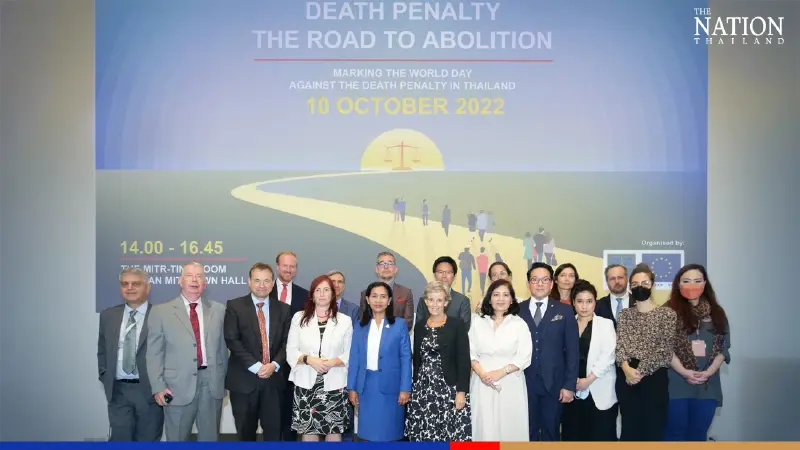


Bangkok, October 25 – On the occasion of the World Day against the Death Penalty, on October 10, 2022, the Delegation of the European Union to Thailand (EU), in collaboration with the Rights and Liberties Protection Department (RLPD) of the Ministry of Justice, organised a dedicated event for university students to enhance their knowledge on human rights and alternatives to capital punishment.
The event reaffirmed the EU’s strong opposition to the death penalty, which is cruel, inhuman and degrading, as well as irreversible and fails to act as a deterrent to crime. It also highlighted Thailand’s commitment to moving towards the abolition of the death penalty as stated in the 4th National Human Rights Plan (2019-2023).
The half-day event, titled “Death Penalty: The Road to Abolition”, was attended by over a hundred undergraduate students from Chiang Mai University, Chulalongkorn University, Mahidol University, Ramkhamhaeng University and Thammasat University.
In her opening remarks, Ms Sara Rezoagli, Chargée d’affaires (a.i.) of the EU Delegation to Thailand, reiterated that “the EU has put the abolition of the death penalty at the very centre of its human rights policy, as we firmly believe that the abolition of capital punishment is essential for the enhancement of human dignity. Death penalty is a violation to the right to life, enshrined in the Universal Declaration of Human Rights. It is irreversible in case of errors and it fails to act as a deterrent of crime. The EU conducts active diplomacy and engages international partners to promote discussion and raise awareness towards the abolition of capital punishment worldwide, as illustrated by this event.”
Ms Sujittra Kaewkrai, Deputy Director-General of the Rights and Liberties Protection Department of the Ministry of Justice, stated that “capital punishment is not a definitive means to eliminate crimes. Therefore, it is crucial to actively raise public awareness and promote better understandings of the adverse impacts of the death penalty among citizens at every age, particularly the young generations who play a key role in the future of change.”
Ms Marta Santos Pais, Commissioner of the International Commission against the Death Penalty (ICDP), delivered a keynote speech to inaugurate the discussion, emphasising the interconnection between the rule of law and abolition, which is reflected in the worldwide trend towards universal abolition. She stressed that “the vast majority of countries have abolished the death penalty, either in law or in practice. And over the recent past, we have witnessed visible progress, with a growing number of States introducing a legal ban on capital punishment and many others pledging to the same goal. Guided by international human rights standards, universal abolition of the death penalty is within reach.”
Prominent experts who took part in the panel were: Ms. Karen Gomez-Dumpit, Executive Committee Member of the Anti-Death Penalty Asia Network (ADPAN) and former Commissioner of the Commission on Human Rights of the Philippines; Dr Kattiya Ratanadilok, Director of Justice Research and Development Institute, Office of Justice Affairs, Ministry of Justice; Dr Mark Charoenwong, Provincial Public Prosecutor, Office of Chiang Rai Provincial Juvenile and Family Litigation; and Dr Khemthong Tonsakulrungruang, lecturer of the Faculty of Political Science, Chulalongkorn University.
The discussion, moderated by Ms Sanhawan Srisod, Legal Adviser of the International Commission of Jurists (ICJ), took stock of the global trend in favour of abolition. More than two thirds of all countries, including all EU Member States, have abolished the death penalty in law or in practice. The panel also touched upon the situation in Southeast Asia. Cambodia and the Philippines have officially abolished the death penalty, while Laos and Brunei have practically done so, having not carried out executions in decades. Malaysia has also announced plans to abolish it. Singapore and Myanmar, however, resumed executions in 2022.
“The anti-death penalty movement should watch closely and respond quickly to all actions that may cause a reversal in the trend towards universal abolition. Case in point is the Philippines, even with ratification of the Second Optional Protocol Aiming at the Abolition of the Death Penalty, the anti-death penalty collective must remain watchful. The ASEAN Region has recently seen such reversals with trials and executions negatively impacting on the rule of law and respect for human rights. Cross-regional cooperation around these reversals is needed to reach universal abolition in both law and practice,” said Ms Karen Gomez-Dumpit.
In Thailand, current law allows capital punishment for 60 offences, though it is rarely carried out, with restrictions on who can be sentenced to death, such as pregnant women and anyone under eighteen. Furthermore, the number of people under sentence of death continued to decrease significantly for the third consecutive year.
The event was facilitated by European Union Policy and Outreach Partnership (EUPOP) with the financial support of the European Union.
