
China pilots L3 vehicles on roads
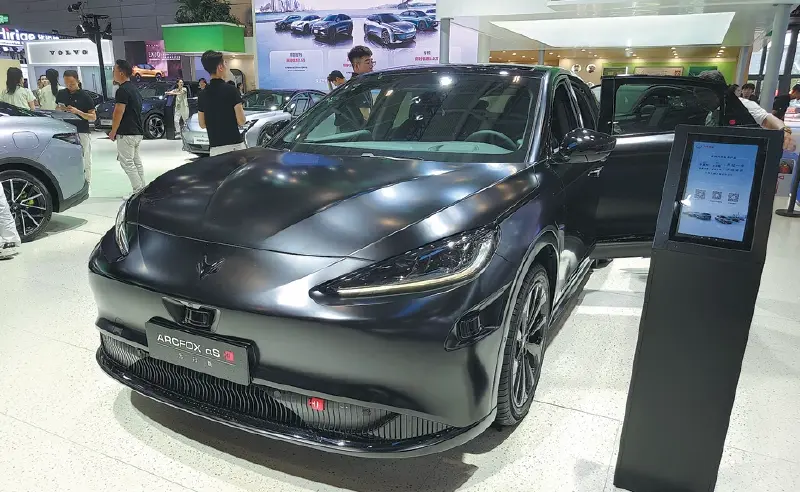


Testing Level 3 cars on public highways an important step to achieving wide-scale development, say industry analysts
China has begun piloting Level 3 autonomous vehicles on public roads, marking a stride forward in intelligent mobility. But hurdles over liability, infrastructure and commercial rollout remain to be resolved for widespread deployment, said analysts.
Under SAE International's classification, L3 refers to "conditional automation, in which the vehicle can take full control of driving tasks under defined conditions, such as on highways, while requiring the human driver to remain available to take over when needed.
By contrast, drivers are not legally permitted to divert their attention from the road and must be ready to take over at any time in L2 systems, although the car can do some jobs by itself.
Earlier in December, two electric sedans, the Deepal SL03 and Arcfox Alpha S, received national-level approvals from the Ministry of Industry and Information Technology, allowing them to operate under defined conditions on designated highway sections in Chongqing and Beijing, respectively.
The move comes months after regulators imposed the country's toughest regulatory oversight to date on marketing hype around smart-driving technologies.
In April, the MIIT and other departments banned the use of misleading terms such as "autonomous driving" and "hands-free driving" for L2 vehicles, following fatal collisions resulting from drivers' overreliance on driving-assist features.
Unlike L3 tests widely seen in the country, the models are registered with standard license plates and driven on public roads, as part of a conditional commercial pilot program.
Industry observers say the rollout of L3 pilots on public roads reflects China's safety-first strategy: tightening rules and clarifying safety responsibilities before limited real-world deployment.
Several automakers, including BYD, Nio, FAW and SAIC, have entered the L3 approval pipeline.
While timelines remain uncertain, 2026 is widely seen as a potential starting point for broader L3 vehicle rollout, provided pilot programs proceed smoothly.
At the Guangzhou auto show in November, Jin Yuzhi, CEO of Huawei's intelligent automotive solutions business unit, estimated that L3 autonomous driving will be available on highways in 2026.
He said Huawei's ADS highway L3 system is undergoing large-scale testing across multiple Chinese cities.
Avatr has confirmed it will be the first mass-production brand to adopt Huawei's L3 system, with new models scheduled for launch in the second half of 2026.
Research indicates that nearly 70 percent of Chinese middle-income consumers aged 30 to 45 are willing to pay an additional 30,000 to 50,000 yuan ($4,280 to $7,134) for advanced intelligent driving features.
But there remain legal and economic hurdles. The key distinction between L2 and L3 lies less in technology than in accountability, said analysts.
L2 systems require constant human supervision, while L3 systems can assume full driving tasks under specified conditions, shifting responsibility from the driver to the vehicle manufacturer.
There is no legislation in place that addresses such situations, although a draft revision to China's Road Traffic Safety Law proposes adding a chapter on autonomous driving.
Large-scale deployment also hinges on technical and commercial realities. Automakers are pursuing different technical paths. A good example is the two models that won approval: the Deepal SL03 adopts a sensor-fusion approach without lidar to control costs, while Arcfox Alpha S uses a multi-lidar system to increase safety redundancy and performance.
Their strategies reflect different trade-offs between affordability, safety margins and user experience, and their performance during pilot programs will influence future industry standards.
Commercial models are also under evaluation. It remains unclear whether L3 functions will be sold as one-time premium options or offered through subscription services, and how insurance costs and long-term liability will be priced.
Infrastructure readiness is another factor. Nationwide deployment will depend on progress in high-precision positioning, vehicle-road coordination and frequently updated high-definition maps, which remain uneven across regions.
Industry analysts say the current pilot programs are designed not to accelerate deployment at all costs, but to test whether technology, regulation and infrastructure can mature in parallel.
If successful, the approach could help autonomous driving move beyond demonstrations toward a more stable and scalable phase of development, they said.
"One of the core markers of automotive intelligence is advanced driver assistance and autonomous driving," said Zhang Yongwei, president of China EV100, a Beijing-based industry think tank.
He said China's decision to formally approve autonomous driving products represents an important step toward industrialisation.
"Only by running pilots, validating technology in real scenarios and making verification robust can the foundation be laid for large-scale application," he said.
In Zhang's view, allowing L3 vehicles on public roads will test and help improve supporting systems, including traffic management, insurance claims, liability allocation and regulatory coordination.
"This is not just a technical proving ground," he said. "It is a process that pushes both technological innovation and regulatory frameworks toward maturity."
"Only when both technology validation and regulatory access are fully established," Zhang added, "can autonomous driving enter a stable and sustainable development trajectory."
Li Fusheng
China Daily
Asia News Network
