
Thailand’s Jan–Nov gold exports top 391bn baht, Commerce Ministry says
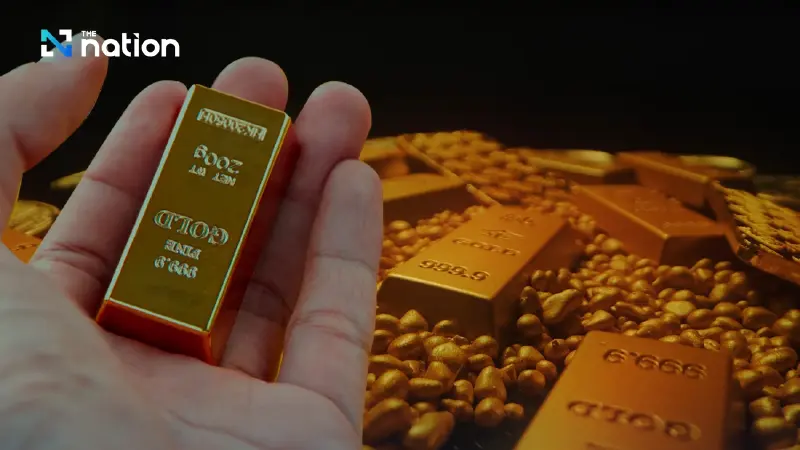


Commerce Ministry: Jan–Nov 2025 unwrought gold exports rose 13.2% to US$11.9bn (about 391.68bn baht), lifting gold’s share of total exports to 3.8%.
Thailand’s exports of unwrought gold rose sharply in the first 11 months of 2025, with the Commerce Ministry reporting shipments worth US$11.9 billion from January to November, up 13.2% from the same period a year earlier.
Gold accounted for 3.8% of Thailand’s total export value over the period, up from 2.9% in 2024.
In baht terms, unwrought gold exports in January–November were valued at 391.68 billion baht, compared with 288.78 billion baht a year earlier.
Exports cooled in November 2025, when unwrought gold shipments were recorded at US$335 million, down 51.2% year-on-year. The ministry attributed the drop in part to earlier front-loaded exports. The November value was 22.74 billion baht.
The ministry said gold’s share of Thailand’s exports has been rising steadily, calling the 3.8% share in January–November notably high compared with last year.
Top markets for Thailand’s unwrought gold exports (January–November 2025):
- Switzerland: US$11.9 billion
- Cambodia: US$5.84 billion
- Singapore: US$2.51 billion
- Laos: US$1.49 billion
- Hong Kong: US$687 million
The ministry noted there were no unwrought gold exports to Cambodia in November 2025.
Nantapong Chiralerspong, Director of the Trade Policy and Strategy Office (TPSO), said gold trading has been one factor behind the baht’s strength. He said gold exports eased in the final two months of 2025 (November–December), likely because profit-taking had already taken place.
On the import side, Thailand’s unwrought gold imports in January–November 2025 totalled US$20.24 billion, up 43.9% year-on-year, or 6.4% of Thailand’s total imports. In November alone, imports were US$2.01 billion, down 6.3% from a year earlier.
Top sources of Thailand’s unwrought gold imports (January–November 2025):
- Switzerland: US$5.57 billion
- Hong Kong: US$4.10 billion
- United Arab Emirates: US$3.54 billion
- China: US$3.30 billion
- Singapore: US$1.21 billion

Thailand’s gold trade expanded sharply in 2025 in line with surging global prices, which hit record highs as many as 50 times this year.
After the market closed on Christmas Day on December 25, gold set another new all-time high, reaching US$4,530, supported by speculative momentum in precious metals and thin year-end liquidity.
Gold trading has also come under scrutiny for contributing to the baht’s strength, which has weighed on Thailand’s broader exports.
Bank of Thailand Governor Vitai Ratanakorn said the baht’s appreciation was not driven by economic fundamentals, but by speculation in gold via mobile applications, as well as dollar-selling and baht-buying to trade gold.
He said the flows have affected exchange-rate stability and hurt exporters without delivering a corresponding boost to GDP.
The government has outlined three measures to address the issue:
- The Revenue Department will consider requiring online gold-trading platform operators to submit transaction data, similar to existing rules under which online platforms report sellers’ income electronically.
- The Revenue Department will study whether it is appropriate to levy a specific business tax on bullion sales by gold shops conducted via online platforms in the future.
- The Bank of Thailand will consider ways to regulate the volume of gold transactions, such as setting transaction value limits on online gold-trading platforms.
