
Fujifilm makes strides in regional healthcare sector with its new ‘one-stop, total solutions’ concept
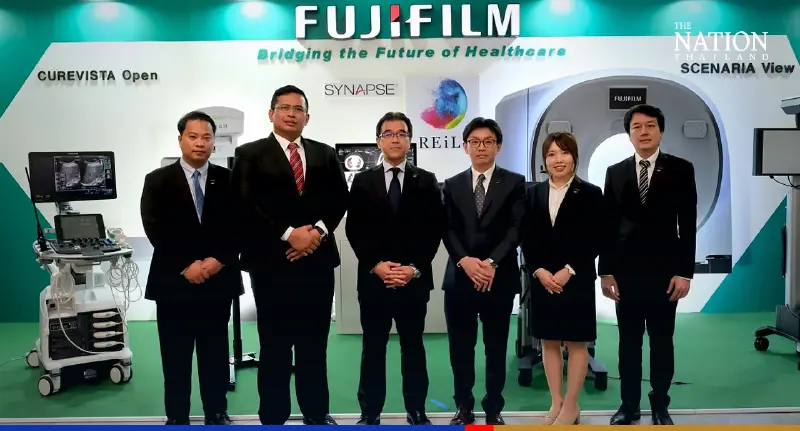


Fujifilm first linked up with Mahidol University in 2019 to apply its 80-year expertise in medical imaging to providing healthcare solutions in the region.
“We chose to start in Thailand because it is a top destination in the region for medical tourism. We hope that Thailand will serve as an example for other nations,” managing director of Fujifilm Healthcare Asia Pacific, Noriyuki Kawakubo, said in an exclusive interview with The Nation.
He was speaking on the sidelines of a press conference on Thursday announcing that Fujifilm was making inroads in the healthcare industry through its “one-stop, total healthcare solution”.

The conference was held at Mahidol University, where the Mahidol University-Fujifilm Asia Pacific Healthcare Learning Academy’s Centre for Advanced Medical Imaging Informatics has been set up to provide additional know-how to hospital IT and radiology professionals.
Kawakubo said Fujifilm has introduced a comprehensive line-up of medical imaging and informatics solutions backed by years of experience in medical image processing and artificial intelligence (AI) as part of its “one-stop, total healthcare solution”.
"Artificial intelligence will support and help medical professionals to execute their duties better by replacing AI to handle some routine tasks, saving more time, and delivering more accurate and efficient results," he stated.

The Japanese company has also been adapting to changing market conditions and diversifying to provide cutting-edge solutions in a variety of industries.
“We have been focusing on four business segments: healthcare, materials, business innovation and imaging,” he said.
As part of its larger ambitious target of US$1 trillion (34.53 trillion baht), Fujifilm reckons it can achieve a global sales goal of $700 billion in its medical systems business by 2027. It also expects a 30% growth this year from the 2022 fiscal year.
“The Asia-Pacific region has three key problems: a shortage of medical professionals, a low-income population and an ageing society. We found it very challenging to solve social issues with the technology we have,” he said. “But to me, it was more of a business opportunity than a problem.”

The Mahidol University-Fujifilm Centre for Advanced Medical Imaging Informatics has so far produced more than 50 operators and engineers overseeing the picture archiving and communications system. The students came from several countries in the region, including Malaysia, the Philippines, Indonesia, Vietnam and Myanmar.
Related News
Fujifilm Healthcare Asia Pacific” Unveils Comprehensive Line-Up of Cutting-Edge Healthcare Solutions
Two Fujifilm entities join hands with goal to become No. 1 total printing solutions provider
Fujifilm to launch advance focus broadcast lens in spring 2020
