
Global economy shifts as Thailand, ASEAN emerge in spotlight
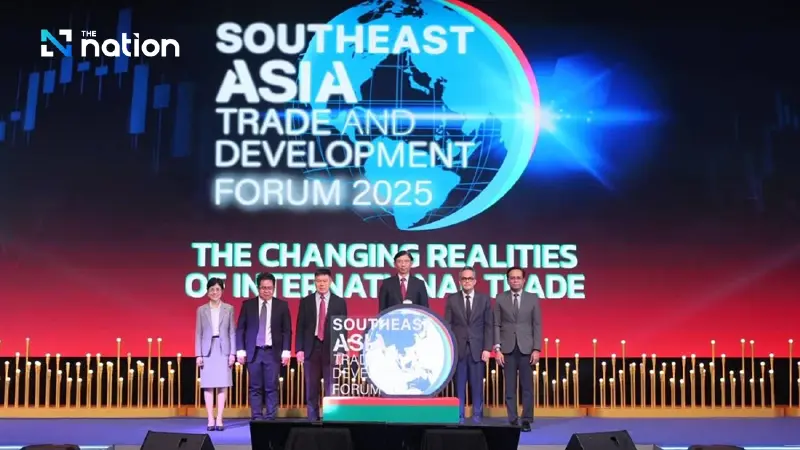


Emerging as a hub for green manufacturing and digital growth, the ITD Southeast Asia Trade and Development Forum 2025 stresses the urgency for Thailand and ASEAN to boost economic resilience against global trade risks.
- The global economy is rebalancing as developing Asian nations, including Thailand and ASEAN, experience rapid growth, with Asia's share of global GDP projected to rise to 35.3% in 2025 from just 8.5% in 1980.
- Economist Jeffrey D. Sachs argues that this shift is a positive "economic convergence" and predicts Asia's rapid growth will continue, positioning ASEAN as a future hub for green and digital technologies despite Western protectionist policies.
- To capitalize on this trend, key strategies proposed for the ASEAN region include upgrading education in science and math, accelerating the green and digital transition, and pursuing regional integration for large-scale infrastructure projects.
- The Regional Comprehensive Economic Partnership (RCEP) is highlighted as a critical factor that will make the region the world's most dynamic trade bloc, solidifying the position of Thailand and ASEAN in driving future sustainable development.
The International Institute for Trade and Development (ITD), in collaboration with Thailand’s Ministry of Commerce and the United Nations Conference on Trade and Development (UNCTAD), hosted the ITD Southeast Asia Trade and Development Forum 2025 under the theme “The Changing Realities of International Trade.”
The regional forum brought together global experts, economists, policymakers, and business leaders from Thailand and ASEAN to examine structural changes in the global economy and discuss sustainable strategies for the region.
The discussions highlighted the urgent need for Thailand and ASEAN to strengthen economic resilience against global trade risks and to draft strategic plans for long-term economic sustainability.

Suphakit Charoenkul, Director of ITD, hailed the success of this year’s forum, noting that it attracted more than 300 thought leaders, academics, entrepreneurs, and civil society representatives.
“They jointly analysed the structural changes in global trade and designed new approaches to help Thailand and ASEAN keep pace with emerging challenges,” he said.
A highlight of the event was a special online lecture delivered by Professor Jeffrey D. Sachs, a world-renowned economist from Columbia University, which drew over 300 participants.
Sachs argued that while today’s global turmoil is often linked to US policy uncertainty, its deeper cause lies in the positive process of economic convergence, the rise of developing economies, particularly in Asia, catching up with advanced economies over the past 75 years.

“The share of GDP from advanced economies has fallen from 64% in 1980 to just 39% in 2025,” Sachs explained. “Meanwhile, Asia’s share—including China, India, Thailand, and ASEAN—has grown from 8.5% to 35.3%. China has sustained nearly 10% growth annually for four decades, ASEAN has grown by 5–6% per year, and India by 6–7% per year, compared with just 2% in the US and around 1% in Europe.”
Professor Sachs also pointed out that the United States and Europe have increasingly turned to protectionist trade policies in response to their declining global standing.
However, he argued that such measures are bound to fail, noting that the US accounts for only 14% of global GDP and does not control any critical chokepoints in the world economy.
As an example, he cited the US–China trade war, where Washington was forced to back down after Beijing threatened to restrict exports of rare earth magnets essential to the American automotive industry.
“I believe Asia’s rapid growth will continue over the next decade, with or without US involvement,” Sachs said, stressing that the transition to green and digital economies is inevitable. He highlighted China’s leadership in electric vehicles and expressed hope that manufacturing would expand across the region. “I hope they will invest in production in Bangkok, in Kuala Lumpur, across Indonesia, and in Vietnam,” he said, envisioning ASEAN as a future hub for technologies the world demands.
Outlining ASEAN’s path to success, Sachs proposed three key strategies:
- Upgrading education with a focus on science, mathematics, and literacy skills, stressing that “the most important investment a country can make is in the skills of its youth.”
- Accelerating the green and digital transition.
- Regional political integration to jointly develop infrastructure such as the ASEAN Power Grid and high-speed rail networks.
He concluded by emphasising that the Regional Comprehensive Economic Partnership (RCEP), comprising 15 member states, is set to become the most dynamic trade bloc in the world, while expressing hope that India will eventually join as the 16th member.
“I believe Thailand and ASEAN are in a very strong position to drive the next generation of economic and sustainable development. We have the potential to achieve genuine sustainable development, shared prosperity, social justice, and environmental sustainability, all woven together.”

Supakit wrapped up the forum by noting that the insights from the ITD Southeast Asia Trade and Development Forum 2025 will be developed into an economic strategy plan for both public and private sectors.
“This forum is not just about presenting theories, it is about generating concrete solutions. The aim is to ensure that Thailand and ASEAN not only survive global crises but also grow sustainably,” he said.
