
Ekniti unveils 10 Plus economic plan, targeting THB1.1 trillion investments
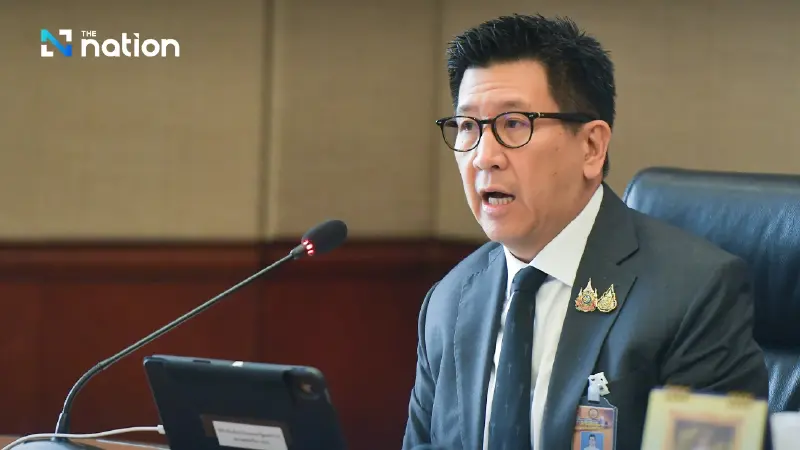


Ekniti Nitithanprapas unveils 10 Plus plan to revolutionise the Finance Ministry into a new era, highlighting the year of investment with THB1.1 trillion, while maintaining maximum fiscal discipline to build global investor confidence.
- The "10 Plus" economic plan aims to achieve over 3% GDP growth by focusing on two main pillars: distributing income to the grassroots and enhancing national competitiveness through investment, AI, and green technology.
- A central target of the plan is to mobilize over THB1.1 trillion in total investment funds during 2026 to act as the primary engine for the economy.
- The investment will be sourced from three key areas: over THB500 billion from private sector BOI applications, approximately THB300 billion from state enterprise budgets, and the remainder from government capital expenditures.
- The strategy will be implemented by a team of private sector experts, bypassing a traditional Deputy Minister, while maintaining strict fiscal discipline by keeping the public debt ceiling below 70% of GDP.
The general election on February 8, 2026, concluded with a landslide victory for the Bhumjaithai Party, sweeping 193 MP seats (unofficial data).
They have become the core leaders in forming the new government led by Anutin Charnvirakul.
The key figure driving the economy is Ekniti Nitithanprapas, Deputy Prime Minister and Minister of Finance.
"Thansettakij" delves deep into the vision and operations of Ekniti, regarding his mission to restructure the Thai economy through the "10-Pill" or "10 Plus" policy.
This policy focuses on distributing income to the grassroots, increasing the country's competitiveness, and maintaining Thailand's economic credibility on the global stage.
It also includes proactive operational strategies that leverage private-sector advisory teams to break down bureaucratic barriers.
No 'Deputy Minister', Bringing in the Private Sector to Strengthen the Team
Ekniti revealed his working model, emphasising speed and tangible results.
Therefore, he will oversee the Ministry of Finance himself without a Deputy Minister to prevent political interference.
Instead, a team comprising individuals from the private sector and academics will serve as Vice Ministers.
Experts from the private sector have been brought in as a crucial cog in the team to transform the Ministry of Finance's operations for higher efficiency, leveraging their deep understanding of the bureaucratic system.
The new-generation team will consist of experts in business, communication, and information technology.
Many have previously worked together since their time at the Revenue Department, co-developing the tax collection system, and continued to the Excise Department, which was adapted into an ESG-focused department.
Consequently, the workflow prioritises high-frequency, proactive policymaking with clear targets.
It specifically uses the country's challenges as the primary focus rather than adhering to traditional administrative procedures.
This approach allows for better management of problems that fall "outside the economics textbook" but have a real impact on the actual economy.
As a result, the accelerated pace over the past four months has driven the "5 Pillars, 1 Foundation" policy to nearly 100% completion.
For instance, the project ready for immediate implementation is "Co-payment Plus" (Khon La Khrueng Plus), which is expected to push Q4/2025 GDP growth to 2.5%, resulting in a full-year expansion of 2.2%.
This surpasses the Fiscal Policy Office's (FPO) initial projection of just 1.8%.
However, only the Individual Savings Account (TISA) project remains incomplete due to the dissolution of parliament.
TISA will serve as a new retirement savings tool, replacing the LTF, which previously faced issues.
TISA will offer the freedom to choose investments, including individual stocks and bonds, according to each person's risk appetite.
The core principle is to incentivise middle-income earners with an annual income not exceeding THB1.5 million to save more, by granting tax deduction privileges at 1.3 times the investment amount.
Nevertheless, he admitted there was a miscommunication regarding the THB800,000 deduction cap, which is actually a higher figure than before.
However, the public focused on the 0.7x tax deduction multiplier, leading to widespread dissatisfaction and necessitating a revision of the details.
There are also efforts to push the Thai ESG fund by requesting an additional advantage of a 1.2x tax deduction to attract investors.
Pushing for THB1.1 Trillion Investment in 2026
Ekniti continued that if investments can be continuously pushed forward, especially the hundreds of billions of THB in pending investment budgets, this year will truly become the "Year of Investment."
He has currently instructed the Board of Investment (BOI) to review and unlock all investment items.
Overall applications for investment promotion are valued at up to THB1.8 trillion, but the portion genuinely ready for investment is approximately THB500 billion.
With less than THB100 billion invested in the first three months, there is still over THB400 billion that must be accelerated within this year.
Therefore, this year's target is to mobilise total investment funds exceeding THB1.1 trillion to serve as the main engine driving the economy.
The investment funds will come from three main sources: private sector investments via BOI promotion applications ready for actual investment worth over THB500 billion; state enterprise investment budgets, which account for 50% of all public investments or approximately THB300 billion; and the remainder from the capital expenditure budgets of the government and local administrative organisations.
However, driving actual investments still faces significant obstacles that must be urgently unlocked.
This particularly involves fundamental infrastructure like "electricity," which remains insufficient for the demands of modern industries such as Data Centres, as well as land and labour constraints.
"The projected 8.1% expansion in total investment for 2025 is a result of the team personally inspecting the frontlines and expediting the visa and work permit issuance processes.
This led to a Cabinet resolution exempting the use of temporary pink cards for BOI groups, reverting to the faster Digital Work Permit system.
This aims to increase the visa processing target from 200 to 500 people per day."
Advancing 10 Plus to Push GDP to 3% Plus
Regarding the 10 Plus policy aimed at pushing GDP to 3% Plus, Ekniti stated that the "10 Plus" policy, or the 10 pills to cure the Thai economy, is divided.
The first five pills aim to distribute income to the grassroots: the Salary Earner group, the Elderly Plus group, the SME Made in Thailand Plus group, the Community Economy group, and equal education via online learning.
The latter five pills focus on enhancing competitiveness, consisting of: Investment, Green Economy, AI Technology, Trade Plus, and Thailand Plus (improving laws to facilitate business operations).
Meanwhile, for the continuation of the "Co-payment Plus" project, if the 2026 budget is limited, a new model may be adopted focusing on increasing the economic multiplier effect.
This could involve setting a minimum spending cap of THB50 following the Chinese model to improve money circulation, alongside providing online sales skills training for merchants.
Data shows this has increased the average income for vendors by up to 49 times.
Reiterating Maximum Fiscal Discipline
As for the preparation of the 2027 annual expenditure budget, Ekniti noted that everything has been prepared.
The speed of disbursement will depend on the formation of the government.
If a government can be formed by April, operations might not face delays or only slight ones.
If it drags on to May, the budget process will be delayed by 1-2 months. While waiting for the budget, other components must be used to drive things forward.
Agencies have already been instructed to submit their requests in advance before the dissolution of parliament.
For the 2027 investment budget, Ekniti has an idea to reduce the burden of the regular budget tied to loan conditions.
He will pivot towards utilising more funds from the Thailand Future Fund (TFF), as well as promoting investments in the form of PPP (Public-Private Partnership) and external investment funds.
Once the new government begins its work and completes its policy statement, the 2027 budget plan will be reviewed to align with the party's policies.
This process allows for internal adjustments to details, although the fiscal plan itself serves as a locked framework that cannot be changed, as it is closely monitored by credit rating agencies.
A crucial point that Ekniti emphasised is maintaining fiscal and financial discipline.
He confirmed that the public debt ceiling will not be expanded beyond 70% of the GDP.
This figure has consistently built credibility for the country.
Although some academics are concerned that it might breach the framework, utmost efforts will be made to control it, believing that if the GDP grows, the debt ratio will naturally decrease.
Simultaneously, before the parliament dissolution, there was a reform of Section 28 of the Fiscal Discipline Act concerning state financial institutions.
This was pushed forward until a Cabinet resolution was issued and included in the fiscal plan, prohibiting the use of these funds solely for cash handouts.
Instead, there must be a clear evaluation of cost-effectiveness and expected benefits.
This establishes a new standard in the administration of state funds.
Furthermore, the declaration to eschew populist policies has garnered confidence and acceptance from foreign investors.
This keeps Thailand's credibility at a good level, especially when compared to neighbours like Indonesia, which heavily utilises populist policies such as tax cuts to stimulate spending, resulting in stock market drops and growing investor concerns.
The improvement in Thai stocks is partly due to investors' confidence that Thailand will implement targeted and prudent fiscal policies.
To maintain the country's rating, arbitrarily shifting the fiscal and financial framework must be avoided, as it risks a downgrade.
One of the most challenging issues is revenue collection through Value Added Tax (VAT).
Ekniti has experimented with using AI technology to help draft communication strategies to reduce public resistance.
The AI suggested a "Give and Take" approach, indicating that if VAT is to be raised, there must be clear returns.
For example, allocating the additional revenue to state welfare cards or elderly allowances, along with reducing personal income tax in the initial brackets to offset the cost-of-living burden.
Finally, Ekniti mentioned the concept of Negative Income Tax (NIT), noting it is a theoretically interesting system.
However, in Thailand's practical context, it remains difficult to implement due to the lack of third-party income data to verify the accuracy of information.
Implementing it without a robust verification system would result in massive amounts of "data garbage" flowing into the Revenue Department.
Reaching that point requires starting with amending the Revenue Code and building a perfectly integrated digital database first.
