
The Breath of Innovation: How Bhornrat Chaimongkol is Redefining Global Healthcare from Thailand
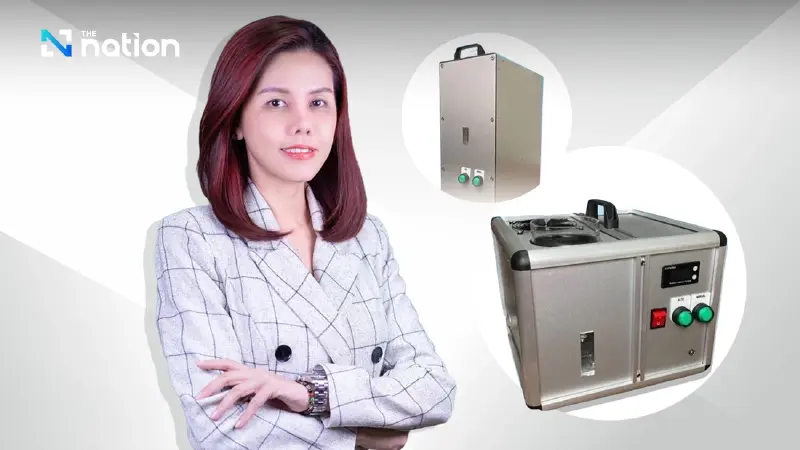


Discover how Dr Bhornrat Chaimongkol’s award-winning AOP ambulance disinfection technology is revolutionising emergency medicine and global healthcare.
There is a quiet, clinical bravery that precedes true breakthrough. For Dr Bhornrat Chaimongkol, a Senior Scientist at the Department of Science Service (DSS), this bravery was forged in the heat of the global pandemic. Clad in a stifling PPE suit and moving with the purposeful gait of a soldier "going to war," she spent her days inspecting contaminated ambulances, collecting viral samples to test her theories. For Dr Bhornrat, science is not merely a sterile laboratory pursuit; it is a fundamental pillar of national hope and the very "breath" that keeps a nation moving forward.

As the architect of a new era for Thai research, Dr Bhornrat has reconciled the abstract rigour of the laboratory with the visceral demands of the frontline. Her mission is as clear as it is profound: to convert deep scientific knowledge into tangible, sovereign benefits for the Kingdom. By shifting the paradigm from "research on a shelf" to life-saving technology, she has pioneered a system that ensures Thai healthcare is defined by indigenous innovation rather than imported dependence.

Engineering a Revolution: The AOP System
At the centre of this transformation is the "Advanced Oxidation Process (AOP) System for Automated Disinfection in Ambulance." In the high-stakes theatre of emergency medicine, traditional hygiene protocols have long been a logistical bottleneck. The World Health Organization (WHO) recommends a rigorous three-step process—cleaning, chemical disinfection with alcohol or chlorine, and prolonged venting—which typically sidelines an ambulance for two hours. During a crisis, this delay is more than an inefficiency; it is a risk to human life.

Dr Bhornrat’s AOP system replaces traditional, manual scrubbing with a bespoke, remote-controlled fogging mechanism. By dispersing a fine mist that penetrates air conditioning systems and microscopic crevices, it achieves total sanitisation in a fraction of the time. The transition from manual to automated hygiene is a masterpiece of fiscal prudence and technical efficiency:
|
|
|
|
|
|
|
|
|
|
|
|
|
|
|
|
The economic narrative is perhaps the most compelling. Whilst the global market offers imported disinfection systems valued at a staggering 10 million THB, Dr Bhornrat’s prototype—developed entirely within Thailand—achieves superior safety outcomes for a production cost of just 40,000 THB. This radical democratisation of high-tier medical safety ensures that world-class hygiene is no longer a luxury of the elite, but a standard for every citizen.

The Innovation Olympics: Global Accolades
Such radical efficiency was destined to transcend national borders. In April 2025, Dr Bhornrat and her team presented their work at the 50th International Exhibition of Inventions Geneva, the "Innovation Olympics" where the world’s most sophisticated minds converge. Thailand’s technical sophistication was validated through a trifecta of prestigious honours: the Gold Medal Award, the Special Prize from the Kingdom of Saudi Arabia, and the Honorable Mention for Excellent Invention from the National Research Council of Thailand (NRCT).
These accolades, following a successful exhibition in Kuwait, signal Thailand’s emergence as a global hub for "Deep Tech." These are not merely trophies; they are a validation of Thai technological sovereignty, proving that local talent can outpace international conglomerates in solving the most pressing challenges of modern medicine.

From Lab to Life: National Implementation
A hallmark of Dr Bhornrat’s career is her refusal to let research remain "up-the-shelf." Her work has reached Technology Readiness Level (TRL) 8—the penultimate stage of deployment. In a strategic collaboration with Chulalongkorn University and the National Institute for Emergency Medicine, the AOP system has moved into real-world pilot programmes across the critical corridors of Bangkok, Samut Prakan, Pathum Thani (including Rangsit), Laem Chabang, and Chonburi.
Beyond the metrics of speed and cost lies the human factor. By employing a remote-controlled fogging system, medical personnel are no longer forced to enter contaminated vehicles to perform manual sanitisation. This removes them from direct exposure to pathogens and harsh chemicals like hydrogen peroxide, ensuring that those who save lives are themselves protected by the silent, automated shield of Thai science.

A Legacy of Scientific Sovereignty
This modern triumph is the fulfilment of a 135-year legacy. Founded during the reign of King Rama VI, the Department of Science Service has long upheld the vision of its first Director-General, Dr Tua Lapanukrom, who famously argued that a nation cannot prosper without its own scientific lead. Dr Bhornrat is the modern torchbearer of this tradition, ensuring that Thailand "builds" rather than "buys" its future.
For the next generation of Thai thinkers, Dr Bhornrat offers a blueprint for meaningful innovation:
- Purpose-Driven Inquiry: Science must leave the laboratory to solve the visceral problems of the street.
- Interdisciplinary Integration: Success requires the seamless merging of scientists, engineers, and marketers to avoid the "research up-the-shelf" trap.
- Intellectual Bravery: Progress demands the courage to test new ideas on the battlefield of real-world crises.
Thai innovation is second to none. As these ambulances traverse the Kingdom, every life saved now carries the silent protection of home-grown brilliance—a "breath" of innovation that ensures Thailand remains a beacon of scientific excellence on the global stage.

SOURCE: www.thailand.go.th
