
Thai Premier Scrambles to Stay in Power
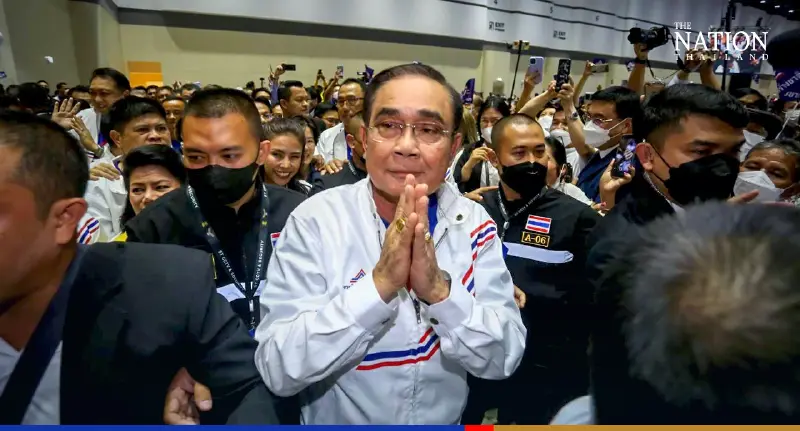


Discarded by the military-backed Palang Pracharat, Prayuth invents a new party
Despite his declining popularity and being discarded by the military-backed Palang Pracharat Party which is weary in propping him up, Thai Prime Minister Prayuth Chan-Ocha is going it alone, becoming a member of the newly-formed Ruam Thai Sang Chart (RTSC) or United Thai Nation Party in a January 9 induction ceremony. In joining the RTSC, Prayuth is seeking to be nominated as the party’s candidate for the next general election, scheduled for May.

The ceremony was a muted affair compared to the political debut of Paetongtarn Shinawatra, daughter of former PM Thaksin Shinawatra, who took the helm of the main opposition party, the Pheu Thai Party, last year. Although some veteran politicians were present at the RTSC rally such as party leader Pirapan Sakirathavibhanga, secretary general Akanat Prompan, executive party member Witthaya Kaewparadai, veteran politician Trairong Suwankiri, and former Labor Minister Suchart Chomklin, there were no political heavyweights and the new crop of politicians was mostly unknown.
Veteran politicians with some clout prefer to remain with the Palang Pracharat Party headed by Gen. Prawit Wongsuwan, Prayuth’s comrade-in-arms during the military coup of 2014 that toppled the democratically elected Pheu Thai government then headed by Yingluck Shinawatra, Thaksin’s sister. Some who followed Prayuth to the RTSC political rally are either uncommitted or undecided pending the dissolution of the parliament or are adopting a wait-and-see stance on how the newly formed RTSC will fare with Prayuth as its member. The remainder is remnants of the PDRC (People’s Democratic Reform Committee) led by former Democratic Party boss Suthep Thaugsuban, whose unruly mob wreaked havoc in Bangkok in 2013 to disrupt the Yingluck government and paved the way for the military coup led by Prayuth.
Technically speaking, Prayuth is not eligible to be a member of RTSC as he is still a member of the Palang Pracharat Party. Furthermore, as a sitting premier, he has shown no scruples in using his position and state money to campaign for his re-election.
Prayuth was the commander-in-chief of the army when he staged the 2014 coup which toppled the Yingluck government and subsequently made himself prime minister. After writing his own constitution to secure his hold on power, he was nominated by military affiliated Palang Pracharat Party for a prime ministerial post in the 2019 election. Although Palang Pracharat lost the election to Pheu Thai Party, it succeeded in putting together a post-election coalition with Prayuth as premier with the help of the military-appointed 250 senators.
During Prayuth’s watch, the country’s economy took a turn for the worse due to his mismanagement, incompetence, and widespread corruption. A recent money laundering case has been traced back to the involvement of one of his own relatives.
With the general election in sight, Palang Pracharat had had enough of Prayuth and decided to nominate Prawit instead as the prime ministerial candidate. Other political parties see him as a liability and are reluctant to support him. With his political future in jeopardy, Prayuth rallied his diehards and nudged them to form a political party as a vehicle to contest in the next election. Hence, the Ruam Thai Sang Chart (RTSC).
Given the rift between Prayuth and Prawit, the path to winning the premiership will not be easy for Prayuth as his new RTSC is much weaker than Prawit’s Palang Pracharat which will contest on the same turf as RTSC. His party will trail the coalition partner Bhumjai Thai Party headed by Public Health Minister Anutin Charnvirakul who pioneered the legalization of cannabis in the face of the dissenting voices of Thai doctors and the public at large. Bhumjai Thai has just got a shot in the arm when about 14 MPs from Palang Pracharat defected to its fold.
However, the main obstacle to Prayuth is the opposition Pheu Thai which is led by the daughter of former PM Thaksin who is still popular in the Northern and Northeastern provinces. The rejuvenated Pheu Thai under Paetongtarn Shinawatra is also expected to make major gains in other areas of the country, not excluding the South which is the stronghold of the Democrat Party and Palang Pracharat. While RTSC is targeting the South in the next election, it has to contend with a 4-way contest comprising Palang Pracharat, Democrat Party, Bhumjai Thai, and RTSC to get Southern votes.
For RTSC to nominate Prayuth as premier, it has to obtain at least 25 House MPs. It is estimated that the party can manage to win about 10 party-list MPs but it is doubtful if it can garner another 15 constituency MPs to make the cut.
Depending on how the RTSC will fare in the coming months, getting the required 25 MPs is doubtful but not impossible. Even if RTSC has 25 MPs, it will have to look for another 101 MPs from former coalition parties to make a total of 126 MPs in the Lower House. At a joint sitting in the parliament to elect a premier, Prayuth can count on the vote of 250 hand-picked senators to win a majority of 376 MPs out of 750 MPs in the joint parliamentary sitting. The big question is whether Prawit or Anutin, who are expected to have more MPs, will renounce their candidacy in favour of Prayuth. Given that Prayuth gets elected with 126 House MPs, he still lacks a majority in the Lower House of 500 MPs. His government will definitely be voted out when the draft budget is rejected by the opposition which commands a majority of the Lower House.
Prayuth may have been aware of such a predicament when he took a plunge into politics but has no intention to go down fighting. He still thinks he has at his disposal his hand-crafted constitution, the Constitutional Court, the Election Commission, the Counter Corruption Commission, and the state apparatus that he can manipulate. Even in the parliament, he can resort to his usual tactic of coercing and buying the MPs from the opposite bench to switch sides or vote for his government.
On the opposition side, the situation is more encouraging. Pheu Thai led by former PM Thaksin Shinawatra’s daughter, Paetongtarn looks set for a landslide. But even if Pheu Thai obtains a House majority of 250 seats, it still needs at least another 126 House MPs to reach a parliamentary majority of 376 MPs out of 750 MPs to form a government as the 250 senators will not vote for the pro-democracy parties. Such being the case, Pheu Thai will have to get another 126 MPs from other pro-democracy parties such as the Move Forward Party, and Seri Ruam Thai Party to reach a parliamentary majority of 376. Failing that, Pheu Thai will have to approach former government coalition partners such as Bhumjai Thai and even Palang Pracharat to form a coalition. Since the next election is meant to unseat Prayuth, it may not be too unimaginable to see former government coalition partners switching sides.
In joining RTSC, Prayuth may have very few options unless he can attract more MPs from other parties, be they government coalition parties or opposition parties going into the election. Another option is for him to run as RTSC party list candidate, in which case he will have to contend with serving in the opposition bench. Or he can dissolve the parliament and serve as a caretaker government until the next elected government takes over. But if he still relishes in his dream of using RTSC to catapult him to the premiership, he can still do it with a Hail Mary.
Pithaya Pookaman
Pithaya Pookaman is a former Thai Ambassador and a regular contributor to Asia Sentinel

