
Data governance: Balancing growth and individual rights
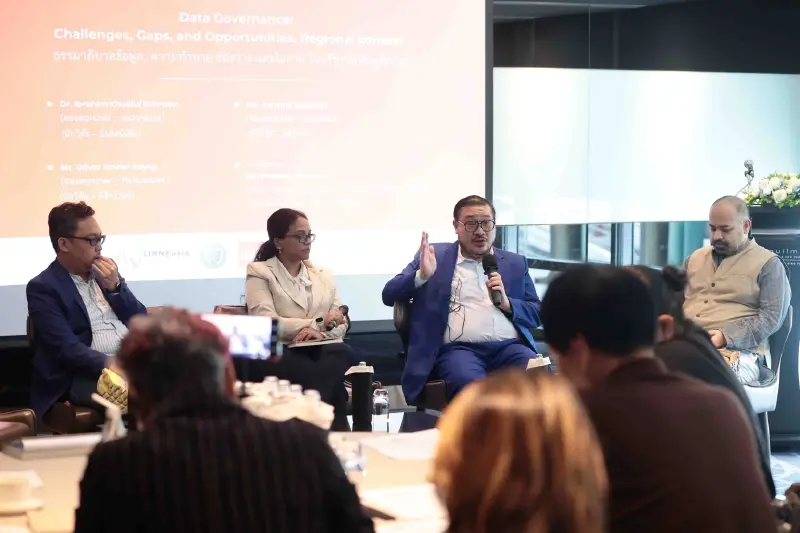


Experts from the public, private, and academic sectors convene to strike a balance between the use of data for national development and the protection of individual rights.
Experts Convene in Bangkok to Shape the Future of Data Governance
Leading experts from government, the private sector, and academia convened in Bangkok on August 5, 2025, for the "Forum on Data Governance in Thailand." Held at the Pullman King Power, the high-level forum aimed to dissect the complexities of data policy, seeking a crucial balance between leveraging data for national development and protecting fundamental human rights.
The event was a collaborative effort, hosted by the independent think tank LIRNEasia in partnership with Hankuk University of Foreign Studies (Republic of Korea), Privacy Thailand, and the Institute of Public Policy Studies (IPPS) Thailand, with funding support from the International Development Research Centre of Canada.


A central theme of the forum was the inherent tension in data governance: how can a nation collect, use, and share data to fuel economic growth and innovation, while simultaneously safeguarding privacy and preventing rights violations? This challenge is not unique to Thailand.
LIRNEasia presented comparative research from seven Asian countries—Thailand, India, Indonesia, Sri Lanka, Nepal, Pakistan, and the Philippines—exploring how different nations navigate this delicate balance. The discussion also considered the influence of global models, like those from Europe, on Asia's evolving regulatory landscape. For the forum, "data governance" was broadly defined to encompass the laws, policies, norms, and systems that regulate access to data.


In her opening remarks, Helani Galpaya, CEO of LIRNEasia, highlighted the complex web of data-related laws that have emerged over time, often created for different purposes and in response to different technologies. "There is never a perfect way to resolve the competing tensions in data governance, such as the right to information versus the right to privacy," she stated. "But we are succeeding as long as we continue making incremental changes and moving towards a better system."
A Regional Perspective on Data Challenges
The first session provided a wide-angle view of data governance across South and Southeast Asia. Pranesh Prakash, LIRNEasia’s Policy Fellow, emphasised the need for frameworks that are transparent, protect citizens' rights, and can adapt to rapid technological change.
A panel of regional experts then shared insights from their home countries:
Indonesia: Dr. Ibrahim Kholilul Rohman of IFG Progress explained that a key challenge is coordinating data management across countless government agencies. Indonesia's "One Data" system is a key initiative designed to facilitate data sharing at the local level.
The Philippines: Attorney Oliver Xavier Reyes noted how data protection laws can sometimes restrict data sharing. However, he pointed to the concept of "Fair Use" under intellectual property law, which creates important exceptions for using data in contexts like documentaries, research, and academic critiques.
Sri Lanka: Ashwini Natesan, a Research Fellow at LIRNEasia, gave an example of how specific sectoral rules, such as those for cross-border financial data, must be aligned with national laws to ensure accountability. She also cautioned against the risks of inaccurate synthetic data and the legal complexities surrounding personal data and intellectual property.
Charting Thailand's Path Forward
The second session, moderated by Saliltorn Thongmeensuk of TDRI, focused specifically on the challenges and opportunities within Thailand. Associate Professor Jompon Pitaksantayothin of Chulalongkorn University presented an overview of Thailand's legal foundation, which includes the Digital Government Act, the Official Information Act, and the Personal Data Protection Act (PDPA), positioning data governance as a critical driver for the nation's digital government agenda.
A dynamic panel discussion featuring key Thai stakeholders yielded several key takeaways:
Integrated Frameworks: Jompon Pitaksantayothin stressed that data sharing and data protection processes must be unified under a single, cohesive governance framework to boost efficiency.
Data for Democracy: Asst Prof Thitirat Thipsamritkul from Thammasat University argued that data disclosure strengthens democracy by enabling public oversight of government and empowering citizens to assert their rights.
Balancing with the PDPA: Pol Col Siriphon Kusonsinwut of the Personal Data Protection Committee described the PDPA as a tool to balance regulatory compliance with individual protection. He also emphasised the critical need for public awareness and capacity building regarding data rights.
Clear and Secure Disclosure: Monta Chayakonvikom from the Digital Government Development Agency (DGA) called for clear guidelines and transparent data classification systems to balance disclosure with security.
Transparency for Economic Growth: Chalermphon Liaptawi of the Office of the Official Information Commission (OIC) highlighted how proactive government transparency—such as publishing budgets and project details—fosters fair competition and stimulates economic activity.
Data Integration for Innovation: Sithon Kulradathon from the Digital Economy Promotion Agency (DEPA) concluded that integrating data from public and private sources is essential for driving technological advancements in AI and the broader digital economy.
Ultimately, the forum served to elevate the conversation on data governance in Thailand, fostering crucial dialogue among key agencies and stakeholders to develop a comprehensive, secure, and beneficial framework for all.


