
Under the shadow of Matebian
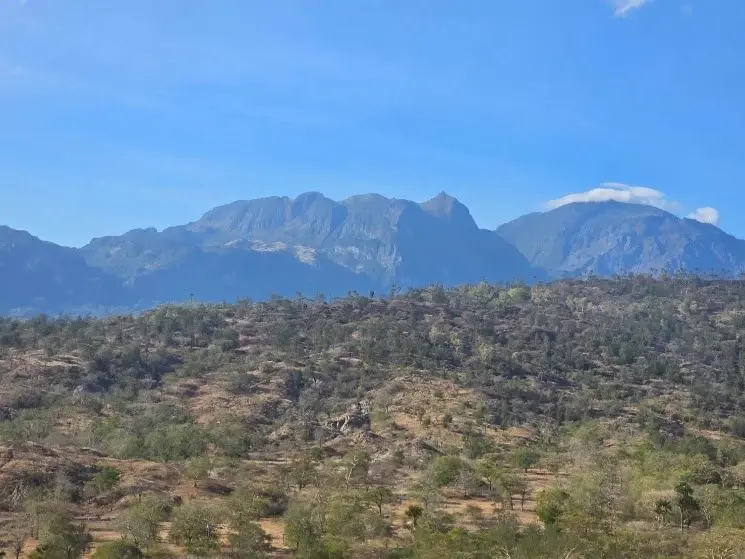


In the mountains of Timor-Leste, the road to safe motherhood is often long and uncertain. For many women, reaching help in time can mean the difference between life and loss. This article takes you to Quelicai, where a newborn named Petrolina and a partnership between Thailand, Timor-Leste, and UNFPA tell a bigger story of hope, cooperation, and the quiet power of saving lives.
The road to Quelicai
Timor-Leste’s mountains are beautiful, but they can also be unforgiving. For a woman in labour, distance is not measured in kilometres. It is measured in heartbeats. Too often, those heartbeats run out before reaching help.
The road to Quelicai is long and winding. From the car window, the view shifts between rice fields, red earth, and houses with tin or thatched roofs. Children wave as we pass. Some chase after the car, while others just greet us with gentle smiles. In the distance, Matebian mountain rises, its peak often hidden in clouds. The country’s second-highest mountain, whose name means “Mountain of Souls.” Locals believe it is where their spirits and souls reside after death. To me, it feels like a quiet guardian watching over the villages scattered below it.
Last year, I travelled further along these roads to visit both Quelicai and Baguia. This year, I returned to Quelicai. The mountain was still there, unchanged. But my journey was different. I was coming back to a place where Thailand’s cooperation, once remembered for its UN peacekeepers, was beginning to take root again. This time, in the lives of mothers and newborns.
A new life named Petrolina
The community health centre in Quelicai is modest - a few concrete rooms painted in soft colours, with faded posters on the wall. There is no bustle, only the steady rhythm of life: a family whispering around a bed, the sound of a baby’s cry breaking the morning air.
That day, I met Celina, a 25-year-old who had given birth just the day before. In her arms lay her first daughter, Petrolina, born on 14 August 2025, wrapped tightly in a cloth and sleeping peacefully. Sitting beside her bed were her mother, sister, and mother-in-law. Three generations of women watching over the youngest one.
Their quiet joy reminded me that the work we do - grants approved and agreement signed - has meaning only when it reaches lives like theirs.
Behind the numbers
Each year, around 40,000 babies are born in Timor-Leste. But too many still arrive in unsafe conditions. 43% of mothers give birth at home, often far from the care of skilled health workers.
In 2010, the maternal mortality rate was among the highest in the world: about 500 women died for every 100,000 births. By 2016, the number had fallen to 195. The hope now is to reduce it further, to 120. For comparison, the global Sustainable Development Goal is 70.
Behind every statistic is a family like Celina’s. Every reduction is not only progress on paper, but a story that could have ended differently.

Thailand’s step forward
The Ministry of Health and the United Nations Population Fund (UNFPA) in Timor-Leste identified that 36 Basic Emergency Obstetric and Newborn Care (BEmONC) centres are needed across the country to ensure women can reach help in time. Each year, more than 6,000 pregnant women here face complications requiring urgent emergency care.
Through a trilateral collaboration between Thailand’s Neighbouring Countries Economic Development Cooperation Agency or NEDA, UNFPA, and the Government of Timor-Leste, Thailand is supporting two of these centres, one in Quelicai and another in Baguia. This marks NEDA’s first pilot project in Timor-Leste.
The USD 700,000 grant will fund the rehabilitation and upgrading of the centres and provide two multi-purpose vehicles that can carry patients across the steep, winding roads where every hour can mean the difference between life and loss.
On paper, it is a USD 700,000 grant. In reality, it is about reducing the distance between danger and safety.
Silverio’s story
During our site visit to Quelicai, I travelled with Silvério, UNFPA’s communication officer. On the road, he shared something personal. His wife is expecting their first child this month. His eyes softened as he spoke. Suddenly, the project was no longer about “maternal and newborn health services” as a policy term. It was about families - his, Celina’s, mine, and countless others.
Looking ahead
On the way back, the car descended from Quelicai as the sun slipped behind Matebian. The mountain’s silhouette stretched long against the sky, timeless and steady.
I thought of Petrolina growing up in its shadow, of nurses working into the night, and of all the unseen hands that made this cooperation possible. And I thought of how, perhaps years from now, when Petrolina is old enough to walk that same road, she will see not only the mountain but also the quiet footprints of those who once came together to give her and her generation a safer beginning.
Once again, I reflected on the value of the work I am privileged to do. Diplomacy is often described in formal terms, such as a grant, cooperation, signing ceremony. But in its truest form, it is not abstract. It is as real as a newborn’s cry, as tangible as the relief on a mother’s face. Our work may begin in documents, but it must end in places like Quelicai and Baguia, in the beating heart of a community, in the fragile beginning of a life named Petrolina, so that she can grow up under the shadow of Matebian not as a statistic, but as proof that cooperation between nations can change the course of one life at a time.
Aritcle by: Waranya Chanthapun, Counsellor at the Royal Thai Embassy in Dili

