
Yala pushes "Pink Mahseer" as new GI product to elevate southern border economy
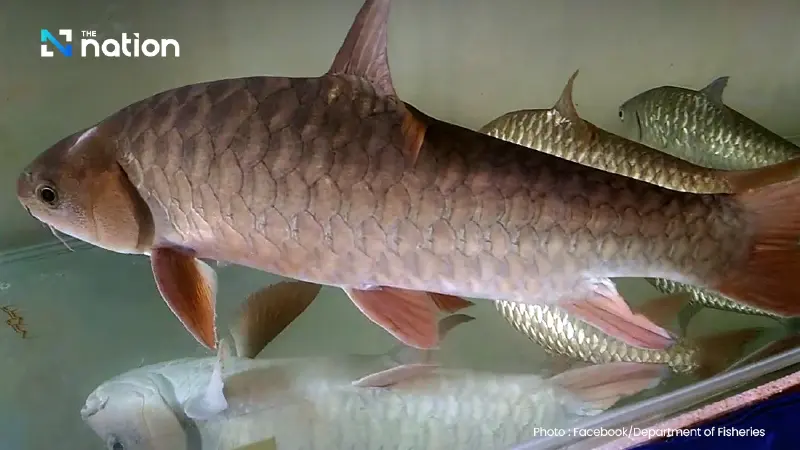


The Department of Fisheries is accelerating its support for the "Pink Mahseer" as Yala's newest Geographical Indication (GI) product, aiming to boost farmer incomes and reinforce the economic foundation of the southern border provinces through sustainable aquaculture development.
- Thailand's Department of Fisheries is promoting the "Pink Mahseer," a rare freshwater fish, as a new Geographical Indication (GI) product for Yala province.
- The initiative aims to boost the economy in the southern border provinces by creating stable incomes for local farmers through aquaculture.
- This strategy follows the success of another GI product, the "Betong Flowing-Water Tilapia," and seeks to use unique local food to attract tourists.
- The government is supporting farmers by providing knowledge, aquaculture technology, and initial production inputs like fish fingerlings to develop the industry.

Manop Nusorn, Deputy Director-General of the Department of Fisheries, revealed that the Department of Fisheries has been driving a project to promote and develop fishery occupations in the southern border provinces.
This is one of the key policies of the Ministry of Agriculture and Cooperatives, aimed at elevating farmers' income and sustainably strengthening the grassroots economy and agricultural sector.
The project supports the "Pink Mahseer" (Pla Pluang Chompoo) as Yala province's new GI (Geographical Indication) product.
This follows the success of the "Betong Flowing-Water Tilapia," which was previously registered as a Thai Geographical Indication, to elevate Thai food as a soft power to drive the economy.
With its outstanding local dishes, it creates a charm that attracts both Thai and foreign tourists.
"Under the implementation of this project, the Department of Fisheries has encouraged farmers to culture various economically valuable aquatic animals, especially the 'Pink Mahseer,' by transferring knowledge and aquaculture technology, alongside supporting Pink Mahseer fingerlings and production inputs as initial capital for their occupation."
Currently, an increasing number of farmers in the area are turning to Pink Mahseer farming.
This reflects the success of driving the economy in the southern border provinces through fishery occupation promotion, creating stable incomes for farmers, and further developing it into a GI product in line with the Department of Fisheries' "FISHERIES CONNECT FOR SUSTAINABILITY" concept.
This concept aims to connect the fishery sector towards sustainability while pushing forward fishery products derived from aquatic animals with local identities, quality, and standards that meet market demands, alongside branding to increase product value, ensuring that farmers have a stable income and robust growth.
Recently, the Department of Fisheries proposed that Yala province apply for Thai GI registration for the "Hala-Bala Pink Mahseer."
This registration certifies that the product has specific characteristics linked to its geographical origin.

The "Pink Mahseer," also known locally as "Pla Kelah," is a rare, local freshwater fish that originates and resides in the streams of the Sankala Khiri Mountain Range, particularly in the Hala-Bala Forest.
It is the provincial fish of Yala, notable for its appearance, colour, texture, and taste, which arises from the abundance of the water sources and terrain, earning it recognition as one of Yala's renowned local products.
Pushing the Pink Mahseer to become a GI product is considered part of driving the development strategy for the southern border provinces.
It can be further developed into a prominent Thai culinary dish, acting as a magnet for tourists visiting Yala province, and allowing the community economy to grow steadily and sustainably.
Furthermore, the Department of Fisheries visited Yala province to inspect farmers' aquaculture practices and exchange ideas on ways to develop the project for greater community benefit.
They visited the farm of Thosapol Rungruangbaiyok in Tano Maero Subdistrict, Betong District, Yala Province.
This is a model farm under the project to promote and develop fishery occupations in the southern border provinces and is one of the 11 farms ready to apply for permission to use the "Flowing-Water Tilapia" Geographical Indication (GI) logo, a local identity product of Yala province.
Additionally, this farm has been certified for Good Aquaculture Practices for Food Fish Farms (TAS 7436-2563) and cultures a variety of aquatic animals, such as Pink Mahseer, Flowing-Water Tilapia, Chinese Carp, and Catfish, which reflects its potential for efficient and environmentally friendly farm management.

In addition, they visited a closed-system Pink Mahseer farm belonging to Nattharat Dueanchamrun in Sateng Nok Subdistrict, Mueang District, Yala Province.
This features a recirculating aquaculture system (RAS) and has the potential to be developed into a model for producing quality Pink Mahseer.
However, it was found that the fish have a slow growth rate.
Therefore, the Yala Provincial Fisheries Office, in collaboration with the Yala Inland Fisheries Research and Development Centre, was assigned to inspect, analyse the cause, and provide academic advice to systematically solve the problem to elevate farming efficiency and production quality before expanding it as an alternative occupation for farmers in the area.
For the fiscal year 2026, the Department of Fisheries has a guideline to comprehensively promote and develop commercial "Pink Mahseer" farming to elevate aquaculture standards to a high quality.
This ranges from fingerling production, nursing, and rearing systems, through to production according to GAP standards.
This aims to create added value for the product, increase income and occupational stability for farmers, alongside sustainably conserving and rehabilitating resources under the principle of "Restore, Maintain, Increase, and Replenish aquatic animals in fishery resource habitats" for the robust development of the southern border provinces.
Farmers and interested individuals requiring further information on Pink Mahseer farming can contact the Yala Provincial Fisheries Office at 0 7321 3971 or the Yala Inland Fisheries Research and Development Centre at 0 7329 7042.

