
Thailand's PM orders oil crisis assessment, agencies coordinate


The prime minister instructed multiple agencies to urgently work together, evaluate the economic impact and prepare a joint response if the oil crisis persists.
- Thailand's Prime Minister has ordered multiple government agencies to coordinate and prepare integrated solutions for a potential prolonged oil crisis.
- As part of the assessment, the Finance Ministry is studying financial measures such as imposing a windfall tax on oil refineries and reducing fuel excise taxes.
- A coordinated crackdown on illegal fuel hoarding is also underway, involving the Royal Thai Police, the Customs Department, and other agencies conducting spot checks.
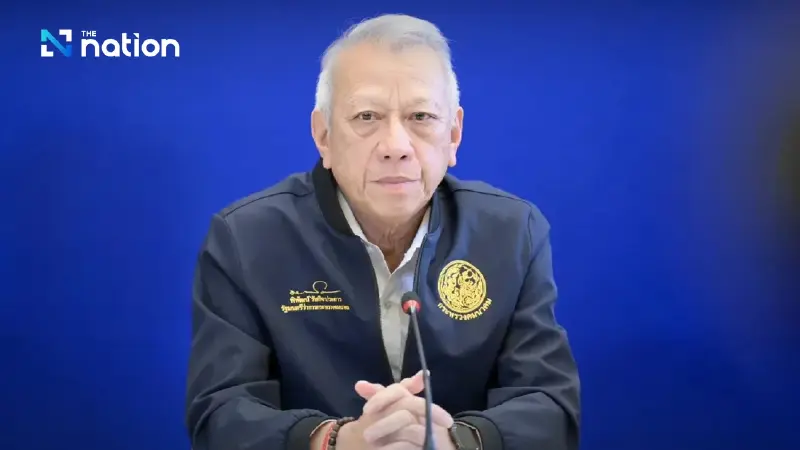
Phiphat Ratchakitprakarn, Deputy Prime Minister and Minister of Transport, in his capacity as director of the Joint Management and Monitoring Centre for the Situation in the Middle East, said after the centre’s meeting to monitor the oil situation that the prime minister today had issued instructions and assigned several agencies urgent follow-up tasks to accelerate integrated efforts to find a joint solution if the war were to drag on, including how it would affect the economy and what measures the government should take.
In addition, the Finance Ministry has been instructed to study and report on proposals to impose a windfall tax on oil refineries, as well as proposals to reduce fuel excise tax, while the Office of the National Economic and Social Development Council (NESDC), the Ministry of Energy and the Oil Fuel Fund Office have been told to prepare measures to cope with a crisis that may be prolonged.
At the same time, in efforts to crack down on illegal hoarding, coordination has been made with the Ministry of Justice, the Royal Thai Police, the Customs Department and the Department of Energy Business to send officers into the field to conduct strict spot checks, with the Ministry of Transport supporting the operation with GPS data to track down offenders.
“If the war continues to drag on, the most important thing is to ask for cooperation from the Thai people. When we truly enter a state of crisis, we must all help conserve energy so that the country can get through this crisis together. As for whether diesel prices will be floated, for now, the government should be allowed to do its utmost to manage prices first, because oil prices remain high and the situation is uncertain at all times.”
Phiphat also used the Joint Management and Monitoring Centre for the Situation in the Middle East press briefing to respond in detail to criticism of the government’s handling of the energy crisis, explaining the limitations of the caretaker government’s powers and calling on critics to offer constructive proposals instead.
In response to accusations from MPs in Parliament that the government was doing nothing, allowing excessive profiteering and refusing to adopt a windfall tax, Phiphat said the government’s current status, without a fully complete new Cabinet under the Constitution, had limited its ability to exercise power in solving the problem.
“Today, the government has only the prime minister... The rest of us, including myself, are only caretakers... We are still serving in a caretaker capacity because there is not yet a new Cabinet under the Constitution. We must continue to work, but we cannot do much more than this. Friends have sent me messages saying they do not see the government doing anything or solving any problems. But today we are trying to solve them by every possible means, within the limited powers we have to do so.”
The deputy prime minister also had a message for those who have criticised the government harshly, urging them to turn their attacks into concrete recommendations.
He said political attacks at a time when the country is facing a crisis do no one any good, and asked all sides to help steady the situation rather than obstruct the government’s work.
“You who criticise us so much, what have you done? Can you offer us any suggestions? It should not be criticism for criticism’s sake alone. If you have knowledge and understanding, please send your suggestions to me directly. I am ready to listen. Please, smearing one another will not move the country forward. If, before we Thai people can do anything, you attack us so that we do not even have a chance to come forward, that helps no one. The government is not yet fully in place. I would like to say to those who are criticising this government, whether they are doing so out of goodwill or ill intent, that it is all right. I am always ready to accept it, because over the past 10 to 20 days I myself have already taken quite a lot of it,” Phiphat said.
