
Ivory network busted — CIB seizes B10m haul in seven-province raids
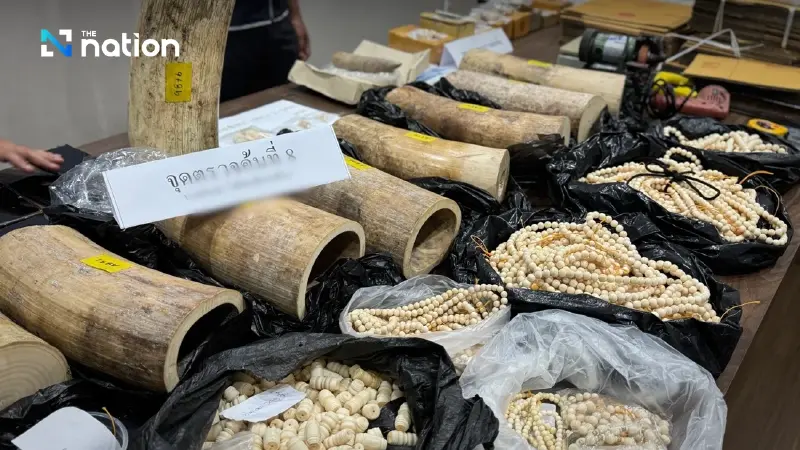


Thai police seized African ivory and wildlife remains worth nearly 10 million baht in a crackdown on a cross-border trafficking network
Thailand’s Central Investigation Bureau (CIB) and wildlife officials have broken up a suspected cross-border ivory trafficking network after raids in seven provinces uncovered African ivory and wildlife remains worth nearly 10 million baht.
The operation was carried out on May 7 by the Natural Resources and Environmental Crime Division (NED) under the CIB, together with the Department of National Parks, Wildlife and Plant Conservation.
Officers searched 11 locations in Samut Sakhon, Uthai Thani, Kamphaeng Phet, Chumphon, Songkhla, Chonburi and Chanthaburi as part of a crackdown on a suspected international wildlife-remains trafficking network. Nine suspects were arrested and reportedly confessed to the charges.
Authorities seized 13 categories of evidence with a combined value of around 9.9 million baht. The haul included around 250 kilogrammes of elephant ivory in tusk sections and fragments, valued at 7.5 million baht, as well as 160 ivory-handled knives worth around 2.4 million baht.
Other seized items included prayer beads, amulet necklaces, jewellery, cutting and grinding machines, scales, the remains of a hawksbill turtle and stingray tail parts.

Investigators spent more than seven months gathering evidence after detecting trading activity in a Facebook group. The group was allegedly being used to trade ivory products widely.
Forensic checks found that all the ivory was from African elephants. Investigators believe the ivory had been smuggled into Thailand for sale to collectors and shops selling sacred objects and amulets. The network was found to have generated about 10 million baht in turnover in just 10 months.
The suspects face charges under the Wildlife Conservation and Protection Act B.E. 2562. Unauthorised possession of protected wildlife remains carries a prison term of up to five years, a fine of up to 500,000 baht, or both. Trading in protected wildlife remains carries a prison term of up to 10 years, a fine of up to 1 million baht, or both.
Officials said the operation was aimed at cutting the cycle of wildlife trafficking. They cited figures showing that more than 20,000 African elephants are killed each year for their tusks, warning that without serious enforcement, wild African elephants could face extinction within the next 30 years.
Thailand, as a party to the Convention on International Trade in Endangered Species of Wild Fauna and Flora (CITES), has stepped up enforcement to help curb illegal wildlife trade.


